
On March 7, 1965, a Sunday night, ABC television was airing the Academy Award-winning film “Judgment at Nuremberg.” In the middle of the film the network did something unusual. The news division at ABC broke into its popular Sunday night movie to broadcast a report that shocked much of the nation and helped create the political environment needed to make a massive advance in American voting rights.
Six hundred peaceful marchers, most of them Black Americans, were marching that Sunday from Selma to Montgomery demanding voting rights. As the marchers began to cross the Edmund Pettis Bridge spanning the Alabama River on the outskirts of Selma they were attacked by 160 Alabama state troopers and sheriff’s deputies, some on horseback others wielding night sticks or whips while wearing gas masks. Many of the marchers were knocked to the ground or forced to sprint away or face real harm. Some, like young John Lewis, then the chairman of the Student Non-Violent Coordinating Committee and later a congressman from Georgia, were not able to get away and were savagely beaten. His injuries required Lewis to be hospitalized.
As I wrote in my study of Senate leadership in the 1960’s, “Nothing, not the March on Washington in the summer of 1963, not the ambush murder of Medgar Evers, not the Birmingham police commissioner turning fire hoses on protesters, not even a church bombing that killed four young African American girls galvanized the country like ‘Bloody Sunday’ in Selma.”
Millions of American saw the shocking images on television in their living rooms and it brought alive the human stakes – and risks – in the struggle for voting rights.
Bloody Sunday in Selma was front page news almost everywhere. The Billings Gazette played the story on page one, below the fold, and with a stark headline: “Clubs, Whips, Gas Rout ‘March for Freedom.’”
The Montana Standard in Butte led with the story and spread a graphic photo on its page one, a picture of a helmeted Alabama state trooper ordering “a prostrate woman to her feet” after troopers broke up the march. The photo caption noted that the woman appeared to be unconscious and was eventually carried away by two fellow marchers.
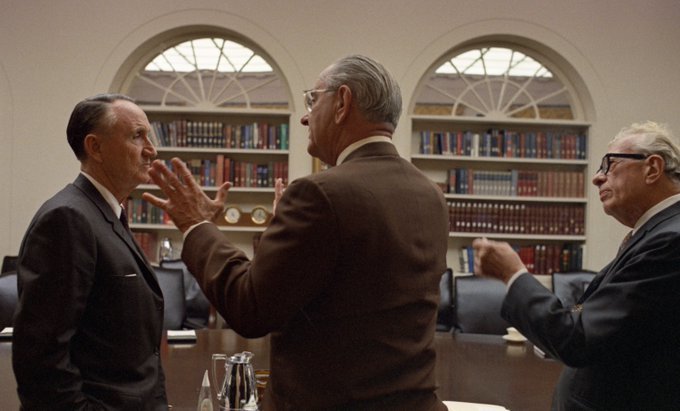
It’s doubtful Senate Majority Leader Mike Mansfield, the Montana Democrat, saw that ABC News report from Selma. Mansfield’s idea of a pleasant Sunday night was to enjoy a quiet dinner with his wife, Maureen, and read a book. His tastes ran to murder mysteries and historical fiction. But the violent events in Selma outraged the former Butte copper miner and University of Montana professor.
By Wednesday – three days after Bloody Sunday – as Mansfield told reporters in Washington, DC, he was working on his own voting rights legislation, apparently in part because he was concerned that President Lyndon Johnson might not act quickly enough in the wake of the outrages in Selma, directed toward Americans simply demanding the right to vote.
With Bloody Sunday in Selma as a powerful and disturbing catalyst, over the next several weeks Mansfield, as he had a year earlier, worked in total cooperation and with absolute candor with Senate Republican leader Everett Dirksen of Illinois, to pass the historic Voting Rights Act of 1965. It wasn’t easy.
Southern segregationists and white supremacists in Mansfield’s own party vigorously opposed the legislation that would encourage voter registration and end literacy tests. Some Republicans argued that the legislation amounted to federal overreach and violated a state’s ability to manage its own elections. But those criticisms were the barely disguised desire of white southerners to continue historic “state’s rights” efforts to make minority voting difficult or even impossible. Additionally Mansfield and Dirksen, as they had with the Civil Rights Act in 1964, needed to overcome a 24-day Senate filibuster, and they did.
Years later Mansfield said he considered the Voting Rights Act the most significant legislation passed during his 24-year Senate career.
Section 2 of the Act prohibited discriminatory practices, including state level redistricting efforts that historically tended to dilute minority voting and deprived Black and Latino voters from electing Black and Latino candidates. Another section of the law instituted a “pre-clearance” test that allowed the Justice Department to evaluate changes in voting or registration practices in areas with a historic record of preventing or suppressing minority voting.
Last week the six decade legacy of Mike Mansfield, Everett Dirksen, Lyndon Johnson, Dr. Martin Luther King, Jr., John Lewis, the Freedom Riders and the many martyrs who fought and even died for voting rights was demolished by an ultra-conservative Supreme Court. The court, blinkered by a generation-long disgust for federal legislation addressing the right to vote, has blithely forgotten the long, twilight struggle to bring American minority voters into the mainstream of American politics.
The conservative, Republican appointed majority on the court was careful, apparently for the sake of appearances, to not seem to directly overturn the Voting Rights Act, but there is little doubt that by continuing, over more than decade, a long series of decisions that have gutted the law, the nation’s politics has been radically altered. The hugely partisan and historically ignorant decision last week was the latest and finally fatal blow that will almost certainly eliminate many Black majority districts and further stoke a hyper partisan death struggle over gerrymandering.
Some commentators have declared the Court’s decision in Louisiana v. Callais the worst high court decision since the Dred Scott ruling prior to the Civil War, and on par with the much lamented late 1896 Plessy v. Ferguson decision declaring that racial segregation – separate but equal – for Blacks and Whites in America was permissible.
“The VRA has not been dealt a ‘blow,’” wrote Atlantic editor Vann R. Newkirk II, “the decision did not merely defang it. The law is dead, and no matter what happens in the coming elections, politics in America has been forever changed. For most of the nation’s history, the former Confederate states have worked hard to minimize the political influence of Black residents in particular. Now they have full cover to do so again.”
The ink was barely dry on the 6-3 decision before Republicans in Louisiana, Alabama and Tennessee signaled immediate efforts to redraw congressional boundaries, in most cases to eliminate “majority-minority” districts represented by Blacks.
In Mississippi conservatives are celebrating the decision as a way to redistrict the state’s only Black congressman, Bennie Thompson, out of the seat he has held for years. Thompson represents a district centered on the state capital, Jackson, that is predominately Black, but the state legislature can now freely dilute that minority strength. Mississippi’s Black population is 38% of the state – the largest percentage in the country – but the decision could well mean that minority voters in Mississippi will no longer be able to elect a Black candidate.
As The New York Times reported: “Critics of the decision expect that any reconfiguration will not only endanger Black incumbents, some of whom have held office for decades, but also threaten a rising generation of Black Democrats in the South, who already have few avenues for ascending in politics.”
Some expect the Court’s effective nullification of the 1965 law will trickle down to local offices at the city, county and state legislative level, crimping off what has been a steadily expanding pipeline of minority political talent.
“This case has the potential to essentially stop Black political representation from advancing in the way that we know it,” Emmitt Y. Riley III, a political science professor at Sewanee, the University of the South, told the Times.
Law professor Joshua A. Douglas wrote in The Washington Monthly that the Court majority in the recent Louisiana case “pretends that race no longer matters in American politics and offers extreme deference to state legislatures, whom we should trust less, not more, to craft fair rules for all voters. The combination makes it virtually impossible for litigants to turn to the federal courts when states enact laws that exclude some people from the democratic process.”
Montana’s Mansfield, who did as much as anyone to bring about the Voting Rights Act, was never one to claim credit for the remarkable and often enduring legislation he helped pass. In fact, he often downplayed the impact of civil and voting rights legislation on his Montana constituents – the state’s Black citizens in the 1960s were never more than 1% of the population – even as many Montanans wrote him making the same arguments against voting rights legislation as those made by southern segregationists.
But Mansfield believed unequivocally in equality, and he held two steadfast beliefs: Faith in the Constitution, as well as the importance of the Senate under the Constitution in confronting the biggest issues facing the nation, and a conviction that the only sure way to bring about lasting positive change in American society was through the tireless work of bipartisan agreement that, while not always perfect, moved the nation steadily toward a more perfect Union.
For most of the 61 years since Mansfield helped engineer passage of the Voting Rights Act – the legislation passed the Senate 77-19 with a higher percentage of Republicans voting yes than Democrats – it was the fixed consensus of courts, politicians and most voters that the VRA was the single most important political step since the Civil War to ensure equality for all citizens in a multi-racial society.
The Supreme Court has now finished the destruction of that once settled reality.
As Lyndon Johnson, a Texan who began his political career as a segregationist and is remembered today as a great champion of civil and voting rights, said in signing the Voting Rights Act: “It is difficult to fight for freedom. But I also know how difficult it can be to bend long years of habit and custom to grant it. There is no room for injustice anywhere in the American mansion. But there is always room for understanding toward those who see the old ways crumbling. And to them today I say simply this: It must come. It is right that it should come. And when it has, you will find that a burden has been lifted from your shoulders, too.”
Unfortunately, the Mansfield dream of equality and political opportunity for all Americans has now been erased from this good and quiet man’s enormous legacy as the longest serving majority leader in Senate history.
While it is dangerous to offer judgments about what historical figures would make of our contemporary world it can, I believe, safely be said that Mike Mansfield would be appalled that the United States Supreme Court has ignored both troubled history and continuing political reality that has time and again diminished or even sought to erase the rights of minorities.
It will take a new birth of freedom and a new commitment to voting rights for all Americans to undo this historically noxious decision, and a new Mike Mansfield – should we be fortunate to have such a person – will have to lead the way – again.
(Marc C. Johnson, a political historian, is a fellow at the Mansfield Center at the University of Montana. His most recent book from the University of Oklahoma Press is Mansfield and Dirksen: Bipartisan Giants of the Senate.)
This story was originally produced by Daily Montanan, which is part of States Newsroom, a nonprofit news network which includes Florida Phoenix, and is supported by grants and a coalition of donors as a 501c(3) public charity.



