
Could the Universe Be a Giant Rotating Disk? A Speculative Theory Reimagines Reality Beyond the Observable Horizon
Scientific note: The framework discussed below is speculative and intended as a conceptual exploration. Modern cosmology currently supports the Big Bang, cosmic inflation, dark matter, dark energy, General Relativity, and an expanding universe that appears broadly isotropic on large scales.
Look into the night sky and the universe immediately feels infinite, yet science reminds us that what we observe is only a fraction of reality. Humanity sees the cosmos through the limits imposed by light, time, and observation. Every galaxy captured by telescopes represents ancient history, and every distant object is seen not as it exists today but as it existed when its light began its journey toward Earth. This means our understanding of the universe is inherently tied to what information has reached us.
Modern cosmology describes a universe approximately 13.8 billion years old, expanding continuously since the Big Bang. Galaxies move apart, space itself stretches, and the observable universe extends to roughly 93 billion light-years across because expansion continued while light traveled. Yet even this enormous volume may not represent the whole universe. It may only represent the region visible from our position.
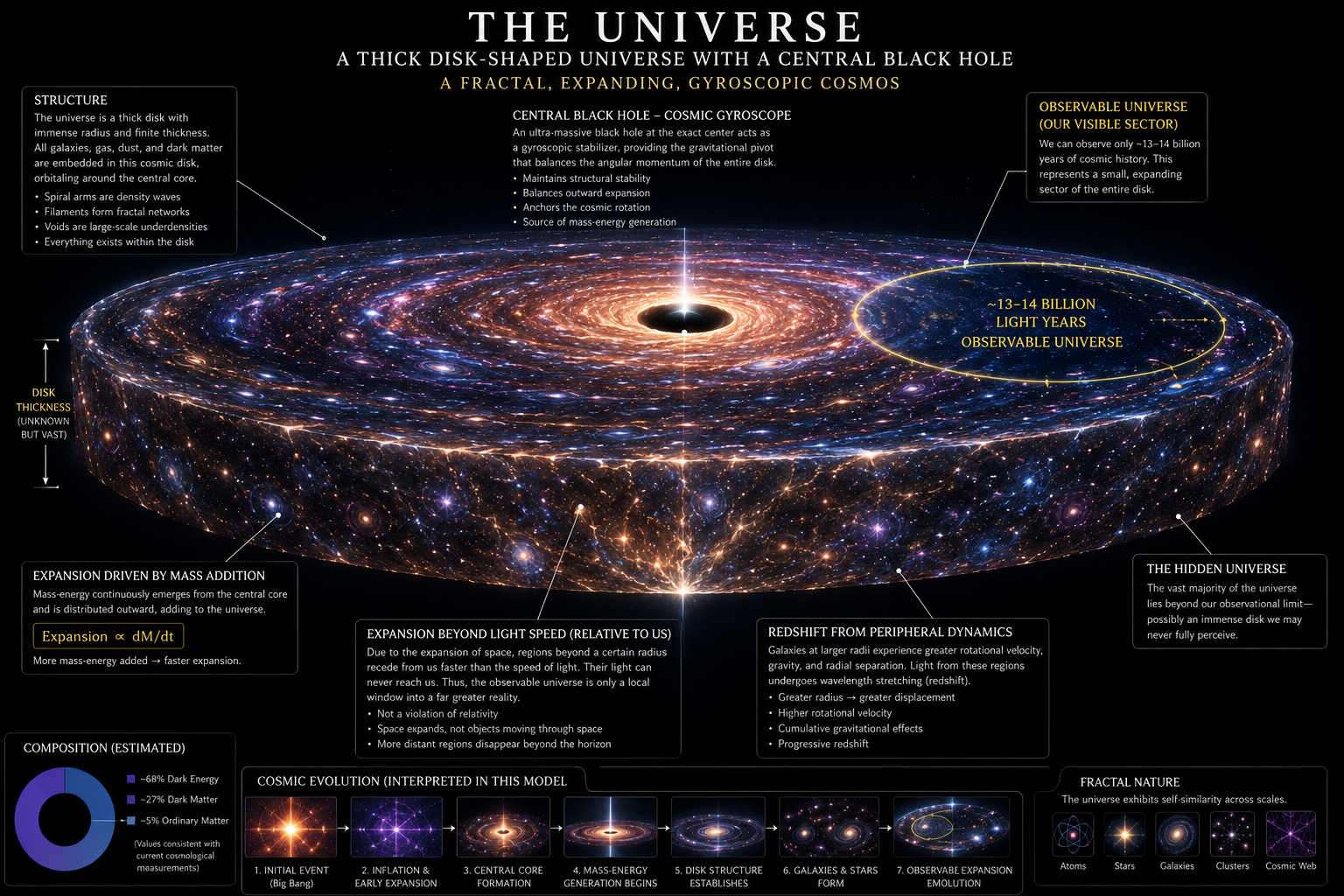
This distinction opens a fascinating possibility. What if humanity is not observing the entire universe, but only a local illuminated sector within something vastly larger? One speculative idea proposes that the universe may resemble a massive thick rotating disk, similar in broad appearance to a galaxy, but scaled to incomprehensible dimensions and organized around a central gravitational structure.
Nature Repeats Itself Across Scale
One of the most intriguing characteristics of nature is its tendency to repeat structural patterns across completely different scales. Tree branches divide into smaller branches much like rivers split into streams. Lightning resembles roots, blood vessels resemble river systems, and neural networks resemble cosmic filament maps. Similar geometric organization appears repeatedly despite the enormous difference in size.
The same pattern emerges in astronomy. Planets orbit stars, stars orbit galactic centers, galaxies form around supermassive black holes, and the universe itself appears woven together by enormous filaments connecting clusters. Spirals, circles, branching networks, and rotational motion seem to appear almost everywhere.
Scientists often describe such repetition as fractal organization, where similar patterns emerge at multiple scales. The disk-universe hypothesis extends this idea further by asking whether the universe itself might be another layer in this hierarchy. If atoms possess centers, solar systems possess centers, and galaxies possess centers, perhaps the universe may also exhibit higher-order organization.
Reimagining the Universe as a Thick Rotating Disk
Mainstream cosmology describes the universe as expanding uniformly without requiring a preferred center or edge. The alternative disk hypothesis accepts expansion but imagines a different large-scale geometry. Instead of a featureless expansion, the universe becomes a gigantic layered disk containing galaxies, dark matter structures, gas clouds, radiation, black holes, and enormous void regions.
This disk is not imagined as flat or thin. It possesses thickness, depth, internal layers, and complex organization. Cosmic filaments become structural veins crossing the disk, galaxy clusters become dense nodes, and voids become regions separating the larger framework. The universe therefore behaves less like scattered objects in empty space and more like components inside an organized cosmic architecture.
Expansion still exists in this interpretation. The Big Bang still remains the initiating event. The difference lies in geometry. Expansion occurs inside a rotating structure rather than within a purely isotropic field. The universe becomes a combination of growth, rotation, expansion, and structure.
The Central Black Hole as a Cosmic Gyroscope
At the center of this hypothesis lies one of its boldest concepts: a gigantic gravitational core acting as a cosmic gyroscope. This object is not imagined simply as a black hole swallowing matter, but as a stabilizing center maintaining equilibrium throughout the larger structure.
A gyroscope remains stable because angular momentum preserves orientation. A spinning top stays upright because rotation resists collapse. The hypothesis extends this principle upward to cosmic scales by proposing that the universe itself may maintain stability through rotation around a central gravitational axis.
In this picture, expansion pushes matter outward while the central structure provides balance. Gravity stabilizes the system, rotation distributes angular momentum, and the core becomes the anchor preserving organization. The universe behaves not merely as expanding debris from an ancient event but as a dynamically evolving structure maintaining internal equilibrium.
Why Rotation Appears Important
Rotation appears almost everywhere in nature and astronomy. Earth rotates while orbiting the Sun. The Moon circles Earth. The Sun itself moves around the center of the Milky Way. Galaxies rotate, accretion disks swirl around black holes, and even elementary particles possess intrinsic angular momentum.
Because rotational behavior appears repeatedly across so many scales, the hypothesis asks whether the universe itself could also rotate. Mainstream cosmology does not presently support a universal rotation axis, but as a conceptual model, the idea creates an intuitive picture. The universe becomes a rotating cosmic body with a stabilizing center and expanding outer regions.
This interpretation naturally leads to another profound idea. If the universe rotates, then what humanity observes may not represent the entire structure. Instead, our visible universe may only occupy one small location inside it.
Humanity May Be Seeing Only a Tiny Sector of Reality
Perhaps the most striking element of this hypothesis concerns observation itself. Humans do not observe the whole universe. We observe only what light has had enough time to reach us. Every telescope image is therefore limited not only by technology but by cosmic history.
Although the universe is roughly 13.8 billion years old, expansion increased distances while light traveled. Consequently, the observable universe extends much farther than 13.8 billion light-years and is estimated at nearly 93 billion light-years across. Yet even this enormous volume represents only the observable region.
The disk-universe hypothesis suggests that humanity may occupy only a small visible wedge inside a much larger structure. Imagine standing in a stadium where only one section is illuminated while the rest remains dark. Someone inside that lit section may mistakenly believe it represents the entire arena.
According to this interpretation, humanity may exist inside a similarly illuminated region. The observable universe becomes a local sector, not the whole structure. Galaxies beyond visibility may continue indefinitely outside our horizon.
The Hidden Universe Beyond Observation
Modern cosmology already supports the idea that some regions remain permanently beyond observation. This happens because space itself expands. At sufficient distances, expansion may increase separation faster than light can cross it, meaning some regions may never become visible from Earth.
This does not violate relativity because galaxies are not moving through space faster than light. Instead, space itself stretches. A useful analogy is a balloon covered with dots. As the balloon inflates, dots separate even though they are not moving across the surface.
The disk hypothesis expands this concept dramatically. It suggests that the hidden universe may already constitute most of reality. Entire regions may lie beyond visibility not because they do not exist, but because expansion has carried them outside our observational reach.
Humanity therefore studies only the frontier. The larger structure may remain permanently hidden.
Redshift and the Outer Regions of the Disk
Astronomers observe that distant galaxies appear increasingly red, a phenomenon called redshift. Mainstream cosmology interprets this as evidence of expansion because stretching space also stretches light waves.
The disk interpretation accepts expansion but proposes additional effects. Galaxies near outer regions of the disk may experience larger orbital paths, increased angular displacement, stronger cumulative motion, and greater separation from the center.
Light traveling from those regions may therefore carry signatures of expansion, rotation, and geometry simultaneously. Distance becomes not merely a measure of location but also a measure of dynamic history. The farther the galaxy, the stronger the accumulated effects.
In this view, redshift remains evidence of expansion but may also reflect the structure and motion of the larger cosmic disk.
Big Bang as the Beginning Rather Than the Entire Story
Contrary to initial impressions, this hypothesis does not reject the Big Bang. Instead, it treats the Big Bang as the initiating event while proposing additional stages afterward.
The standard sequence describes a hot dense beginning followed by expansion and cosmic evolution. The alternative interpretation extends this pathway by suggesting that expansion eventually organized itself into rotation, structure, and large-scale equilibrium.
The Big Bang remains the origin of matter and energy. The central gravitational core emerges later as a stabilizer. Expansion continues while the universe gradually organizes itself into a rotating system. The universe becomes not simply an explosion frozen in time but an evolving structure.
Could Expansion Be Driven by Cosmic Growth?
Perhaps the most speculative extension of the hypothesis concerns expansion itself. Instead of viewing expansion solely as leftover motion from the early universe, the model suggests that expansion may remain linked to ongoing mass-energy growth originating from the central core.
Conceptually, the center continuously contributes mass-energy that spreads outward through the disk. As additional matter emerges, the structure enlarges and expansion continues. Growth becomes the mechanism driving evolution.
Nature frequently follows similar patterns. Trees grow outward from internal biological activity. Stars create heavier elements within their cores. Galaxies build structure around gravitational centers. The hypothesis extends this idea to cosmic scales by proposing that the universe itself may behave like a growing fractal system.
The symbolic relationship often proposed is:
Expansion ∝ dM/dt
meaning expansion may be proportional to the rate of mass-energy growth.
Although unsupported by mainstream evidence, the concept offers an intuitive picture of a universe that continues developing rather than merely expanding.
A Universe Larger Than Observation
The emotional appeal of this hypothesis comes from history itself. Humanity repeatedly believed its visible world represented the whole reality. Ancient civilizations placed Earth at the center. Later discoveries moved humanity outward again and again.
Earth became one planet.
The Sun became one star.
The Milky Way became one galaxy.
The observable universe itself may eventually become another layer.
Perhaps the visible cosmos is not the final boundary but merely the next horizon.

The first publicly released science-quality image from NASA’s James Webb Space Telescope, revealed on July 11, 2022, is the deepest infrared view of the universe to date. (Image credit: NASA, ESA, CSA, and STScI)
The Cosmic Dancer Analogy: Expansion and Angular Momentum
Imagine a dancer performing a spin.
As she rotates faster, her skirt lifts and expands outward due to motion and centrifugal effects, creating a larger visible radius. As the spin slows, the skirt settles and the diameter contracts.
The visual effect appears as:
Higher rotational energy → larger expansion
Lower rotational energy → reduced radius
The Fractal Disk Universe Hypothesis draws inspiration from this behavior.
The universe may behave similarly to a rotating dynamic system where outward expansion and rotational motion remain interconnected.
As mass-energy emerges from the central gyroscopic core, the outer cosmic disk expands.
The increased radius redistributes angular momentum across larger distances.
Unlike the dancer, however, the universe may continue receiving energy or mass from the central structure, allowing expansion to continue without necessarily slowing.
Thus the model proposes:
Central mass growth → outward disk expansion → angular redistribution → continuing cosmic acceleration
In this interpretation, present-day expansion may not be residual motion alone.
It could indicate that the larger cosmic rotation and growth process remains active.
Not so Final Perspective
Imagine an immense thick cosmic disk extending beyond imagination. At its center lies a colossal gravitational engine maintaining balance against expansion. Around it rotate galaxies, clusters, filaments, and enormous cosmic structures moving slowly across billions of years.
At the outer regions, light stretches and reddens while visibility fades into darkness. Entire portions disappear beyond observation, not because they vanish, but because they remain forever out of reach.
Somewhere inside one small visible sector, humanity looks outward and attempts to understand the whole.
Perhaps modern cosmology is entirely correct.
Perhaps the universe is broadly isotropic and centerless.
Or perhaps the observable universe is only one illuminated window inside something much larger.
The greatest mystery may not be what humanity has discovered.
It may be how much still lies beyond the horizon.
को अद्धा वेद क इह प्र वोचत्कुत आजाता कुत इयं विसृष्टिः ।
अर्वाग्देवा अस्य विसर्जनेनाथा को वेद यत आबभूव ॥ [1]
meaning -This verse questions the origin of creation, noting that even the gods emerged after the universe began.
The emergence of the universe as Lord Brahma arising from the navel of Lord Vishnu, a concept rooted in Hindu mythology, has often been referenced by various cosmologists and philosophical thinkers in discussions about cosmic creation and the origins of existence.
Scientific note: In standard cosmology, accelerated expansion is attributed mainly to dark energy, and there is presently no evidence that universal rotation drives cosmic acceleration. The dancer analogy is conceptual rather than established physics.



