
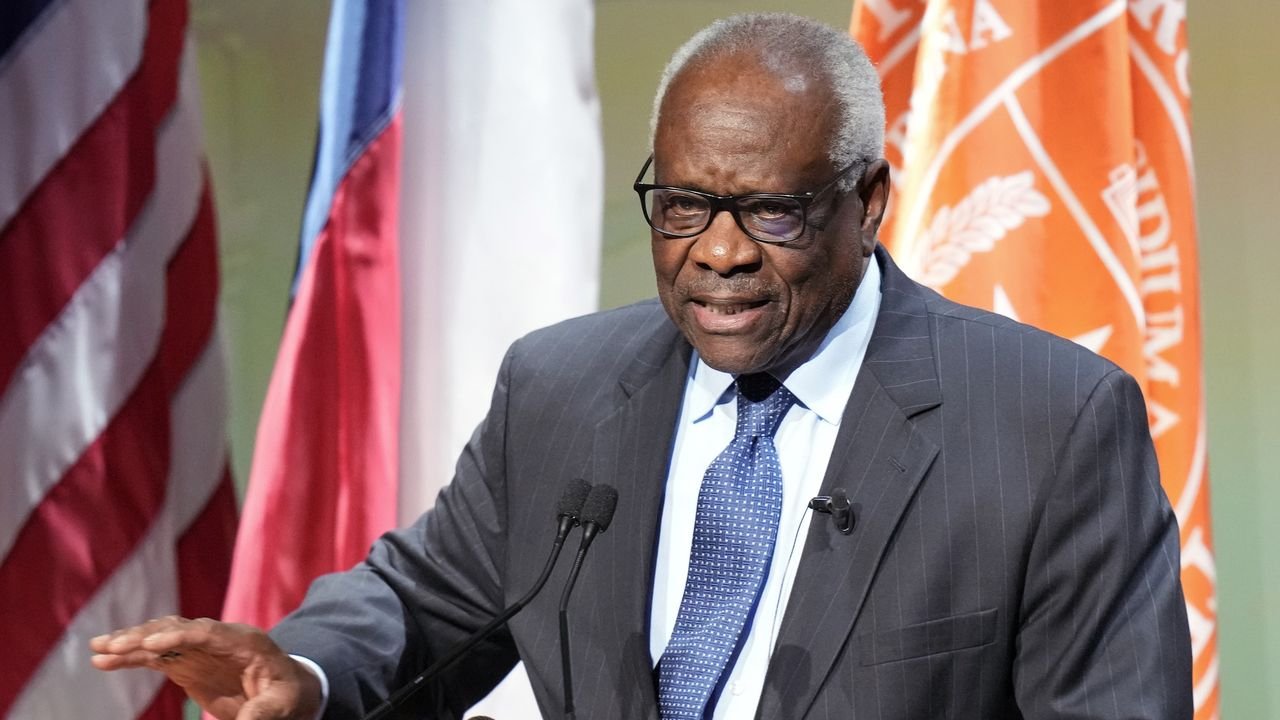
Thomas singled out Woodrow Wilson—a political scientist, a Progressive, and a Southern Democrat, who, as President, from 1913 to 1921, segregated the civil service and helped create the modern bureaucratic state, including the Federal Reserve and the Federal Trade Commission. “To Wilson, the unalienable rights of the individual were, quote, a lot of nonsense,” Thomas said. “Wilson redefined liberty not as a natural right attendant and antecedent to the government but as, quote, the right of those who are governed to adjust government to their own needs and interests.” Wilson, Thomas said, “described America still stuck with its original system of government as, quote, slow to see the superiority of the European system,” and saw the public as “selfish, ignorant, timid, stubborn, and foolish.”
Thomas went on to link Progressivism to the worst crimes of the twentieth century. “The European system that Wilson and the Progressives scolded Americans for not adopting, which he called nearly perfect, led to the governments that caused the most awful century that the world has ever seen. Stalin, Hitler, Mussolini, and Mao all were intertwined with the rise of Progressivism, and all were opposed to the natural rights on which our Declaration are based,” Thomas said. “Many Progressives expressed admiration for each of them shortly before their governments killed tens of millions of people.” He warned that the danger of Progressivism persists to this day: “Since Wilson’s Presidency, Progressivism has made many inroads into our system of government and our way of life. It has coexisted uneasily with the principles of the Declaration. Because it is opposed to those principles, it is not possible for the two to coexist forever.”
Thomas’s account of Progressivism as a malign force threatening individual liberty echoes an argument developed by scholars at the conservative Claremont Institute. When I asked Charles Kesler, a senior fellow at the institute and the editor of the Claremont Review of Books, about the significance of Thomas’s address, he invoked Abraham Lincoln’s in 1858, on the existential stakes for a nation riven by slavery. “This is really Thomas’s, in a strange way, his ‘house divided’ speech,” Kesler told me. “He doesn’t expect the Union to fall, but he doesn’t expect it to remain half slave and half free permanently. It will become all one or all the other.” Ronald Pestritto, also a senior fellow at Claremont and the graduate dean at Hillsdale College, wrote in praise of Thomas’s speech: “The Left doesn’t want us to notice that they predicate their core governing vision on a rejection of America’s founding principles, and so they are bound to protest Thomas’s account. Yet his account is dead-on accurate, and for proof one need only look to the original Progressives, who were open in their disdain of the Declaration of Independence and the Constitution. In this, they were far more honest than their present-day cousins.”
Numerous scholars of the Progressive Era with whom I spoke said Thomas had offered up a distorted version of the movement. Nancy Unger, a past president of the Society for Historians of the Gilded Age and Progressive Era and a professor emerita at Santa Clara University, said, “Progressives were not perfect, and I don’t pretend that they were, but this is such a misrepresentation of who they were. The driving force for most Progressives was not that they were anti-American, not that they were anti-Declaration of Independence and Constitution, but that they were saying, ‘Look, this is a different nation than when we started, we’re an industrial, urban nation, and a lot of things that didn’t require government before do so now.’ So to turn that into some kind of vilification, I just think, is unconscionable.” Christopher Nichols, a historian of the Progressive Era at the Ohio State University, said of Thomas’s account, “It’s a deeply problematic reduction of Progressivism to its most negative elements,” including racism and support for eugenics. Thomas’s speech, Nichols continued, “absolutely mistakes and conflates figures like Stalin and Hitler and Mussolini as Progressives, none of whom would have defined themselves as such, or were defined in their eras as such.”
As Matt Ford noted in The New Republic, Wilson offers a convenient target, given an ugly record of racism that led Princeton, in 2020, to remove his name from the public-policy school, as an “inappropriate namesake.” But Thomas’s focus on Wilson misrepresents his role in the Progressive movement. “Presenting Wilson as the inventor of progressivism is historically illiterate, akin to saying that Joseph Stalin invented communism or that Ronald Reagan invented conservatism,” Ford wrote. (Thomas never mentioned Wilson’s Progressive predecessor, Theodore Roosevelt, a Republican.) In addition, as John Milton Cooper, Jr., the author of a 2009 biography of Wilson, pointed out, Thomas overstated Wilson’s rejection of natural rights. “Think of this deeply, thoughtfully, intellectually religious man not believing in natural rights—come on, you can’t believe that,” Cooper told me. Wilson’s father was a Presbyterian minister, and Wilson read the Bible daily.



