
When Paul D. Austerberry tackled production design on HBO’s It: Welcome to Derry, his goal was to bring the same big-screen quality to the series that he created for director Andy Muschietti’s 2019 It: Chapter Two. What he didn’t bank on was TV’s challenge of tight production timelines, particularly when it came to small details that bring a set to life.
“If I look back at it, there are things I’d love to have spent a little more time on,” Austerberry says. “I went to a screening recently with an audience and I was worried whether it would hold up. But everything as far as I could tell looked just like it did on the small screen.”
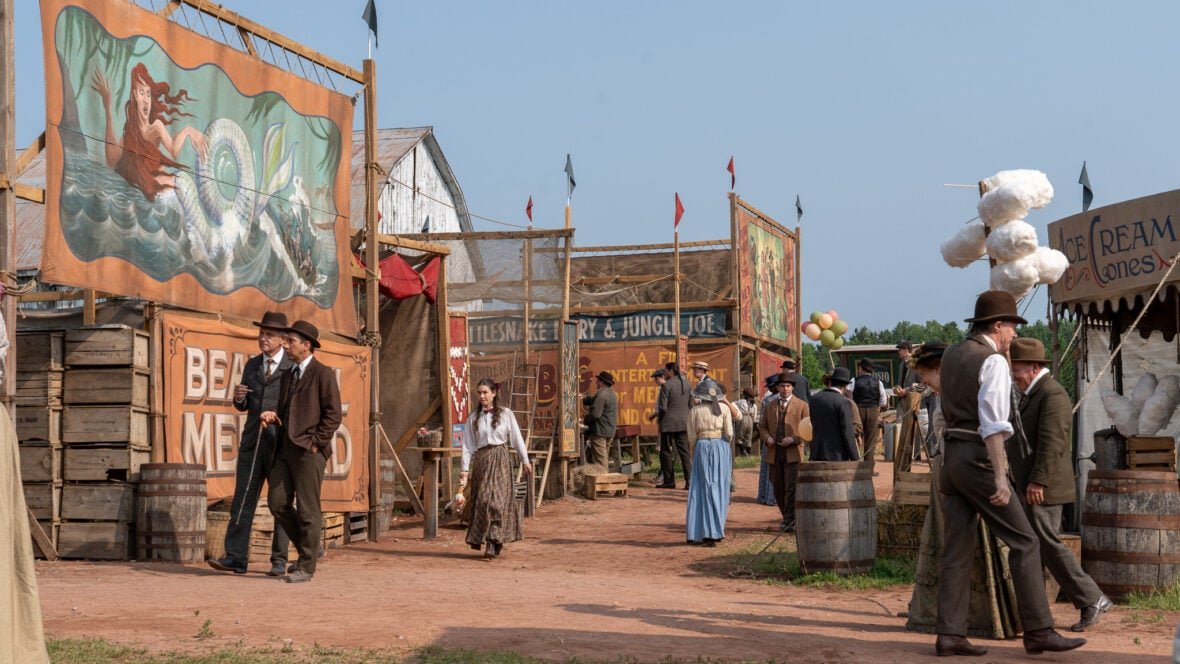
The production designer reveals that having a larger team for the eight-part TV series helped with those “time deficiencies,” especially when it came to the large carnival location that served as an important backdrop to the origin story of Bob Gray, a.k.a. Pennywise. He credits early access to the scripts with helping him deliver authenticity.
“A small version of those digital backdrops from the film were given to scenic artists, theatrical painters or sign painters. There would always be banners hanging around the sides of the studios and someone working away,” Austerberry says. “There were a couple of small things we did on the computer, but pretty much all of them were done by hand.”
Paul D. Austerberry on Leaning Into the Past for It: Welcome to Derry
Other additions that brought the scenes to life were the wooden animals and simple theatrical elements you might find in a 1900s carnival, like the changing clouds and backdrops.
They all helped to tell Pennywise’s story in a way that would be interesting to the show’s fictional children, but also to viewers.
“It was all very low-tech stuff, but the special effects guys, who are used to blowing stuff up, had a wonderful time figuring out how to rig all of those things,” Austerberry continues. “They were very proud of it, because there were a lot of moving parts.”
Austerberry relied on 1950s and ’60s images of Americana and the color palettes of the time to create the sense of a small American town.
“My job was to make it feel as real as possible for the audience so they believe where they are and the time period they are in,” he says. “Then, the supernatural and creepy stuff can be more powerful, because you’re in this very normal little piece of period Americana.”
Austerberry also points to several small details on the sets that helped the actors feel immersed, from the parachuting soldiers, airplanes and Flash comics in the treehouse, to the ’50-style spaceships in a bedroom, to the old convent in Niagara Falls, Ontario that the show used as the sanatorium.

The show’s main street had hand-painted signage and about 35 businesses, including the grocery store. It took months to prep, given all of the products and packaging from the era.
“The products on the lower and upper shelves are just as detailed as those at eye level,” he says. “Because we don’t really know what’s going to happen during the shoot, and part of the job is to provide everything to the camera. When you’re on a location and you want to look around, you can only look around to what we’ve prepared.”
It: Welcome to Derry is now streaming on HBO Max. You can read more of our Emmy contender interviews here.
Editor’s note: Corrects headline.



