
Although the Moro peace process has significantly reduced large scale separatist warfare, Mindanao in the southern Philippines has continued to experience violence involving communist rebels, clan feuds, extremist organizations such as Abu Sayyaf and Islamic State linked factions, as well as periodic clashes between security forces and armed groups. Brillante Mendoza has dealt with the issue in “Mindanao” and “Motherland”, but Mark Duane Angos’s effort, “Hand of God”, moves into a distinctly different path.
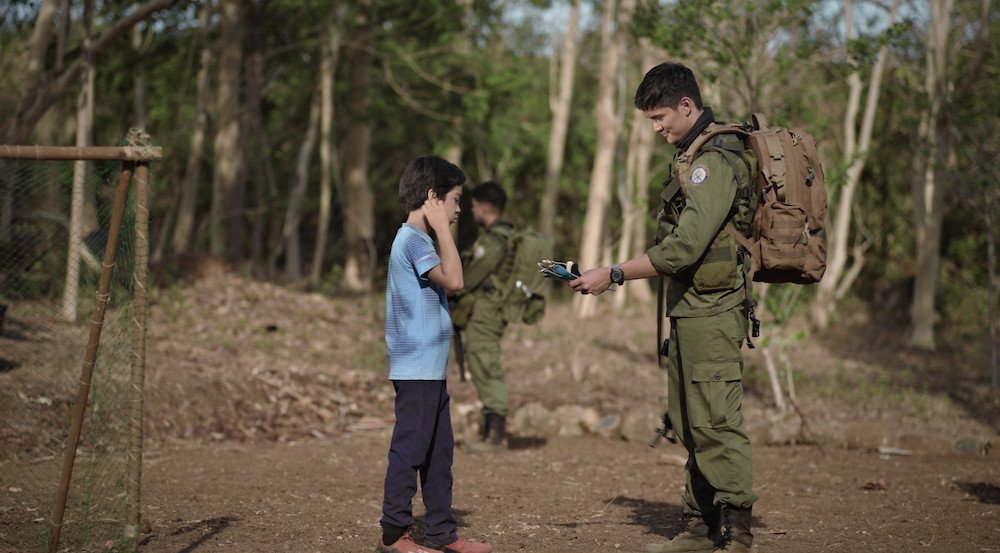
A military lieutenant sets up a collapsible football post in a remote village in the southern Philippines to teach the local children how to play football, aiming to gain the trust of a Muslim community that has long been suspected of colluding with terrorists. The leader of the village is initially reluctant. However, after watching the joy of the children, witnessing the kind demeanor of the soldiers and facing pressure from the mothers in particular, he eventually allows the whole concept to proceed, even if only briefly.
What begins as a tactical strategy becomes deeply personal when the lieutenant forms a bond with the children, especially ten year old Khaleel, a child soldier in a violent terrorist group who, as the lieutenant’s second in command points out, has come to spy on them. Gradually, though, and despite the initial bullying he receives, Khaleel becomes part of the group and emerges as a talented goalkeeper. After a hard earned trip to a football tournament in Manila, he begins to dream bigger, along with his teammates.
Mark Duane Angos directs a movie that moves in varying directions, although the circumstances in the area always hang over whatever is happening in the story. The part where the military eventually manages to convince the local community, and particularly its suspicious leader, to allow them to train the children in football leads to the trip to Manila, the participation in the tournament against all odds and the final result. All these elements point towards a kind of Hollywood style underdog story. This aspect is quite appealing to watch, although the progression of the narrative in that regard also points towards a kind of fairy tale.
Nevertheless, when reality eventually hits the story, problems begin to emerge. Despite the rather dramatic outcome and the rewarding release that follows, both the transition towards this part and the finale feel awkward. The latter, in particular, becomes mythical and highly excessive in a way that actually intensifies the fairy tale aspect mentioned above.
At the same time, the result could be perceived as a cautionary tale. The fact that the leader of the community was essentially correct all along sends a message that feels rather sanctimonious, even if this does not seem to be what Angos was aiming for. The effort not to portray either side as outright villains, with one notable exception, is understandable, but occasionally leads to complications in the message the story eventually communicates.
The acting is definitely on a high level. Ruru Madrid in the role of the lieutenant highlights his good intentions and the way they repeatedly come crashing down on him quite eloquently. Ronnie Lazaro as the leader of the community appears equally convincing as both the voice of caution and a backwards, conservative presence. KD Omalin in the role of Khaleel is quite good in both his initial reluctance and his eventual enthusiasm, while Iza Calzado as his mother delivers an excellent dramatic performance. Sue Ramirez, in the role of the lieutenant’s wife, is a very pleasant presence throughout, both during the happy and the dramatic moments, cementing the excellent job done in the casting and acting.
AB Garcia, LPS’s cinematography captures the rural setting with realism, while the football sequences are rather well presented. The action scenes close to the end are also impressive and provide a sharp contrast to the more optimistic sports sequences that precede them.
Jamie Dumancas’s editing results in a relatively fast tempo that suits the story for the most part. Nevertheless, a number of the transitions, particularly close to the end, do not work that well, while some lagging also exists. These issues become more evident precisely because the earlier parts move with considerable fluency, making the abrupt change in tone towards the finale stand out even more.
The work done in the sound design by Bien Sparks also moves towards realistic paths, intensifying the overall approach while finding its apogee in the football and action scenes.
“Hand of God” is a competent movie that sometimes seems to stumble due to the director’s effort not to paint either side as villains, with one exception, as well as some issues with the writing and pacing. As a whole, however, the movie definitely works, particularly because it remains entertaining while highlighting the particular issue and, most importantly, its consequences for children quite thoroughly.



