
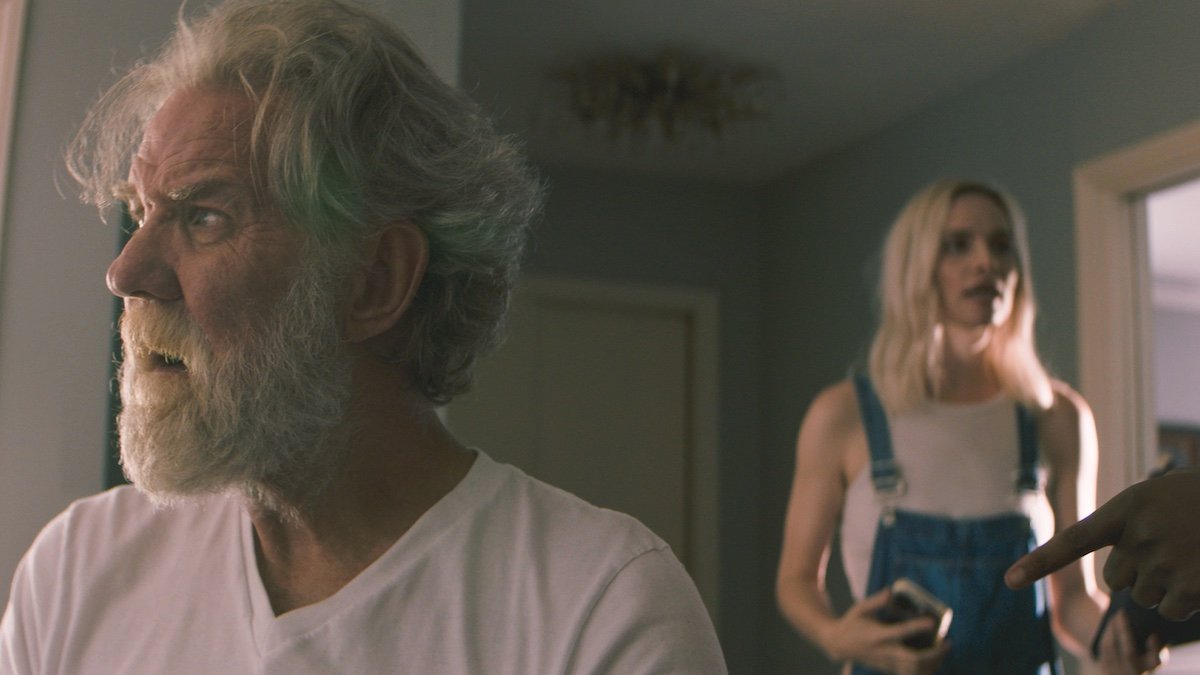
Raeden Greer drew on intense personal experience for her smartly provocative new short film “I Love You This Much,” in which she stars as a young woman caring for an elderly father in near-constant pain.
The film takes a frank look at when patients have the right to end their own pain, and is skillfully structured in a way that maximizes both the element of surprise and emotional sweep of the story. It’s typical of Greer’s gutsy work, in that she never shies away from hard subjects. Her production banner, Foxy Foxy Films, follows the slogan, “Films about the things we don’t say out loud.”
Before turning to making her own projects, Greer acted in several high-profile projects, including Magic Mike XXL, Maggie, and The Host.
“I Love You This Much,” which also stars Barry Clifton as the father and Erica Michelle Singleton as a frustrated health care worker, screens this weekend at Little Rock’s prestigious Filmland film festival, and marks another career achievement for Greer: Years ago, when she was starting to direct her own films, “my main goal was to just get it into Filmland,” the Arkansas-based filmmaker says.
She succeeded in getting into Filmland, which is run by the Arkansas Cinema Society. And with “I Love You This Much,” she’s back again. It plays Saturday morning in the Pro Shorts: Mosaic block.
We asked Greer about her experiences caring for her own father, transitioning from acting to calling the creative shots, and how she wouldn’t do what her character does in her new film.
Raeden Greer on ‘I Love You This Much’
MovieMaker: Can you talk about the experiences that informed this film?
Raeden Greer: My dad has been disabled from a stroke for almost ten years now. I’m an only child; my parents are divorced; he lives alone, and a lot of responsibility fell onto me with respect to helping him live independently. A couple of years ago, my grandfather very quickly came down with dementia and needed to live at an inpatient facility, and I found out that the cost was something like $8,000 a month out of pocket.
I was shocked by the cost and started wondering what a family would do that couldn’t afford to pay for their loved one to get proper care. My dad had a conversation with me about his own life and care and said he never wanted to end up in a facility, draining all of his savings, losing his house, and that he would want me to do the right thing to ensure that never happens. I asked him, and myself, what that meant. And this film was the answer.
I remembered an episode of This American Life about a man who had essentially walked this road with his terminally ill, suffering partner, and he was arrested and prosecuted. I had also heard firsthand accounts of a family who had taken their dad from Arkansas to Switzerland to do a medically assisted death once he deteriorated with dementia. When you have means, you have a whole other world of options. When you don’t, you’re often pushed into morally ambiguous and often illegal territory to solve your problems.
I’ve also noticed in my own life how families are often unable to have conversations about what they want to happen with their estates and medical directives. It’s just too hard to talk about for a lot of people. And when you don’t face it, you end up making a lot of mistakes and having regrets. Estate planning, or lack thereof, is also a class issue. High net worth individuals have trusts and estate plans that are worked and reworked over a lifetime. People who don’t have a lot of assets tend to lack education in this area, which compounds the difficulties and confusion that arise during the end of life.
Just to clarify — I personally would not handle this situation the way my character did. But as an exploration of the issues, the way this story plays out rings true for people every day.
MovieMaker: I’ve seen lots of “issues” movies lately that end with a postscript giving audiences some facts or details the filmmaker thinks they should know. I’m not a fan of that approach, as it can make a movie feel like a PSA. But I really like how you structured this movie — you slip in some crucial facts about the right to die in a way that makes sense for the narrative, when your character Googles it. How did you decide how to structure this story for emotional impact, while making a broader point?
Raeden Greer: I don’t ever want to spoon-feed the audience. I want to let them decide who’s the good guy and the bad guy, and maybe their idea of that switches and reverses based on how the film progresses. The fun of filmmaking for me is presenting information and letting the audience decide what to do with it. I like to let it linger in the air as the credits roll.
All of the movies I make are “issues” movies. I don’t see myself going to the effort to raise thousands or millions of dollars and spending years developing and making a movie if I’m not going to at least attempt to make a profound statement. I remember writing this script with tears streaming down my face, then letting it rest for several months, then returning to it and reading it again, uncontrollably sobbing. The story is just emotional at its core, and nothing could have taken that out of it for me.
I have also edited all of my films, and there were a couple of really impactful scenes we shot that didn’t make the cut for time. There’s so much to work with here that I plan to make this into a feature.

MovieMaker: You started out as an actor. What made you want to take the wheel and write and direct as well?
Raeden Greer: When I started in the industry around 2012, it was totally different. I would audition in person and see the same people in the waiting room every time. I would meet the same casting directors over and over, and we developed relationships. Self-taping has depersonalized the entire casting process, and now actors are expected to be their own self-generating content machine. It’s not the place I once knew anymore.
I enjoy the whole process of filmmaking — the photography, writing, editing, performances, production design. I like being the architect of a world as much as I like inhabiting someone else’s. And I have a lot of films in me that I need to express.
It used to just crush me to audition for a really interesting role and not get the opportunity to play it. I enjoy creating my own rich characters to inhabit. Nobody can tell me no, or offer me the role of “Girl #2” instead of the part I really wanted.

MovieMaker: Though this film is at Filmland, where met at another great Arkansas film festival, the El Dorado Film Festival, where I also first met two of your collaborators on this film, producer extraordinaire Tamra Corley and the wonderful actress Erica Michelle Singleton. Did you first connect with them through El Dorado?
MovieMaker: I met Tamra through the Arkansas Cinema Society several years ago, and she graciously welcomed me into the El Dorado Film Festival community, where I’ve been in attendance each year since she first invited me.
Erica and I first worked together in New Orleans more than a decade ago on a movie called The Last Exorcism II. We were both in this group of girls who live in a halfway house infested by demons. Julia Garner played one of them. And Erica and I just coincidentally both happened to be from Arkansas.
MovieMaker: Can you talk about any experiences with Filmland and Arkansas?
Raeden Greer: I grew up in Arkansas, but moved away to pursue my career in 2012. I came back to start working on my own films, and that’s when I learned about the Arkansas Cinema Society. They had sprung up while I was gone. I thought, “Wow, this is major.” When I made my first film, a documentary called The Hill We Climb, my main goal was to just get it into Filmland.
I thought if I could get it in there, I would have succeeded in some way. I got in that first year, and they’ve really embraced me and my work and been my biggest support in this new phase of my career. Filmland has a certain elegance to it that really makes you feel proud to be a part of it. It’s a club you want to be in.
You can learn more about Filmland here and read more of our festival coverage here.
Main image: Barry Clifton and Raeden Greer in “I Love You This Much.” All photos courtesy of Foxy Foxy Films.



