
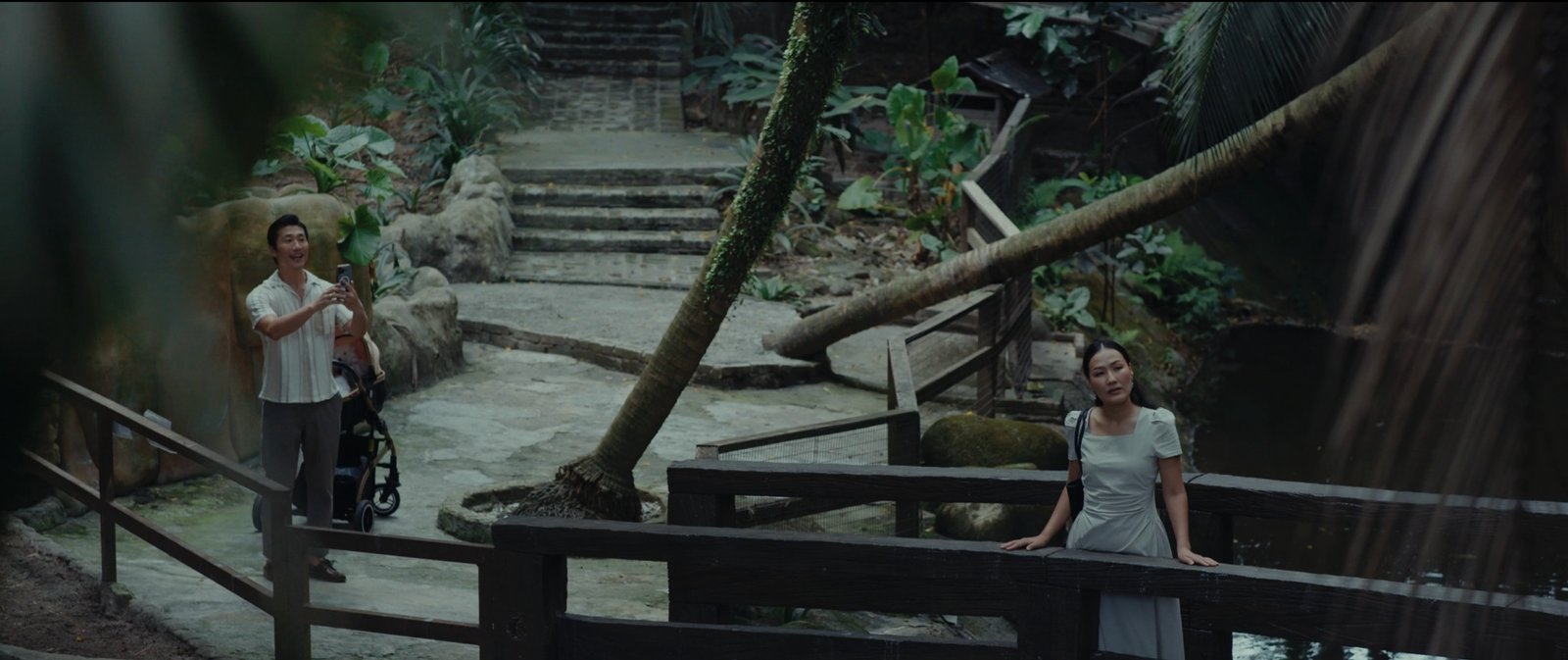
“The Penthouse” is an English language psychological drama and thriller directed by Sakha filmmaker Stepan Burnashev. Produced by Burnashev and Syarizan Md Isa through Saidam Baryl, the 102 minute international production was shot in Kuala Lumpur. Soji Arai, known for his appearances in the television series “Pachinko” and “Tokyo Vice”, and Irina Mikhailova, who previously starred in Burnashev’s “Our Winter”, appear in the leading roles.
Saina and David move with their baby into a luxurious penthouse in the centre of Kuala Lumpur, hoping to leave their previous lives behind and make a fresh start. However, Saina soon begins hearing unexplained noises and noticing fleeting shadows inside their new home. Certain that something is wrong with the apartment, she turns to David, but the successful businessman dismisses her concerns as the result of postpartum depression, exhaustion and stress.
As the disturbances intensify, Saina performs a cleansing ritual rooted in her Yakut heritage, leaving food for the spirits in an attempt to restore peace. She subsequently encounters the ghost of a young girl and becomes convinced that an invisible presence is haunting the penthouse. David refuses her requests to move and begins isolating her from friends and family, claiming that her behaviour threatens their reputation. After a psychotherapist diagnoses her with a mental disorder, Saina starts questioning her own perception, while also suspecting that her husband may be connected to the apparently supernatural events.
Stepan Burnashev moves from Yakutia to Malaysia and attempts to adapt his style to a more Southeast Asian aesthetic, while also trying some new things. The presence of ghosts and the horror elements are well embedded in the narrative. They are additionally heightened by the question that permeates the story, namely whether the apparitions truly exist or are figments of Saina’s imagination. This combination of horror, psychological and family drama, thriller and a slight crime element that appears towards the end forms the core of the narrative, although not all of these aspects work equally well.
On the one hand, the difficulties of adapting to foreign countries and cultures are explored well. Saina finds herself unable to do so and frequently attempts to return to her roots, while David’s attitude does nothing to help her in that regard. The difficulties relationships face in contemporary settings are also examined, particularly as getting to know one another has taken a completely different turn due to technology and the speed of life. The same applies to raising children under such circumstances.
Regarding the acting, Mikhailova is quite good at portraying the despair, fear and eventual resolve of her character. However, her delivery in English is occasionally less convincing, while Burnashev’s decision to have her serve as the narrator is not exactly ideal. On the other hand, her chemistry with Soji Arai is quite convincing. Arai is equally effective in a role that undergoes a number of transformations.
Danila Goryunkov’s cinematography captures the luxurious apartment in a way that frequently makes it feel claustrophobic, while the exterior locations are presented with realism. There are moments when the scenes are too bright, but the visuals work well as a whole. The editing results in a midtempo pace that suits the overall aesthetics of the movie.
The context may be rich and the beginning of the movie intriguing, but as the story progresses, some unrealistic moments and plot holes start to appear. Furthermore, the detective’s presence towards the end suffers somewhat from the writing. The same essentially applies to the final part, where the truth is revealed through flashbacks, resulting in a conclusion that needed a little more work. The editing during this section could also have been tighter.
Although “The Penthouse” is on a lower level than Burnashev’s previous Sakha productions, the result is definitely hopeful, particularly considering that this represents a new beginning for both him and Mikhailova. His prowess as a director remains evident, although he needs more time to adapt his style fully to a Southeast Asian aesthetic.



