
RepoNut started during the Great Recession. Nearly nine million jobs were lost between December of 2007 and early 2010. Forced to make tough spending choices, many Americans prioritized their car payment over the mortgage, weighing the urgent need for personal transportation—work and groceries, church and medical appointments—against the relatively slow-moving process of home foreclosure. Even so, at the recession’s peak, in 2009, 1.8 million cars were repossessed, according to Cox Automotive, an unprecedented number. Pitman’s was the face that thousands of consumers saw, or didn’t, when the financial system came for them.
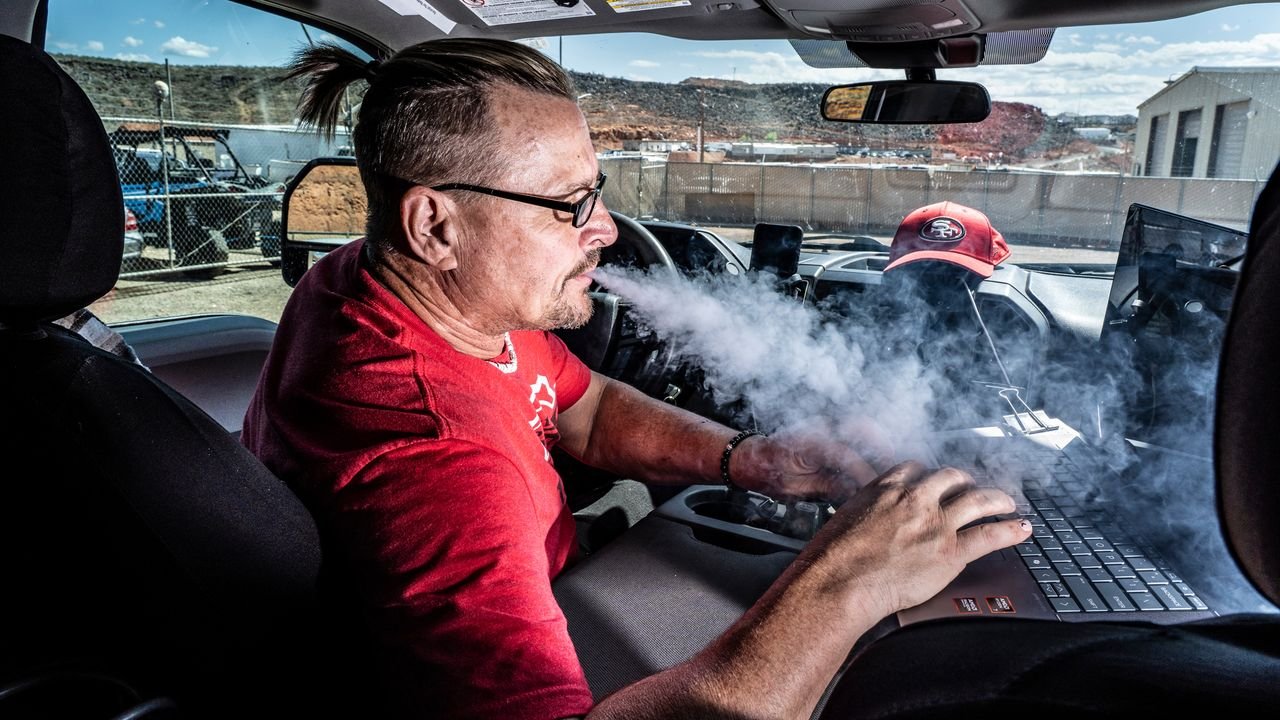
Repossessors and tow-truck drivers work different jobs but use the same equipment. The tow truck was patented in 1918 by Ernest Holmes, Sr., the owner of an auto-repair shop in Chattanooga, Tennessee, who pulled vehicles out of ditches using a modified Cadillac and chains. Today’s tow trucks, also known as wreckers, are computerized work stations with integrated digital dashboards, camera systems, blind-spot monitoring, and hydraulic rotators. Pitman eventually switched from a wrecker to a “sneaker” unit, a heavy-duty Ford F-series pickup equipped with a steel boom, shaped like a cross, that can be maneuvered with joysticks from inside the cab. He could extend the boom, like a stinger, to “hook” and lift a vehicle’s front or back wheels within seconds.
The tactical aspects of repo interested him more than the mechanical. Pitman liked finding cars that drivers didn’t want found. He got his taste for “investigating” in childhood, after smelling Burger King on his parents’ clothes and watching them lie about where they’d been. Their deception “didn’t hurt me,” he said. “I just found it interesting.” He began to figure out, ahead of time, what everyone was getting for Christmas, and followed his older brother when he sneaked out at night, learning that there was power in discovering information, and in withholding it.
When Pitman started in repo, orders arrived by fax; agents used foldout maps. He got ahead by working dead paper. Fresh eyes on an unfulfilled assignment generated leads that lesser repo guys never saw. A target vehicle that went missing from the address listed on a loan account might be parked down the block, or in a friend’s driveway or a cousin’s garage, or in a storage unit, a church parking lot, a barn. Pitman once tracked a vehicle to a shipping container headed for Hawaii. A debtor’s grandparents’ house was often a good place to look: older people don’t move around that much. Pitman observed that you could tell a lot about a family by how close together everybody lived—data, potentially, for later. Hard-core hiders are called skips, as in skipped town. A skip could maintain spotless op sec and still be undone by an associate’s social-media incontinence; Pitman once noticed a license plate in the background of a photo on the Facebook feed of a target’s relative, traced the plate to an unchecked address, and drove by the house. There sat his repo.
Once a vehicle is hooked, a repossessor may still need the key—sometimes the emergency brake is on or the car needs to be put in neutral, and an inventory of the car’s contents must be taken, too. Having the key is easier and cheaper than cutting a new one. Asking for it required Pitman to “make contact” with the debtor, which usually started with knocking on a door. If a debtor refused to coöperate, Pitman might ingratiate himself, explaining, truthfully, that having the key sure would help him out, or that, without it, the lienholder would bundle the cost of making a new one into the price of getting the vehicle out of hock. Most people were reasonable. Most repos go smoothly. If the vibe soured, Pitman explained that his job was simply to transport collateral for the lender. One of his rigs had a large decal on the back window: “Why are you pissed at ME? I didn’t miss YOUR payment.”
Outside the truck, Pitman wore the GoPro on his forehead, making it clear that he was recording. It is unlikely that the people losing their cars knew that their interactions with him would live forever on the internet, with some of their private information exposed and the repo man getting the final word. In one video, a debtor, wearing a “Ridin’ on Faith” T-shirt, stands in her driveway and denies the true whereabouts of a Land Rover that Pitman knew perfectly well was sitting out back. Pitman floated in text: “Lie #1 . . .” When that same debtor then says, “You’ve been in my back yard why?,” Pitman replies, “When you signed the contract for the title loan, you gave them the right, if the loan goes into default, for us to come out and pick up the vehicle.” That frame read “Did that answer you snootie question?”



