
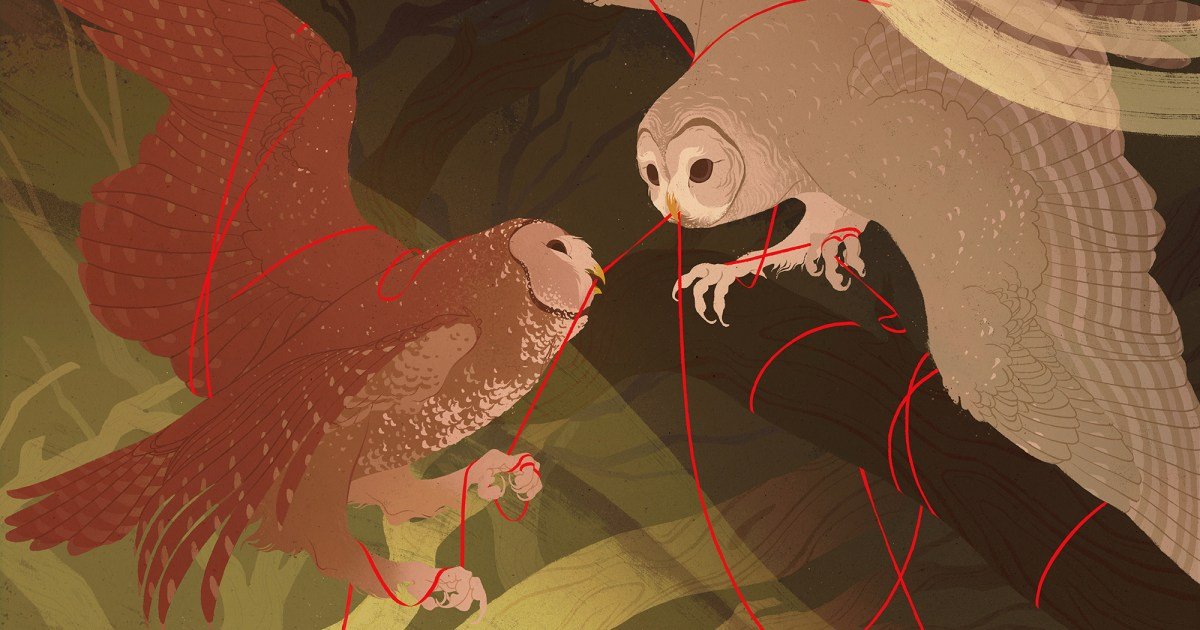
The northern spotted owl is in trouble—per usual.
This vanishingly rare subspecies of spotted owl earned its iconic status in the late ’80s and early ’90s, during the height of the Timber Wars in the Pacific Northwest. For forest defenders, the spotted owl is a sacred totem. For loggers, it’s been a pest. In 1990, federal officials reclassified the raptor as a threatened species, and greens won the Timber Wars with the establishment of the Clinton-era Northwest Forest Plan. The spotted owl left the trees standing—yet the number of spotted owls continued to decline.
The culprit? The barred owl, a more aggressive species that has been expanding westward since the 19th century. While the northern spotted owl survives almost entirely on tree-dwelling rodents, the barred owl is a voracious predator that has easily outmuscled its more timid cousin. Today, just 15,000 spotted owls remain across North America; in comparison, there are some 3.5 million barred owls. So officials with the US Fish and Wildlife Service have come up with a bold plan to help the spotted owls: Shoot the barred owls.
In September 2024, the agency released its Barred Owl Management Strategy, which calls for trained “removal specialists” to kill up to 15,600 barred owls annually in Washington, Oregon, and Northern California over the next 30 years. By one estimate, this could cost up to $1.35 billion, or roughly $3,000 per feathered carcass.
The idea of blowing away nearly half a million owls to protect another owl has sparked green-on-green infighting and led to some strange bedfellows. Last year, the animal rights groups Animal Wellness Action and the Center for a Humane Economy worked with Republican lawmakers on a Congressional Review Act resolution that would have halted the owl-killing program. It failed to pass. But those animal welfare groups notched a win for their cause when Elon Musk’s so-called Department of Government Efficiency nixed some federal owl-related grants.
And if a hands-off approach leads to the extinction of the northern spotted owl? “I acknowledge that it’s a real risk,” says one advocate.
Meanwhile, some of the environmentalists behind the ’90s logging ban are in the odd position of siding with their age-old nemesis, the timber industry. Logging companies are now fans of the barred owl culling because, oddly enough, the program will reopen permits that waive penalties if the loggers accidentally kill spotted owls, thus enabling timber harvesting in habitats that were previously off-limits.
The controversy has split the National Audubon Society, whose staff did not respond to our request for comment. The group’s eponymous magazine has expressed cautious support for the barred owl culling, but at least 18 local chapters—including four in the Pacific Northwest—have come out against it. Biologists are also flummoxed. William Ripple, a professor of ecology at Oregon State University who was involved in some of the early research on the northern spotted owl, tells me, “Reasonable people can disagree on the best path forward.”
Noah Greenwald, endangered species co-director at the Center for Biological Diversity, says he and his organization take no joy in the prospect of shooting thousands of barred owls, but he insists there is no other choice. “We don’t love that an owl is being killed…I just don’t want to see the spotted owl go extinct, and it will go extinct without some barred owl control.”
Animal welfare advocates argue that the Fish and Wildlife Service’s plan is inhumane and unworkable. “In the long run, we don’t think it’s going to help any species,” says Jennifer Best, the wildlife law program director at Friends of Animals, which has sued the agency to halt the program. “And in the immediate term, it is cruel and will result in hundreds of thousands of owls being shot down from their homes.”
Lurking over the debate is the larger, knottier question of which species should be considered invasive. Greenwald argues that the barred owl is an invasive species, even if it made its way west due to vast ecosystem shifts wrought by people—“and invasive species are the second leading cause of extinction.”
But should we punish the barred owl for adapting to a human-created environment while the northern spotted owl has failed to do so? “The Fish and Wildlife Service is essentially saying that any species that changes its range can be considered an invasive species,” Best says.
And if a hands-off approach leads to the extinction of the northern spotted owl? “I acknowledge that it’s a real risk,” she says.
This isn’t the first time humans have targeted one bird with the goal of saving another. For decades, the Fish and Wildlife Service killed brown-headed cowbirds that were laying their eggs in the nests of the Kirtland’s warbler, an endangered species. The program worked, and in 2019, the Kirtland’s warbler was removed from the endangered list. But now, the little songster is what’s known as a “conservation-reliant species”—its survival depends on constant human intervention.
The spotted owl is on the path to becoming another conservation-reliant species. Such nonstop vigilance is the price we pay when humans pick winners and losers in the wild world. We might like to think that nature is a harmonic arrangement, but in truth, it’s a constant competition—red in talon and beak. “I see this as a complex ecological and ethical issue rather than a simple conflict between a good species and a bad species,” says Ripple, the Oregon State ecologist. “The challenge is that there are no easy solutions.”



