
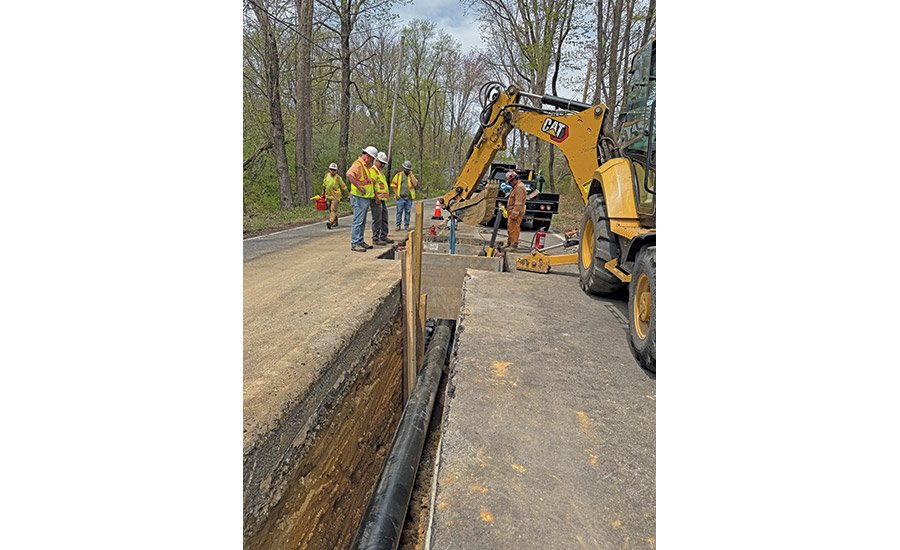
For more than 60 years, Flanders, N.J.-based Skoda Contracting has taken a measured, methodical approach to growth, evolving from a pipeline welding company to a go-to underground utility contractor for New Jersey’s leading natural gas companies. A similar strategy has guided the family-owned company into other subsurface construction services, such as water lines and underground electric systems, and into new territories, with divisions established over the past 15 years to serve Pennsylvania’s Lehigh Valley and metropolitan Washington, D.C. This year, the firm ranked No. 36 on the ENR East Specialty Contractor rankings, is projected to report about $105 million in revenue, with backlog expected to grow as utilities seek to upgrade their aging infrastructure. Investments in employee skills development and community service also contributed to the firm’s selection as Specialty Contractor of the Year for ENR’s New York/New Jersey region.
CEO Dane Evans discussed Skoda’s place in the region’s construction market and what his firm learned from a recent settlement with the Pennsylvania Public Utility Commission that stemmed from incorrectly documented plastic-pipe fusions. This interview has been edited for space and clarity.
Skoda’s Top Three Regional Project:
Flocktown Interconnection, Elizabethtown Gas, Hackettstown, N.J.—Skoda recently completed this three-phase, 7.5-mile steel pipeline for Elizabethtown Gas—finishing one month ahead of schedule. One of the most technically demanding pipeline projects in the firm’s recent history, it included complex bridge hangings, 40-plus offsets and a crew that placed an average of more than 300 linear ft per day.
Area Wide Water and Sewer Connection Contract, Prince George’s and Montgomery Counties, Md.—This multiyear new business contract in the two counties represents Skoda’s successful expansion beyond gas projects into water and sewer construction after deliberately retooling and investing in building a dedicated water construction department.
Purple Line Utility Relocation, Washington Gas/Maryland Transit Authority, Montgomery and Prince George’s Counties, Md.—Skoda was selected to relocate dozens of gas pipeline utilities for Washington Gas to clear the corridor for Maryland’s new Purple Line light rail system. The high-profile, coordination-intensive project required precise execution alongside a major public infrastructure program and demonstrates the company’s ability to operate in complex, multi-stakeholder environments, the firm says.
ENR: What trends are driving the utility services market in New Jersey?
Skoda Contracting — By the Numbers
0.6 –Experience Modification Rating
1962 – Year Founded
$120 million – Value of Contract Awards
2025 Revenue—Key Segments
$94 million–Utilities
$0.94 million–Power
$84.60 million – Oil and Gas
$0.47 million – Washington D.C.
$4.70 million–Virginia
$18.80 million – Pennsylvania
$65.80 million – New Jersey
We’re seeing not only business expansion—as gas utilities try to pick up new customers and grow the number of services—but also gas line replacement and reliability projects. Utilities are upgrading their older pipelines from vintage materials, such as cast iron and steel, to polyethylene.
Diversification has been a big part of Skoda’s recent growth. What’s been key to your strategy?
We only work for utility companies, so we have a specific type of personnel and culture that’s built around safety, client-focused execution and reliable project planning. We’ve diversified methodically and intentionally, picking projects and scopes of work that made sense for us—where we weren’t going to overextend or take on unnecessary risk. We’re lucky that our utility clients allowed us to take our time and get it right. They knew our level of care and approach to safety would help foster long-term relationships with them.
“We have a culture of choosing the right people and allowing them to grow without pressure.”
—Dane Evans, CEO, Skoda Contracting
How did this guide your expansion into Pennsylvania and Maryland?
We have a culture of choosing the right people and allowing them to grow without pressure, whether it’s an apprentice level laborer or senior manager who is looking for a next career step. It’s been good to see the Washington, D.C.-Maryland and Lehigh Valley divisions blossom through that methodical growth. We’re lucky to be a family-owned business, so we can think in decades instead of six-month intervals. We can build the right foundation for each area to grow without getting too excited and then over-promising but not delivering.
How does the Flocktown Interconnection project exemplify Skoda’s work?
That was an extremely complicated, three-phase 12-in. steel pipeline interconnection project spanning more than seven miles of work on narrow streets with a large number of offsets, directional drilling and hanging lines on bridges. We had such a good project management team around the planning and logistics side; our crews executed at a really high level, and our engineers worked tirelessly on the back-end work. We’re proud of that project.
Looking for quick answers on construction and engineering topics?
Try Ask ENR, our new smart AI search tool.
Ask ENR →
Skoda had to rework several Pennsylvania projects after finding that an employee failed to follow proper pipe-joining documentation procedures. What did you take from that experience to not only prevent a reoccurrence but also to improve overall work quality?
At first, we were defensive, because we’ve never had a safety incident. But once we realized that this is happening for us, and not to us, and would make us better, we engaged in a really constructive way. Over the course of a few years, we worked with the utility to replace pipelines on which that employee was involved at our own expense.
Internally, we changed the way we supervise projects in terms of documentation. We built out a different inspection branch of our client safety and education division, and we put a focus on company supervisors to be much more intentional in the way they are inspecting jobsites.
Now we’re documenting all of the utilities’ procedures on iPads and tracking metrics. We’re also scorecarding field managers and crews not just for efficiency and profitability but also on how well they follow procedures. If for some reason an incident like this happens again, we know it’s going to make us better if we engage constructively.
Source: www.enr.com



