
Published November 5, 2026 06:00AM
Age-group triathlete Rebecca Jaussi shares her personal story with Triathlete of how receiving a cancer diagnosis drove her to signing up for and racing an Ironman 70.3.
I have spent most of my life making plans.
Endless lists of goals. Race calendars. Career milestones. Bucket-list adventures. I have always believed that if I worked hard enough and planned carefully enough, I might chart the course of my life.
Running and occasional triathlons are at the top of my goal-making lists.
I was a late starter professionally, choosing to stay home with my children when they were young. When I eventually returned to school, I didn’t ease my way back in. I was accepted into an accelerated doctoral nursing program, completing an intense year of coursework and clinicals before becoming a registered nurse, followed by three years of doctoral study. In 2020, I earned my doctorate in nursing practice and became a family nurse practitioner.
I have always been willing to push myself, physically and mentally, and my tenacity has benefited me.
I never imagined I would need it to fight cancer.
The fall
This story began with a fall. It was another beautiful morning on the North Shore of Oahu (where I was living at the time) in February 2023, and I was running a technical trail when I went down on a rocky section. I experienced a pop in my right hamstring and some pain. But I did what I always do and just kept going.
I finished the run. I experienced some pain afterward, but not enough, in my mind, to stop running for good. I took a few days off and then returned to the trails.
As a healthcare provider, I knew better. But as a runner, I convinced myself otherwise.
I continued running through an increasingly persistent, insidious pain. Eventually, my pace deteriorated from slow to a limping shuffle. Finally, I went to my colleague who practiced sports medicine, and was referred to physical therapy.
I started PT in May. My physical therapist told me I needed to stop running, and I thought that was an unreasonable course of action. There have been very few occasions in my life when I stopped running, including childbirth and surgery, and they were brief periods of time.
Running wasn’t simply exercise for me; it was where I found my flow state and truly part of my identity.
I didn’t feel ready or willing to give up running due to the pain but trusted my physical therapist, whom I considered a friend and a respected colleague, that this was the best course of action.
For three months, I walked on flat trails. I continued my physical therapy exercises and cross-trained but abstained from running or hiking.
When I returned for another assessment, my physical therapist was puzzled. I wasn’t improving. He suggested imaging, and that push changed everything.
Receiving the diagnosis
I went in for an MRI of my right leg. The imaging was ordered for my mid-thigh, which was not where I had originally injured my hamstring. When I discussed this with the technician, I pointed out that it was in my hip region, so he modified the imaging order.
The MRI showed enlarged lymph nodes in my right groin, hip, and possibly behind my knee, which was an abnormal finding.
I had no recent infection or other obvious explanation for the swollen lymph nodes. I asked colleagues and peers for their opinions, and most believed this was a benign finding.
My mind vacillated between thinking that it was probably fine and the worst-case scenario of malignancy. It felt unsettling to me, and I decided to push for a biopsy rather than wait a few months for an ultrasound to see if the lymph nodes were still enlarged.
After the biopsy, I waited eight grueling days for the results. The physician, who was also my colleague and friend, told me the findings indicated that I had a form of B-cell non-Hodgkin lymphoma.
This was not easy to ingest, but I didn’t want to burden her with the heaviness of this diagnosis and began joking around. I was blasé and asked her, “How are we going to fix my leg so that I can run?” refusing to fall apart on the phone.
Then I hung up and broke down in front of my husband. Suddenly, all the plans I had spent my life making seemed irrelevant. Questions revolved in my head. What would happen to my family? My future? My career?
The next step I took was to do what I knew how to do, which was research my diagnosis to find out everything that I could about it. I wanted to know the prognosis, treatment options, statistics, anything to help me wrap my head around this.
What I discovered in this process was much more difficult to accept. There were things that I could not control.
I was driven to face the possibility that I may not live as long as I had expected. I had to accept that I would be living with the uncertainty of my health status and that fighting incurable cancer might become a permanent fixture in my life.
For someone who had devoted decades to building goals and marking off boxes, this was terrifying. There were no checklists for this.
Choosing to keep living
I took time to process what I was facing and came to the recognition that I had a choice – not about living with cancer, but about living my life.
Most importantly, I still wanted to run.
I was not going to allow this diagnosis to define me; I had a strong desire to live my life to the fullest with purpose and direction. I still wanted to work as a nurse practitioner for as long as I could. I still wanted to pursue medical humanitarian work. I still wanted to travel. I still wanted to be active.
In January, I was accepted into a clinical trial for immunotherapy.
Before treatment began, I did something that probably sounded slightly unreasonable to the people around me.
I signed up for Ironman 70.3 Hawaii on June 1, 2024.
I asked my oncologist and the lead investigator of my clinical trial whether I could participate. They told me that I was the first patient they knew of to ask about competing in a half Ironman while undergoing treatment.
They gave me their blessing with one caveat: It would be essential to listen to my body. This was going to be physically taxing on my body due to the cancer already exhausting my body and undergoing treatment in addition to the rigors of training for a 70.3.
I understood the risks. I also understood something else: Training gave me a goal and purpose to keep moving.
Although cancer had taken away my perception of control, it hadn’t taken away my ability to choose a direction.
Racing in Hawaii
I arrived in Kona on May 30, 2024. I was nervous and exhausted. I had received treatment the week before and was still recovering from it.
My younger brother, who had agreed to race with me when I asked, and I gathered our swag and attended the informational session. As we were walking out, I saw the iconic walls of all the participants, their bib numbers, and the “why” wall. Seeing my “why” story on the wall solidified my resolve in what I was doing.
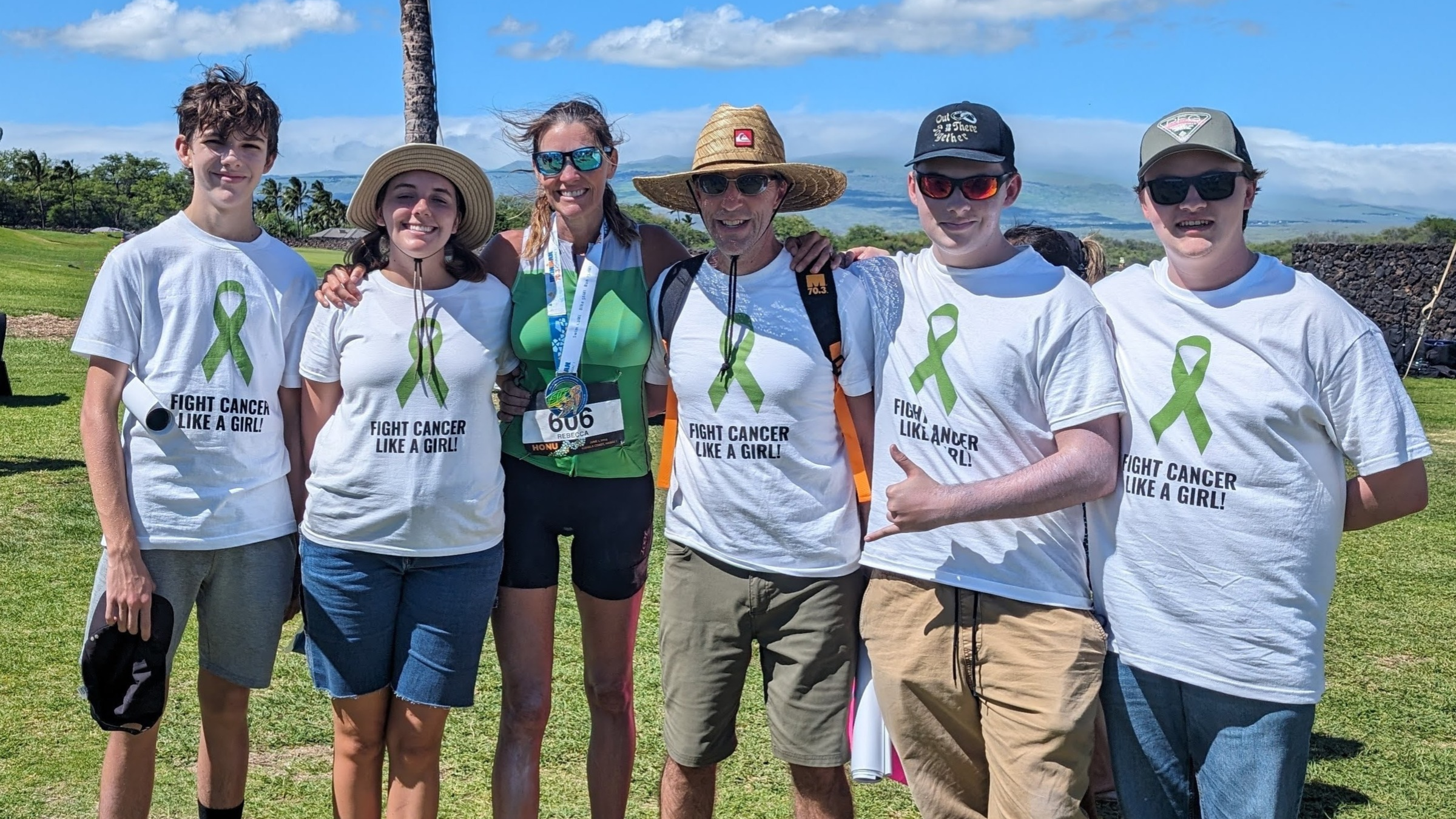
The day before the race, I started receiving text messages with their pictures attached, early in the morning, from friends, family, and my whole care team from Fred Hutchinson Cancer Center, wearing a T-shirt that had my cancer ribbon with the words “Fight Cancer Like a Girl” on the front and “Team Rebecca 01” on the back. My amazing husband made nearly 100 shirts and sent them out, asking them to send me a picture and words of encouragement the day before the race. I felt so much love and support from the people in my life.
On June 1, 2024, I stood on the beach waiting for my wave to start at Ironman 70.3 Hawaii. I remember feeling incredibly grateful to be there and have the ability to push my body to the limits.
The race was hard; the winds were cranking so hard that several cyclists were blown into the lava rocks along the highway. It took some serious grit to keep going, but with my husband and kids driving by with my favorite songs blasting on the stereo, cheering me on, I was able to finish the bike.
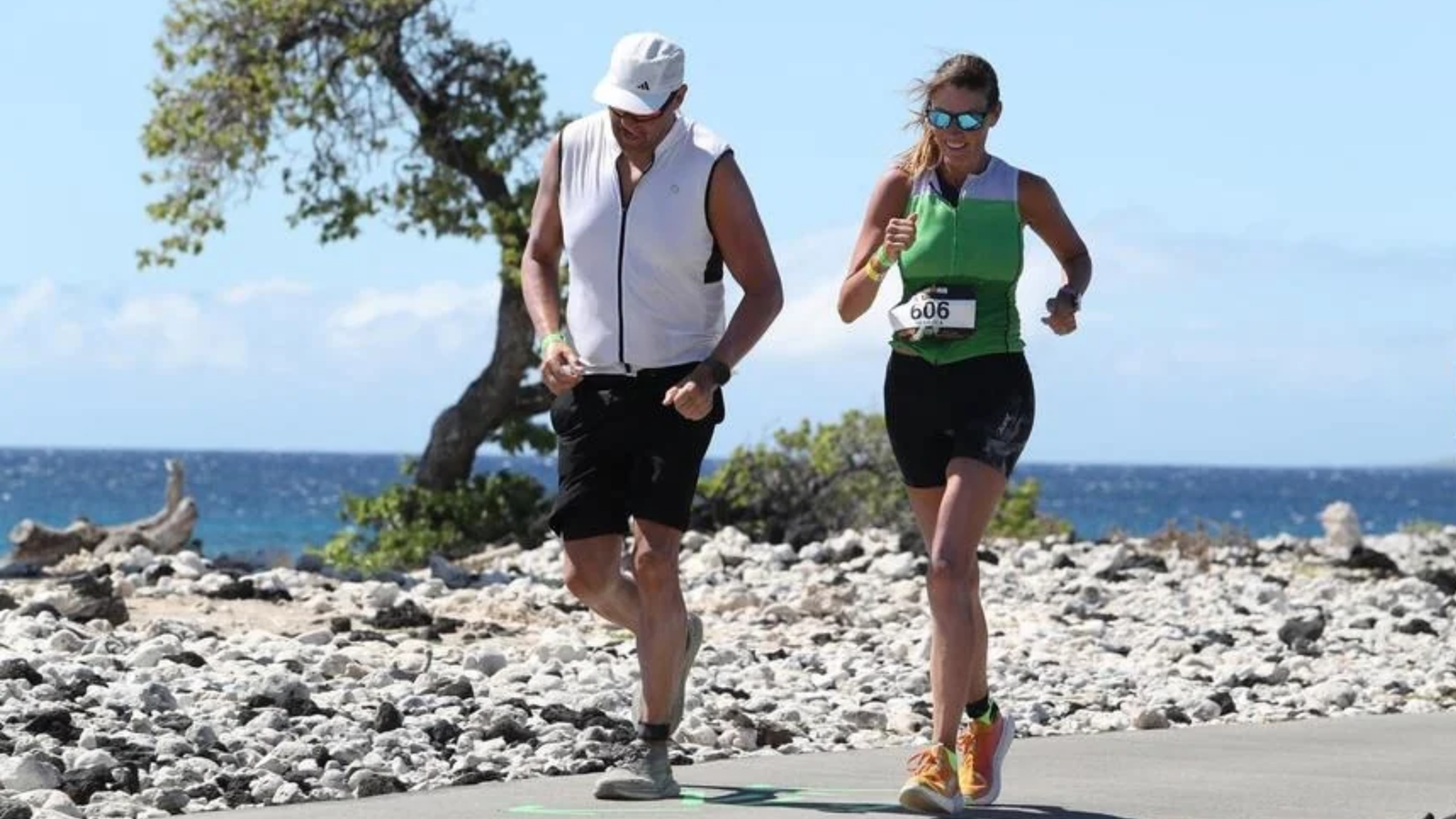
By the time I started the run, it was midday, and the sun was searing, with temperatures climbing above 90 degrees. My body was fatigued, and every part of me wanted the race to be done. I dug deep. My mantra was “I can do hard things” on repeat. I kept moving.
During those final miles, rolling thoughts in my head surfaced: If I can fight cancer, I can finish this race.
There was an alteration in my thinking and in the purpose of that day; this was no longer about the race but rather an understanding that I was capable of moving forward.
I crossed the finish line with my brother beside me and my family waiting and cheering. I was overwhelmed by my emotions as I crossed the line.
My body was spent; however, there was something strangely beautiful about that exhaustion. I would rather be exhausted from swimming, cycling, and running than exhausted from lying still, consumed by the knowledge that I have incurable cancer.
One mile at a time
My training looks different than it used to. Some days are hard, and my body needs downtime.
I’ve learned that listening to my body isn’t a weakness, or even optional at times, but rather a way for me to keep up the fight.
With every step I take, every mile I cycle, every lap that I swim, it is more than just training; it serves as a reminder that my body is still mine and truly a gift to be cherished.
My cancer diagnosis has altered my relationship with time. I functioned at a faster pace and was always thinking ahead about what was next: the next race, the next degree, the next goal, the next item to add to my list.
I am more focused on the mile that I am in right now. I have not stopped making plans; I just hold them differently.
My desires to work, travel, race, and serve others remain, but their priority and intensity are more flexible, as my health and energy can be fluid.
This diagnosis has shifted my perspective – I no longer believe that my worth or value depends on completing every goal I write down.
Some days a win is simply to get out the door. Sometimes it is a slow swim, and the distance may be shorter than planned. Sometimes it is walking instead of running. Sometimes it is resting.
And sometimes, it is standing at a finish line I wasn’t sure I would ever reach.
The trajectory of my life feels unsure and more constrained. However, I know that running, swimming, and cycling are things I can do at the moment, and they make me feel alive.
Honestly, for me, that’s what endurance sport has become. This is not a means of escape from cancer but rather my way of living despite it.
One step, one mile, one breath, I will keep going.



