
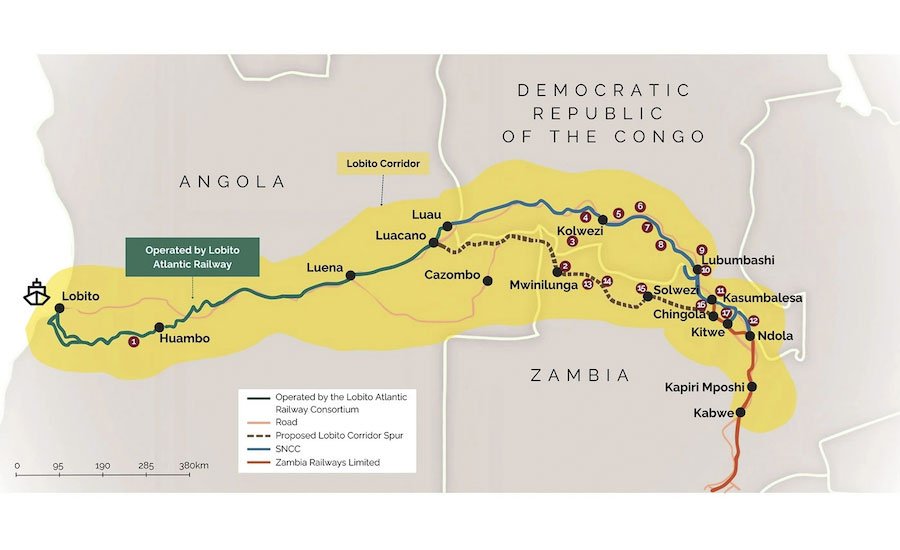
The planned construction of the 830-kilometer (515-mile) greenfield Zambia Lobito rail line project, which would connect the mineral-rich African countries of Zambia and Angola, moved closer to construction late last month with the selection of two consortia as preferred bidders for separate engineering, procurement and construction contracts.
The project’s lead sponsor and developer, Africa Finance Corporation (AFC), unveiled a consortium comprising Italy-based Webuild S.p.A., along with Turkish firms Mota-Engil and IC İçtaş Construction as the preferred bidder for the 550 km Zambian section, and Mota-Engil and Brazil’s Odebrecht Engineering and Construction for the 279-km Angolan section of the project. Construction of the entire line is expected to cost between $3 billion and $5 billion.
AFC said contract negotiations for the project, which is expected to create approximately 500 permanent jobs and 5,000 temporary jobs across construction, logistics, border post operations and professional services, “will begin in November 2026, with the aim of concluding EPC agreements within 8 to 12 weeks, subject to satisfactory technical, commercial and legal negotiations.”
The project is intended to establish a much-needed trade route for copper, critical minerals, agricultural products, petroleum and other materials. It will connect inland Southern African countries to international markets via the Port of Lobito on the Atlantic coast, with an aim of reducing transit times to seven days, down from up to 16 days via other corridors.
The Zambia Lobito rail project has drawn an international coalition of development partners and advisors, including the U.S. government. It has already attracted financing from the European Union, which has provided $ 1.1 million as a development grant, $320 million from the Italian government under the Mattei Plan for Africa, $255 million from the African Development Bank and $500 million from AFC.
The route will run from Chingola in Zambia’s Copperbelt Province—the second-largest source of copper in Africa after the Democratic Republic of the Congo (DRC)—to the Zambia-Angola border at Kangongesha. It will subsequently connect to Angola’s rehabilitated 1,344-km Benguela Cape rail line. The new line will be part of the broader Lobito Corridor, which spans Southern and Central Africa, linking Angola, the DRC, and Zambia to the Port of Lobito on Angola’s Atlantic coast.
Currently, the Lobito Atlantic Railway, a joint venture between Trafigura, Mota-Engil, and Vecturis, is operating the Benguela line under a 30-year concession in Angola. The corridor is also being revitalized as a cost-effective and efficient alternative to traditional export routes via Durban in South Africa, Beira in Mozambique, and Dar es Salaam in Tanzania.
Looking for quick answers on construction and engineering topics?
Try Ask ENR, our new smart AI search tool.
Ask ENR →
Enoh Titilayo Ebong, who formerly served as the director of the United States Trade and Development Agency (USTDA) between 2022 to 2025, previously said the rail project “will help reshape the economic landscape of Angola, Zambia, and the Democratic Republic of the Congo, and it will foster trade while uplifting the people whose livelihoods will be tied to economic activity along the corridor.”
She said USTDA’s partnership with the Africa Finance Corporation “will help mobilize financing and ensure the highest project development standards for the rail line. U.S. companies are well positioned to provide innovative solutions and expertise to this project.”
The project, whose debt and equity fundraising is expected to commence in the second quarter of 2027, is making progress at a time when China accounts for up to 85% of the export of the DRC’s rare earth minerals including 76% of its cobalt, a mineral essential in EV battery manufacturing and other electronics.
According to the Lobito Corridor Investment Promotion Authority (LCIPA), a permanent multi-stakeholder engagement agency linking public and private in the advancement, financing, and development the Lobito Corridor, the investment in the new railway line “will be the first major rail infrastructure investment by Washington D.C., in Africa and it must succeed so that future infrastructure spending on the continent is encouraged and ultimately unlocked.”
“Once upgraded, the Lobito Corridor will encourage large-scale mining investments which are associated with higher wages, stricter environmental and ethical standards, and better tax compliance. Large-scale investments are catalysts for economic development and the benefits of large greenfield FDIs are well-known to economists and development aid practitioners,” the Authority said.
Source: www.enr.com



