
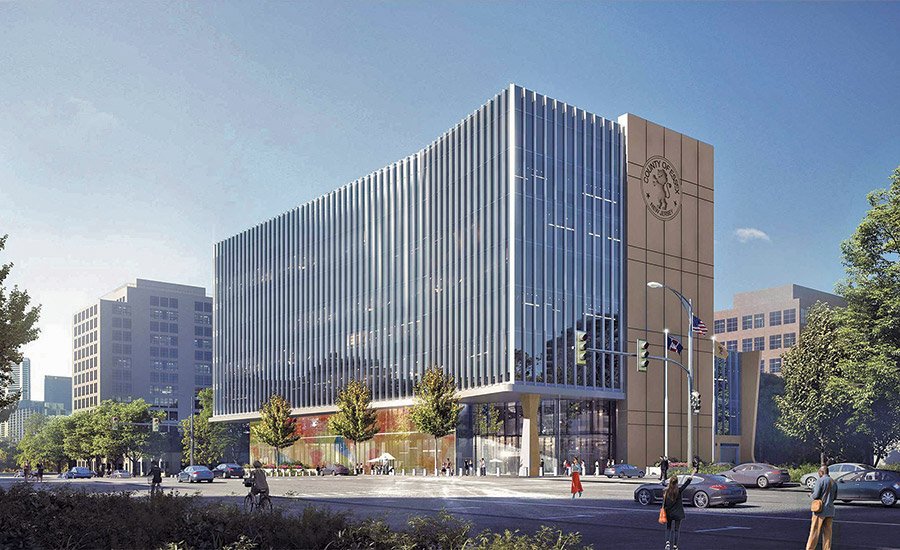
Essex County Wynona Lipman Family Courthouse
Newark, N.J.
BEST PROJECT
Submitted by: Dobco Inc.
Owner: Essex County
Lead Design Firm and Civil Engineer: Comito Associates
General Contractor: Dobco Inc.
Structural and Mechanical Engineer: French and Parrello Associates
Landscape Architect: Baretto Dowd
Subcontractors: B&B Iron Works Inc.; Alessandra Misc Metal Works; Galdi Mechanicals Corp.; Kenvil United Corp.; Sealant Technology Services Inc; Mechanical Associates of NJ
The 266,000-sq-ft, eight-story building consolidates previously dispersed family and children’s courts, probation services and domestic violence units into a central urban location. The principal public entry is carved out under the building’s upper floors to form a plaza as an extension of the public streetscape and as a ceremonial front door marking the entry on its tight urban site.
Unlike criminal or civil courthouses, family courts require a highly specific, de-escalating environment, says the submission. A multicolor, art-glass two-story translucent screen on the public street wall shows inside activities while also introducing a calming, playful element to offset the serious nature of traditional courthouse expectations. Family courts are further softened with separate child-friendly playrooms in designated waiting areas, the team says.
Photo courtesy Comito Associates
Constructing this massive complex in downtown Newark required meticulous coordination. Logistical challenges included working within strict property lines, managing daily traffic flows and minimizing disruptions to neighboring city blocks. The design also required dividing the interior to separate hostile parties while also accommodating sensitive spaces. Integrating modern security was likewise critical, as the building needed specialized structural additions to properly segregate victims, defendants and judicial staff. This included separate private entry points, youth and adult holding cells, secure sallyports for the sheriff’s department and secure underground parking for judges.
To counter unpredictable conditions in this challenging environment, the project team relied on a foundation of constant communication and close collaboration. Daily meetings were essential—allowing project managers, superintendents, safety managers, field leaders and crew members to address immediate obstacles, coordinate daily tasks and adapt to unforeseen issues in real time.
The rigorous internal teamwork was mirrored by external cooperation with the city of Newark and other key stakeholders to ensure goals were aligned and enable swift, collaborative decision-making when budget or schedule adjustments were needed.
Source: www.enr.com



