
As data centers look to alternative energy options for backup power and behind-the-meter power generation, alternative energy technologies are getting a shot in the arm from new investment by hyperscale builders.
Phinergy, a maker of aluminum-air electrochemical battery technology, is scaling up its power generation capabilities as one of the first resident technologies being tested at the Net Zero Innovation Hub for Data Centers near Madison, Wis. The innovation hub is an initiative by a consortium of data center builders and contractors intended to pursue more sustainable power sources and technologies for hyperscale data centers. Partner companies include hyperscale builders Google and Microsoft as well as suppliers Schneider Electric.
“We are scaling up a technology that existed in the lab,” explains Emmanuel Levy, CEO of Phinergy. “We’ve developed it for a decade, it’s already been rolled out as backup power for small telecom sites.” But the scale of power needed for data centers is larger by orders of magnitude.
Aluminum-air fuel cells generate electricity through electrolysis, essentially a reverse of the power-intensive process in aluminum manufacturing where naturally occurring aluminum oxides are converted into market-ready aluminum. “We are taking the metal and releasing the electrons injected by the electrolysis process—we are effectively closing the loop on the process. [Manufactured aluminum] is in the middle of the process, with energy stored in the metal,” says Levy.
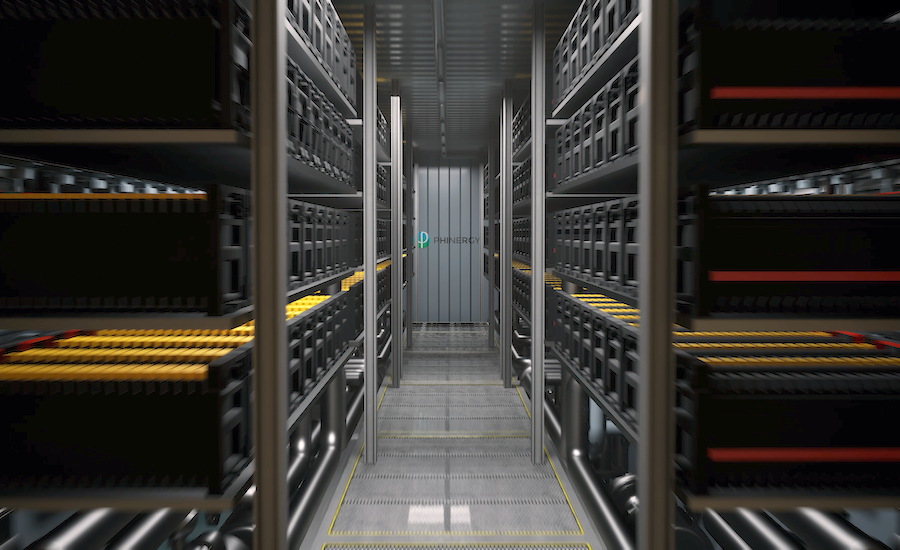
A scaled-up version of the Phinergy technology, the Aluminum Air Generator, rated at 72kW/1.4MWh is now being tested at the Net Zero Innovation Hub.
The fuel cells are stored in refrigerator-sized cabinets. When they come online, an electrolyzer gel is introduced between the layers of the fuel cell, starting the power generation process. One reason data center builders are interested in aluminum-air fuel cells is their relatively quick spin-up time, comparable to a diesel generator hooked up to a switchgear.
“We’re not looking at the primary power market, we’re looking at added-value energy,” says Levy. “So either backup power, or during grid congestion, peak periods, we can discharge the data center from the grid. Readily available power, no emissions, no noise—more compatible with the local communities.”
Looking for quick answers on construction and engineering topics?
Try Ask ENR, our new smart AI search tool.
Ask ENR →
This issue of community pushback is directly addressed in a recently published white paper by Phinergy and power subcontractor Rosendin Electric, which notes that “operators require backup systems that deliver traditional generator-class reliability while remaining compatible with increasingly restrictive deployment environments.”
Exploring Alternative Power Options
Getting the Phinergy fuel cells up to megawatt-scale, let alone gigawatt-scale for data centers, will require outside assistance. And that’s where the Net Zero Innovation Hub comes in. “Data centers are growing extremely fast, changing the order of magnitude in our power density discussions, and that requires new ways to build,” says Alberto Ravagni, the innovation hub’s CEO.
The innovation hub will test out new power technologies at scale, with a nearby data center serving as a test bed for alternative power systems. Backed by a group of data center hyperscale builders, the Net Zero Innovation Hub is meant to address some of the thorniest issues with the data center buildout, says Ravagni.
Impacts on local communities from data center operations can be addressed through cleaner energy sources, especially when it comes to backup power, he explains. “It is our first mission to find clean alternatives to diesel generators,” he says, and the available alternatives are just not enough yet. “These [diesel generators] have become a symbol of public opposition to data centers, and we’ve received a mandate from the hyperscale builders to find clean alternatives to diesel.”
Public opposition and community outrage at data center construction has arisen on many fronts, from the impact of noise and emissions during normal operation, to the draining of local water resources, to impacts on ratepayers as data centers connect to the power grid. But the use of fossil fuel-based power for backup or temporary power has caused consternation in many communities over air pollution and noise. State regulators in New Jersey recently fined data center operator Data One $123 million over unpermitted use of 123-MW of natural-gas-fueled generators.
Temporary power solutions can also become semi-permanent at data centers, as builders look for more “behind the meter” power that won’t involve connecting to the local power grid. This has created a bit of a Wild West environment for data center power, which Ravagni says will only further contribute to a negative image.
“The goal of these [new technologies] is we have to go beyond net zero—data centers should have a positive impact on community, improve grid to allow more renewables to connect to them.”
And while the Innovation Hub aims to eventually find alternative, clean power sources for data center primary power, Ravagni notes that “replacing diesel generators are the most urgent and visible goal.”
Whether it is data centers or other high-demand power customers, he says the net-zero goal goes beyond general concerns about the environment. “Net zero is linked with sustainability, but only with the part that is about the health of the planet,” he says. “But sustainability is more than that. If something is not sustainable it will get worse for everybody. So sustainability is not only the planet: it is the people, the community and also profitability. If a net-zero approach is profitable it will be adopted.”
Source: www.enr.com



