
We need to talk about planning in construction. After a decade of heavy investment in technology, cost overruns of 30 to 80% and delays of 20 months or more remain common in the industry. Why is that?
Significant elements of the process, such as shifts in labor availability, inflation, and complexity, remain outside a project team’s control. Yet not planning. Planning sits resolutely within the team and is among the more controllable drivers of project performance, yet most teams still treat it as a contract document and reporting requirement. Instead, planning needs to be treated more like a control system.
Thanks to artificial intelligence. generative scheduling can now produce plans that are faster and flexible as conditions change. On major capital projects, generative scheduling has the potential to compress schedules by 10 to 20%
Why Generative Scheduling Now?
Capital spend is surging on energy transition, manufacturing reshoring, AI infrastructure, and a long-deferred wave of public infrastructure spending. Demand for skilled labor has far outpaced what the market can supply. Projects are more complex, with tighter interfaces between disciplines, resulting in construction productivity not improving significantly over a generation.
Meanwhile, each slippage month carries extended overheads, deferred revenue, and exposure to claims. In this context, leadership tends to ask how late a project might run when a more future-facing question might be “what is a month of acceleration worth?”
Where plans go wrong
Most capital project schedules are built much as they were in the 1990s: a top-down critical-path network drawn from experience and rules of thumb, with little data and limited optimization. Even as the design and scope develop, there remains a disconnect with the schedule. The result is a static Gantt chart, which is fragile from the outset and typically out of date within weeks on site.
Several recurring problems flow from this approach. Schedules are anchored on optimistic precedent, with little real productivity data behind them. Plans are built around a single execution logic, with scenario testing done by hand across a handful of options. Owners pass schedule ownership to the EPC at contract award and lose the ability to pressure-test it, and after which float is used as a broad risk-hedge and complex network of logic links that are challenging to follow. Few schedules are resource-loaded in enough detail to show where resources are likely to run short, so crew shortfalls appear as delays during execution when they should have shown up as risks during planning.
Looking for quick answers on construction and engineering topics?
Try Ask ENR, our new smart AI search tool.
Ask ENR →
On top of all of this, from the board’s milestone view down to the foreman’s weekly work plan, schedules sit with different teams in different tools and get reconciled by hand.
What the evidence shows
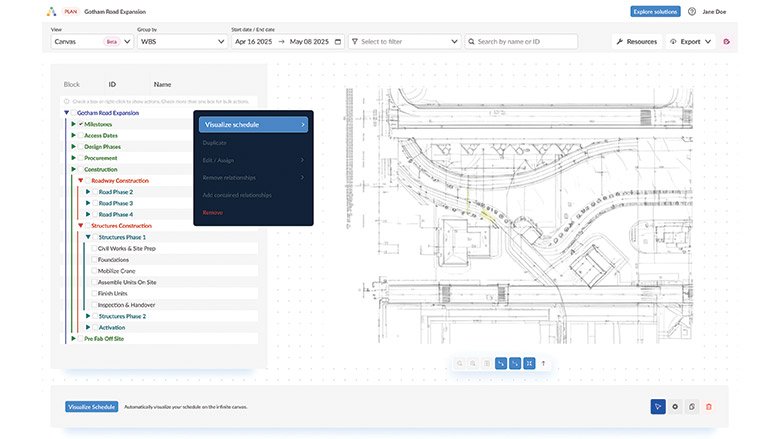
Generative scheduling is an optimization engine that pairs recent advances in analytics with established Lean construction methods. The team that defines the build, describes how each element gets built through resource-loaded recipes, and lets the algorithm test millions of sequence, resource, and method combinations. Solutions, like ALICE Technologies, return a cost- and duration-optimized plan with the trade-offs around it, running alongside construction project management tools such as BIM, Last Planner, and Primavera P6.
For example, an EPC stress-tested its baseline before mobilization on a large civil infrastructure project and found rate-limiting resources in the forms of a specialty crew, a class of heavy equipment, and a long-lead procured item. The engineer-procure-construct contractor exposed the project to about 10-plus months of risk against client milestones, priced the delay as a fully loaded cost line, and used the findings to justify buying the additional resources up front. The investment was approved, the risk retired before mobilization, and significant cost savings achieved.
Elsewhere, a global data center developer cut roughly 40% from a baseline construction schedule by clearing redundant logic and resequencing. On pipeline, industrial-turnaround, and mining-expansion work, teams have compressed schedules by 15 to 20%.
What Owners and Contractors Should do Differently
For owners, treating planning as something you buy from the EPC is becoming increasingly risky. The EPC is paid to optimize within its own scope, while the owner carries the full business case which may be impacted by multiple scope items. Without an independent planning capability, an owner cannot pressure-test a schedule submission, model a trade-off, or judge a change order on its own terms.
For EPCs, the constraint is capacity. Senior planners are among the scarcest skills set in the industry. Most of their hours go into producing and updating the contractual Gantt chart, which leaves little room to explore alternatives and continuously improve. With generative scheduling, the engine can help explore options, while planners refine them. As a result, owners and EPCs can reimagine their planning process end-to-end, building on the technology advancement generative scheduling enables.
As part of the process, generative scheduling removes excess scope, with lower risk than adding resources, maximizes opportunities for parallel work, and adds crews, shifts, or equipment, in that order. The cumulative result is schedule compression.
Why First-Movers Will be Rewarded
The operations principles on which generative scheduling is based are decades old, and the optimization process is well understood. Indeed, the technology runs on many live projects today. What has been missing up to now is the will to treat planning as a core capability rather than a compliance task, and the discipline to bring more generative tools, construction expertise, and field data into one system.
Owners that achieve this are at a significant and increasing advantage, with a defensible business case, an independent read on execution risk, and trade-offs settled with data and not guesswork. EPCs get schedule compression their competitors struggle to match. If planning is the construction industry’s biggest solvable problem, it is also its biggest opportunity.
McKinsey has an alliance with ALICE Technologies, whose generative-scheduling engine underpins several of the deployments referenced here. Mark Pitcher is a partner at McKinsey & Company; René Morkos is founder and CEO of ALICE Technologies; and Tim Drake-Brockman is asset leader of McKinsey’s Capital Analytics group
Source: www.enr.com



