
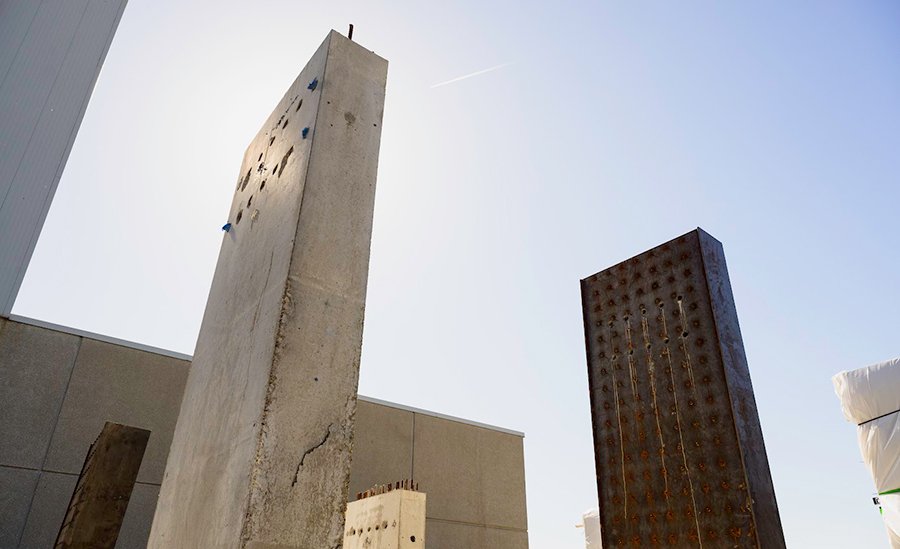
A one-third-scale mock-up of a nuclear power plant containment vessel and surrounding reactor building planned at Purdue University will test using steel-plate composite construction for small modular reactors—a method more commonly associated with constructing tall buildings than nuclear power plants.
Amit H. Varma, executive director of the Purdue Applied Research Institute that will assess the mockup, says the new twist is that researchers plan to combine functions of a conventional steel containment vessel and a separate protective shield building into a single steel-plate composite structure.
He likens the approach to a sandwich that has two steel plates on the outside and thick concrete on the inside.
“The [containment vessel] becomes very expensive because it must be built with the highest level of quality,” Varma says. “We are proposing (to) leverage this construction technology to make a better containment vessel.”
Steel-plate composite construction was used in construction of Plant Vogtle nuclear plant Units 3 and 4, completed in Georgia in 2024, but the proposed method would integrate pressure containment and protective shielding into one structure, potentially simplifying construction, and cutting costs and schedules for future SMRs, he says.
The 24-month project is primarily funded by the U.S. Dept. of Energy’s Office of Nuclear Energy, which is providing up to $27 million.
Addressing Reactor Challenges
Looking for quick answers on construction and engineering topics?
Try Ask ENR, our new smart AI search tool.
Ask ENR →
Information gained from the mock-up is intended to address major challenges in SMR construction, including cost certainty, schedule reliability and optimizing quality requirements, Varma says.
“Steel-plate composite has the potential to cut the construction schedule on site by up to 50% by eliminating schedule-critical and labor-intensive processes such as assembly of rebar cages, and assembly and removal of formwork,” he says, adding that steel modules will be manufactured at the university and transported to the site already assembled, erected and filled with concrete.
Researchers also plan to test other advanced construction techniques, including robotic and automated welding, and artificial intelligence-assisted welding and nondestructive evaluation and inspection methods. Digital engineering tools and digital twins will help monitor construction quality and identify imperfections or flaws as work progresses.
Steel-concrete composite construction is attracting increased industry interest, says Joelyn Hansen, a spokesperson for Idaho National Laboratory’s National Reactor Innovation Center, a federal research site. She notes that two SMR vendors have submitted designs using steel-concrete composite construction to the U.S. Nuclear Regulatory Commission for review.
“Regulators and industry reviewers consistently express the desire to see [the containment vessel] built and demonstrated at scale, addressing concerns about constructability, inspectability and structural performance,” Hansen says. “This project addresses that gap by a scaled construction mockup, integrity test and deconstruction demonstration of a generic [vessel] and associated reactor building.”
The project will use high-flow or self-consolidating concrete, eliminating the need for vibration during placement and further reducing on-site workforce needs, thereby addressing the shortage of experienced, qualified craft workers in the U.S. nuclear power sector as it evolves from recent decades when there was relatively little new construction, Varma says. Both structures will use generic, nonproprietary designs representative of SMR technologies now being considered for domestic deployment.
Hands-On Experience
The Purdue mockup will provide construction workers with hands-on experience and opportunities to gain qualifications. Researchers also plan to document construction activities through videos, digital twins and other materials that can be used to train future workers.
In addition, “Purdue students are an integral part of the project as graduate research assistants and undergraduate research interns,” Varma says. “They will participate in most aspects of the project, and will get the opportunity to work hands-on as well.”
The project will involve SMR vendors, engineering-procurement-construction firms, steel producers and suppliers, fabricators, erectors, concrete producers, contractors, quality assurance and quality control inspectors and regulators. The collaboration is intended to improve coordination among industry stakeholders while evaluating construction methods that could be applied to multiple reactor designs.
Steel fabrication and erection contractors will be selected through a competitive bidding process that will include nuclear-qualified and commercial steel fabricators to help broaden the potential supply chain. The Idaho national lab will manage the project, with the Purdue research institute primarily responsible for fabrication and construction, Hansen says.
Data collected from the mockup, which will be built outdoors on Purdue’s campus to reflect real-world conditions, will be publicly available to help contractors and other industry participants better estimate costs, schedules and construction requirements for future projects, Varma says.
“That’s why the mockup is so important. It will actually generate real data, real cost of materials, real cost of fabrication, real cost of erection and real schedule information,” he says.
Although the project focuses on SMRs, researchers expect the findings to apply to other nuclear power plants, including large advanced light-water reactors and smaller microreactors.
The project team also includes the Electric Power Research Institute and Nuclear Energy Institute.
Source: www.enr.com



