
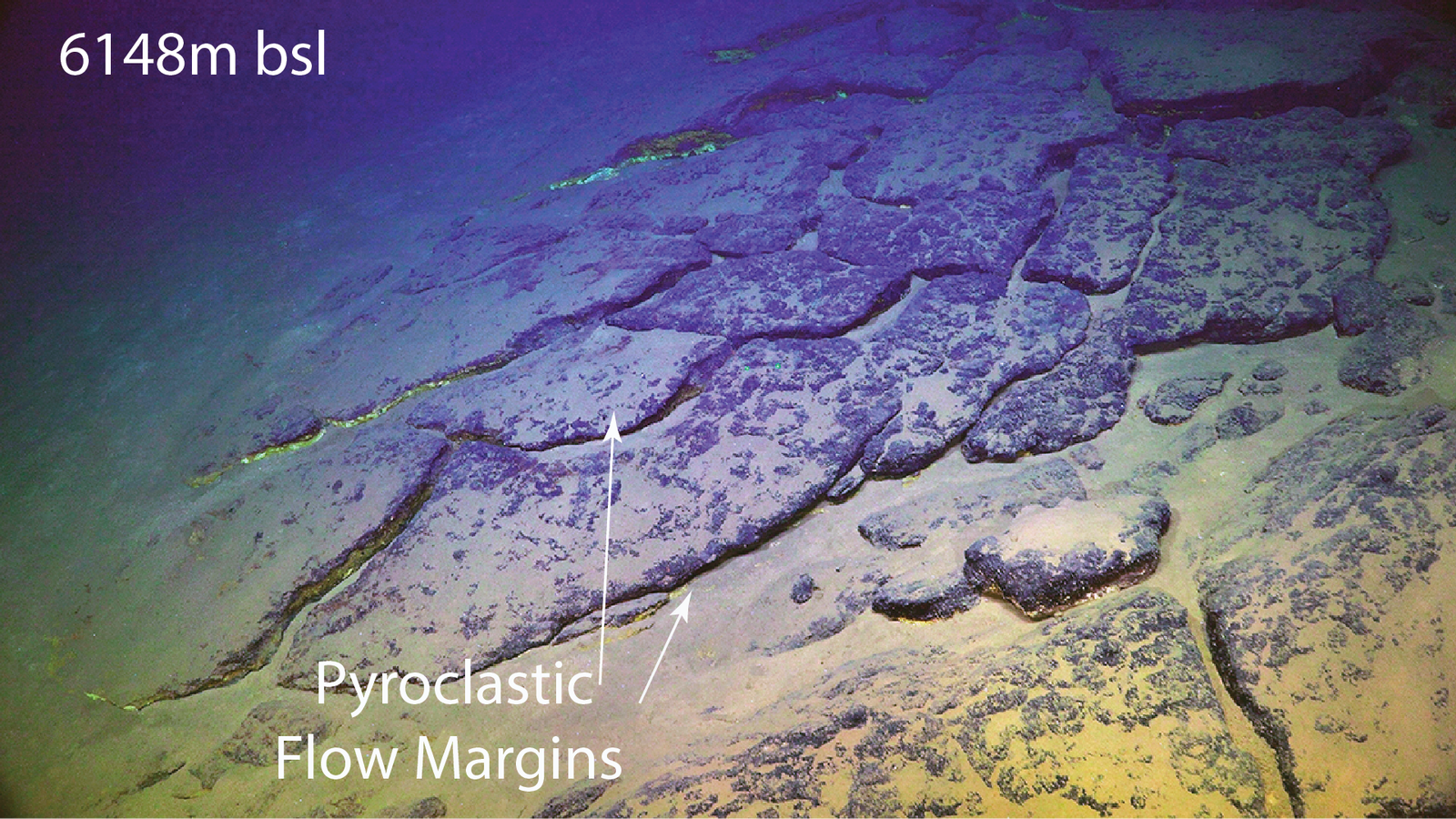
A submersible mission to the deepest ocean trench on Earth has made a shocking discovery: the deepest pyroclastic volcanic flow ever found on the planet, in a place geologists didn’t expect to see any volcanic activity.
This evidence of a violent undersea eruption was found 20,000 feet (6,000 meters) below the ocean surface on the walls of the Challenger Deep, the deepest point of the Mariana Trench and the deepest part of the ocean. It was a “complete surprise,” said Robert Stern, a professor emeritus of geosciences at the University of Texas at Dallas and first author of a new study describing the discovery.
Typically, volcanic activity doesn’t occur that close to an ocean trench, Stern told Live Science. And given the site’s extreme depth, the lava that made the flow must have had some very strange chemistry. Normally, the intense pressure of seawater at these depths would prevent an explosive eruption, instead favoring a goopier, seeping type of flow. But the flows seen on the edge of the Challenger Deep were similar to the explosive, roiling gases that coated Pompeii in ash in A.D. 79.
Latest Videos FromLive Science
“It’s not something that as a geoscientist I would have said would be predicted,” said Sune Nielsen, a geochemist at the University of Lorraine in France who was not involved in the study. “Very far from it.”
A fish in the genus Pseudoliparis in an image taken during during a dive by the Jason/Medea ROV at 20,659 feet (6,297 m).
(Image credit: Image by Dr. Tomoyo Okumura, taken as part of Cruise TN438, supported by the National Science Foundation)
The deepest place on Earth
The Challenger Deep is in the remote western Pacific at the southern end of the Mariana Trench. There, the Pacific oceanic plate pushes under the Mariana oceanic plate in a process called subduction. At the trench where the two plates meet, the ocean floor plunges down 6.8 miles (10.9 kilometers). Mount Everest could fit in the chasm, with room to spare.
Geoscientists aren’t sure why the trench is so dizzyingly deep, but they have turned up some clues. For instance, there is a tear in the Pacific Plate that allows one narrow strip of the plate to subduct particularly rapidly. The curvature of the plate is also very steep, perhaps because the rocks of the Mariana and Pacific plates aren’t very strongly connected to each other, allowing the Pacific Plate to dive steeply and flex freely.
The new findings, reported Monday (Nov. 23) in the journal Frontiers in Earth Science, suggest that volcanism and magma also may play a role, Stern said. The researchers were exploring a segment of the Challenger Deep’s forearc, a roughly 120-mile-wide (200 km) expanse that sits between the trench itself and the volcanic arc created by the subduction zone. These volcanic arcs are standard subduction zone features; for example, Mount St. Helens and Mount Rainier are part of the volcanic arc of the Cascadia subduction zone in the Pacific Northwest.
Get the world’s most fascinating discoveries delivered straight to your inbox.
But though there are some volcanoes north of Challenger Deep along the Mariana Trench, the Challenger Deep segment of the trench is odd in that there is not an organized volcanic arc there. Instead, there’s an ocean ridge. Regardless, the space between this ridge and the trench was expected to be volcanically quiet because there is not usually enough heat in that region of a subduction zone to melt magma.
Nevertheless, the cameras on the deep-diving remotely operated vehicle Jason/Medea, which went to the site in 2014, caught strange, pancake-like rock features at three different spots in a 60-mile (100 km) stretch of the trench. Samples brought on board the ship revealed rock embedded with volcanic glass and a pyroclastic flow texture.
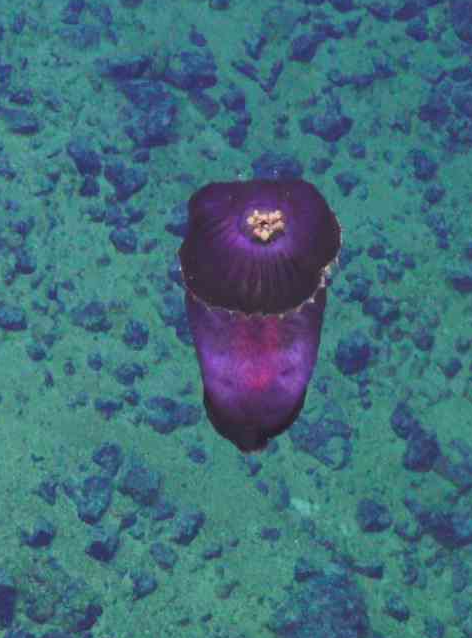
A sea cucumber in an image from the Jason/Medea dive at 12,726 feet (3879 m).
(Image credit: Image by Dr. Tomoyo Okumura, taken as part of Cruise TN438, supported by the National Science Foundation)
New mysteries
The researchers are currently getting the rock dated, but volcanic glass usually erodes quickly in the ocean, Stern said, so the presence of glass suggests the eruptions were fairly recent. “They’re not yesterday,” he said, “but I don’t think they’re a million years old.”
The pressure of the water at the depths of the flows is equivalent to 592 atmospheres of Earth stacked on top of one another. Typically, that kind of pressure keeps a lid on the dissolved water and carbon dioxide in magma that expands rapidly to cause explosive eruptions. Thus, Stern said, the eruptions by the Challenger Deep may have been driven by a supercritical fluid — a weird state sort of in between a gas and a liquid.
“We just don’t know how those magmas will behave at those water depths,” said Stephen Self, a volcanologist at the University of California, Berkeley, who was not involved in the study.
The mission’s observations also suggest that the crust of this region is extending, or stretching, in two different ways. To the east, the stretch is caused by a mechanical pulling apart of the crust. To the west, volcanic eruptions are stretching the crust. It’s a perplexing finding, Nielsen said, without a clear explanation.
Stern and his colleagues suspect that the two plates are starting a new subduction zone in this western part. That would be an exciting finding; subduction zones move around over tens of millions of years, and researchers don’t know much about how new ones start. The geochemical studies of the rocks that Stern and his team pulled up could answer questions about where the lava that made the pyroclastic flows came from and why this bizarre region can generate magma where none should be.
“This region is really, really unusual for our planet, and there is quite a bit of, ‘What, really? Wait, how is that? OK, yeah, I guess maybe.'” Nielsen said. “So obviously, I find it super interesting.”
Stern, R. J., Pujana, I., Anderson, M. K., Chin, E., Dygert, N., Harigane, Y., Le Roux, V., Leybourne, M., Ohara, Y., Okumura, T., Segee-Wright, G., & Etheridge, E. (n.d.). ROVing in the deep: Tectonic and magmatic complexities of the challenger deep forearc segment, southern mariana convergent margin. Frontiers in Earth Science, 14, 1929806. https://doi.org/10.3389/feart.2026.1929806
What do you know about the deepest place on Earth? Find out with our Mariana Trench quiz!
Source: www.livescience.com