
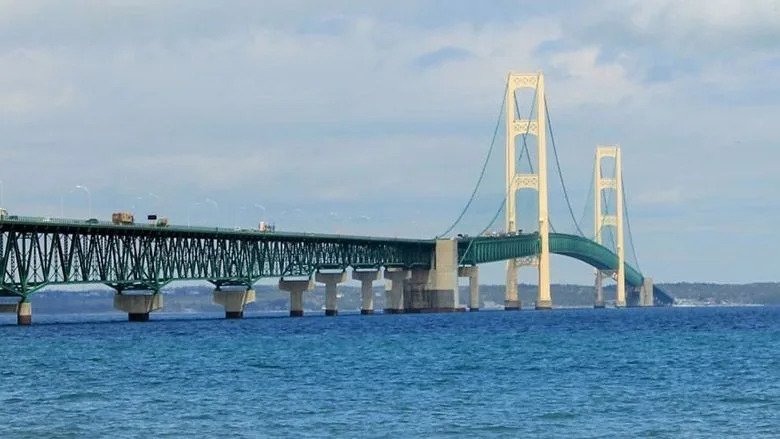
Michigan Gov. Gretchen Whitmer (D) has directed the state Dept. of Environment, Great Lakes and Energy to suspend further action on resource and pending wastewater permits for a 4-mile-long tunnel proposed by energy developer Enbridge beneath the Straits of Mackinac in the state’s northern area that would enclose a replacement segment of its Line 5 oil and natural gas liquids pipeline.
The directive follows a Michigan Supreme Court decision on July 31 that vacated state siting approval for the project and returned it to regulators for further review.
“I have always said my ultimate goal is to get Line 5 out of the water,” Whitmer said in a Nov. 24 statement. “Just one spill threatens irreparable damage to our water, our economy and our way of life.” The ruling introduced significant delays and uncertainty for the project, including the time Enbridge would need to seek renewed approval from the Michigan Public Service Commission, she said.
Jocelyn Benson, Michigan’s Democratic secretary of state, also is governor-elect and will replace Whitmer on Jan. 1, 2027, but she has not explicitly committed to shutting down or opposing the proposed pipeline. Benson said during her campaign that she would explore all options to protect the Great Lakes and diversify Michigan’s energy supplies and also advocated for a statewide audit of aging pipelines including Line 5.
Responding to the pause, Enbridge spokesperson Ryan Duffy noted in a statement that the review process was thorough and that the state had issued permits in July 2026 and in 2021. “Both permitting rounds included detailed technical reviews, public meetings, hearings, and consideration of thousands of public comments,” he says. “They also involved extensive interaction between Michigan’s tribal leaders and state agencies.”
A six-justice court majority reversed a Michigan Court of Appeals ruling, vacating the commission’s December 2023 approval and remanding the case for further proceedings. The court found that the commission had not properly applied the Michigan Environmental Protection Act in reviewing the proposed replacement segment.
In September, Whitmer said the state needed to consider the impact of the ruling on resource permits issued for the project. At the same time, she also sent a public letter to Enbridge CEO Gregory Ebel urging the company to pursue an alternative to the existing twin pipelines and proposed tunnel.
“Multiple energy supply-chain experts have concluded that, with sufficient notice and an orderly transition, the market can adapt to a Line 5 shutdown without significant supply shortages or price hikes,” Whitmer wrote. “An alternative solution can be months away. But Enbridge must act.”
While construction has not proceeded, the U.S. Army Corps of Engineers issued a permit Aug. 12 for construction of the tunnel, which would replace a segment of the 645-mile pipeline that extends rom Superior, Wis., to Sarnia, Ontario.
The line has operated under a state easement granted in 1953. Michigan revoked the easement in 2020, and ordered Enbridge to cease operating the dual pipelines beneath the straits. The company refused to shut down the line, and a federal court ruled in December 2025 that Michigan could not enforce the shutdown order. The state is appealing that decision.
Enbridge has faced other setbacks related to the Line 5 pipeline—recently including damage on another portion of it that occurred in August when an unoccupied subcontractor’s flatbed truck rolled into an open excavation near Saxon, Wis. It struck a valve that caused the release of about 1.3 million gallons of natural gas liquids, prompting a major cleanup and ongoing investigations. Enbridge estimates costs related to accident cleanup and property damage and repair at about $15.1 million.
The company’s Wisconsin portion of pipeline crosses land owned by the Bad River Band. Enbridge is in the process of building a 41-mile, 30-in.-dia section to bypass the tribal land.
Three separate fires were reported on the Wisconsin pipeline and at an Enbridge office in September and October. The FBI is investigating, but a cause or perpetrators have not yet been identified.
Whitney Gravelle, president of the Bay Mills Indian Community, which opposes the project, applauded Whitmer’s directive, but said the project’s future is still uncertain.
“This decision is not the finish line. Our responsibility to protect the Great Lakes does not end with a pause in permitting,” she said.
Source: www.enr.com



