
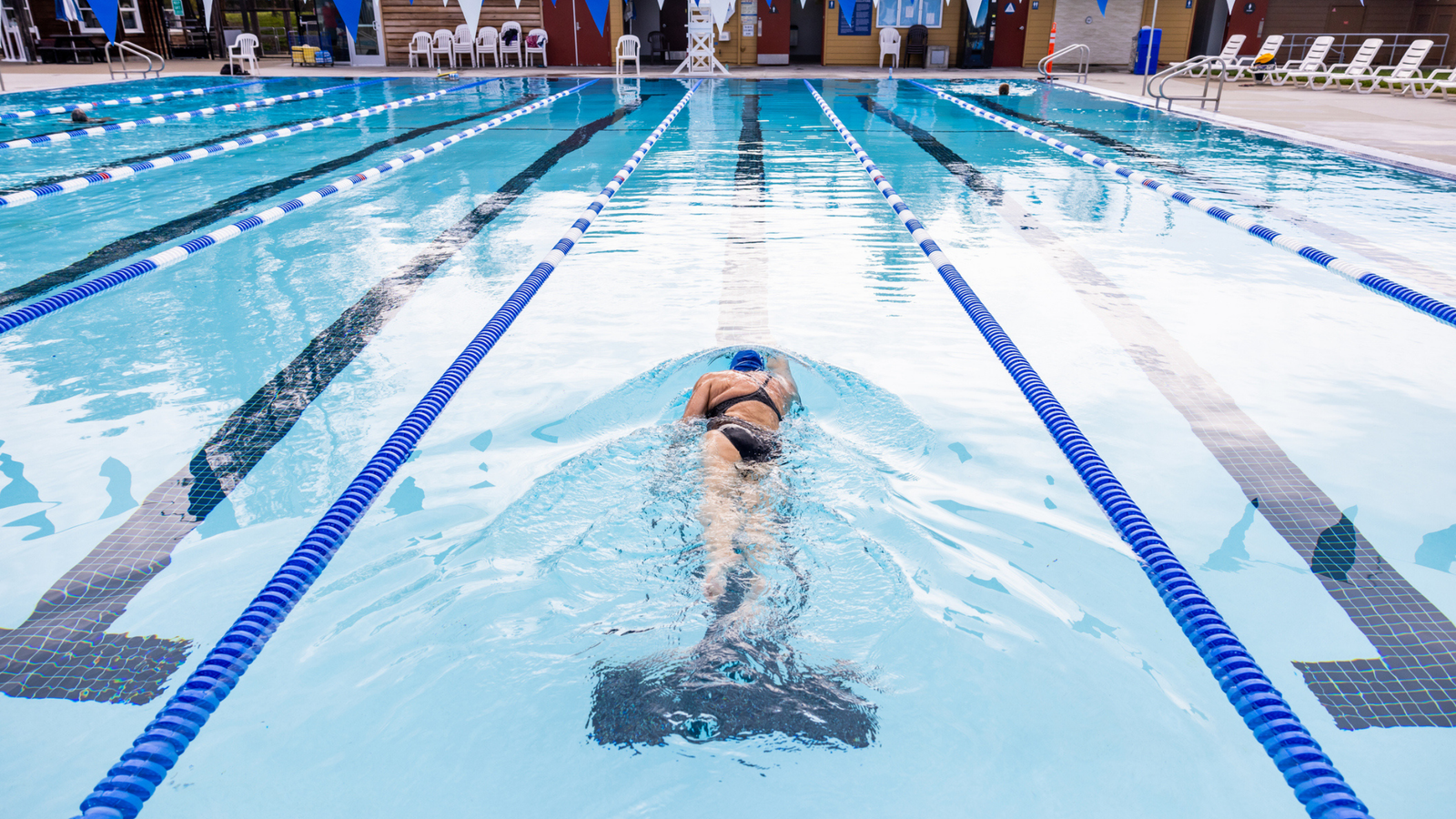
Stop kicking from the knees and start swimming from the hips. This drill will help you become a fast, efficient, and powerful triathlon swimmer.
(Photo: Getty Images)
Published September 2, 2026 06:00AM
For this article, Triathlete spoke to a 25-year triathlon coaching veteran and a physical therapist to learn the keys to an efficient triathlon swim kick, and a drill to improve it.
If we had to describe the relationship between triathletes and their swim kick, we all know the only descriptor that fits is: “It’s complicated.” But you don’t have to suffer – know that with this relationship there is something you can do to help it. Read on to learn what you’re likely getting wrong, and what you can do to fix it.
What most triathletes get wrong
When it comes to the swim kick, Marilyn Chychota, a coach who has spent more than 20 years working with endurance athletes, sees the same two failures at opposite ends of the spectrum: athletes who kick far too much and burn through energy they’ll want later, and athletes who barely kick at all because they’ve been told to protect their legs.
Between those two is the technical error that undoes both groups: kicking from the knees.
“An effective freestyle kick begins at the hips, with relaxed knees, loose ankles, and relatively small movements,” Chychota says.
A knee-driven kick is a shorter lever doing more work for less return, and it does something worse than failing to propel you: It creates drag. Your lower legs swing down out of the slipstream, your hips sink to compensate, and now you’re dragging a wider profile through the water than you were before you started kicking.
Chychota also flags ankles, which is where most triathletes are quietly disqualified. Years of running build stiff, stable ankles, which are excellent for propulsion on land and terrible for the loose, plantar-flexed foot a good kick requires. What you want, she says, are feet held long and near the surface, toes pointed with big toes lightly touching, providing rhythm and balance.
The reason these errors persist is instructive. Triathletes tend to focus on upper-body propulsion, or they watch experienced distance swimmers kick sparingly and copy the reduced kick rate without first building the technique and body position that make a small kick viable. The pros aren’t kicking less because kicking doesn’t matter. They’re kicking less because their body position doesn’t require them to.
Should triathletes kick at all?
Yes — just not the kick you’re picturing.
“Triathletes should kick, although they do not usually need the large, powerful kick used by a sprint swimmer,” Chychota says. What she advises instead is a compact, relaxed, sustainable kick that supports body position, balance, and stroke rhythm without cooking the legs.
That kick isn’t a fixed setting; it’s more of a dial that should be light during steady-state swimming, then turned up when you need it, such as when you’re accelerating off the start, working through congested water, coming into a buoy, or closing out the last 200 meters and wanting to get some blood into your legs before getting vertical.
Chychota also points to the open-water demands the pool never prepares you for, such as sighting higher, fighting currents, getting clear of the scrum at a turn buoy, all of which take a kick you can call on.
“The aim is not to exhaust the legs,” she says. “It is to make the entire stroke more stable and efficient.”
What the kick is actually for
Here’s the reframe that makes the rest of this make sense: Your kick is only incidentally about propulsion. Its real job is holding your hips and legs near the surface, which reduces drag and gives your upper body a stable platform to work from. It also underwrites your rotation – it’s what times and connects the movement of hips, torso, and arms.
Take it away, or mistime it, and you’ll likely feel your whole stroke degrade. It becomes hard to feel stable in the water, and your legs are scissoring side to side. You might also find that your breathing gets rushed and your arm recovery feels sloppy, largely because both are now happening on a foundation that’s moving. This is exactly why the notion of not kicking and “saving your legs” tends to be a false economy. A dropped-hip swim is a harder swim. You’ll spend the energy either way – you just won’t get a better body position for it.
How to fix it
- Start with hip mobility: If your hip flexors and hip joint don’t move well, you’ll struggle to get your kick to originate from your hips, and then your lower back absorbs what your hips won’t do. Focus on mobility first, then the strength to hold it for a full session.
- Build rotary core strength: Without it, you’ll lose energy in transfer. The kick should always start at the hip. Bird dogs and supine trunk rotations both build the anti-rotation control you might be missing.
- Don’t skip the ankles: If you’ve been running for a long time, you’re likely stiff through the ankles. Add ankle mobility work and consider short fin sets to teach your ankles how to move. You can’t hold a long, pointed foot you don’t have the range for.
Pool drill: 500-meter kick-focused repeats
Chris Ingstad, P.T. and physical therapy educator, recommends this session to fix an inefficient swim kick.
Once you’re warmed up, swim 200 meters freestyle, then 200 meters backstroke. Both demand a functioning kick to hold momentum – backstroke in particular will tell you the truth about yours.
Then do 100 meters with the kickboard, and no big splashes. Think about kicking from the hip, not knee; your feet should stay just under the surface. Reach your arms as far forward as you can on the board and let the rotation happen – you should feel a slight trunk rotation with each kick. Start with big, powerful kicks for the first 50 meters, then switch to quick, shallow kicks for the last 50 meters.
Repeat the cycle three to five times for a total 1,500–2,500-meter session.



