
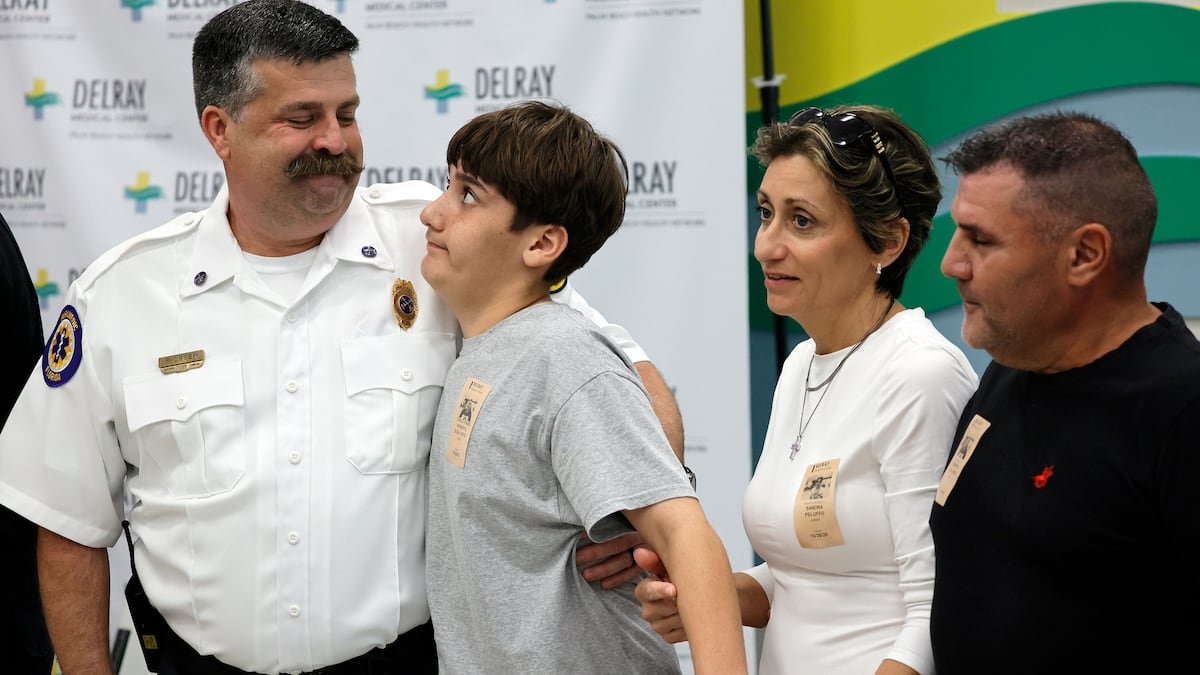
Paul Leser has responded to five or six lightning-strike incidents during his time with Palm Beach County Fire Rescue. None of the victims lived.
Not until two months ago, when 14-year-old Kevin Sosa was struck while playing soccer in Boynton Beach.
Leser, who was the on-call EMS captain during what he described as the “chaotic” moment of Sosa’s rescue, credits the teen’s survival to the CPR his father administered on the scene — compressions the man had learned from watching TV.
“It was amazing — amazing,” Leser said about Roberto Sosa’s actions. “There’s what’s called the chain of survival, and the first link is bystanders. Without that …” Leser shook his head.
The teen’s father sat beside his son at Delray Medical Center on Wednesday as they visited and thanked the fire rescue, EMS and medical teams involved in his care. Earlier this month, some of them visited the family at their home the day Kevin Sosa was released.
Speaking through a translator, Roberto Sosa grew emotional while describing the moment of the strike. The two were playing soccer with a group in a field at Sea and Sand Mobile Home Park on Aug. 23 when the sky grew cloudy and a light drizzle began.
The snap of lightning came out of nowhere. Roberto Sosa turned around and saw his son on the ground, not responsive. His wife, who actually saw the lightning strike her son, began screaming, begging him not to leave them, he said.
Roberto Sosa turned his son over and realized he wasn’t breathing. He couldn’t hear a heartbeat, so he began doing CPR. Soon, his son’s pulse returned, and they saw some color creep back into his face before medical responders arrived.
“He has no way to express how thankful and how grateful he is for everything that was done by the fire department, the police and the hospital here in Delray,” Roberto Sosa said through Pedro Gonzalez, the trauma surgeon translating for the Spanish-speaking family.
Roberto Sosa often took long pauses while recounting the incident and paused to wipe his eyes. To his left, his son leaned against his mother, Sandra Peluffo Sosa. She refused to leave the Delray facility for nearly the entire month her son was there, not wanting to miss the moment he woke up or said his first words, hospital staff said.
Roberto Sosa doesn’t have a medical background. He learned how to do chest compressions from TV shows, he said.
More parents should take his lead, said Peter Antevy, a pediatric emergency medicine physician. Family members, particularly in the U.S., often hesitate to administer CPR on their own children, he said.
Although CPR administered immediately after cardiac arrest can double or triple a person’s chance of survival, according to the Red Cross, only about 40% of people who go into arrest receive bystander care.
Palm Beach County responds to about 750 cardiac arrest victims per year, and only one in 10 survive, Antevy said. The department has worked to close that gap by moving away from the “scoop and run” method, where a child is immediately rushed to the hospital. Instead, responders bring them back to life on the scene.
But the one piece Antevy’s team can’t always control is bystander response. Ideally, CPR is administered within the first one to two minutes, before brain damage begins.
Antevy correlates low intervention rates with education. In the U.S., parents must go through an hourslong course to become CPR-certified, which makes them think the procedure is more complicated than it is, he said. In reality, just watching a 30-second video — or TV shows, in the Sosas’ case — can make a difference, he said.
Instead of calling and waiting for medical responders, Antevy said a bystander should begin CPR immediately.
“We’ve kind of told people, ‘Call 911,’” he said. “In reality, they should do what Roberto did, which is just do what you think is right.”
Kevin Sosa is now on his way to recovery. He greeted some of the first responders who gathered to see him Wednesday by patting their bald heads or giving quick hugs. Several of his former nurses also visited, some on their day off.
At one point, Kevin Sosa lifted his gray T-shirt to reveal the scar that now stretches from where the lightning entered his left chest to where it exited his body from his shoes.
His mother held photos of the Messi soccer cleats he was wearing, which are now part-charcoal. But the near-death experience hasn’t affected Kevin Sosa’s enthusiasm for the sport.
“I’m going to play soccer after this,” he said.
Lightning strikes on people are rare, and fatalities are even more uncommon. Fewer than 25 people in the U.S. die each year after being struck, according to the National Weather Service. This year, there have been 16 deaths as of October.
Six of those deaths took place in Florida. That includes a mother and 2-year-old child who died Aug. 23 in Broward County, the same day Kevin Sosa was struck.
Candace Pineda, the hospital’s trauma program manager, said Kevin Sosa still goes to physical therapy three days per week. He had to retrain his muscles to learn how to walk, talk and use his hands and feet. Like other lightning-strike victims, he could also experience muscle spasms, pain, trouble speaking and behavioral changes.
But just two months after the strike, Kevin Sosa is now sleeping more easily, she said. He’s homeschooled for now, but his team is hoping he can return to school soon. He had just started ninth grade when he was struck, and he turned 14 one week into his hospital stay.
Pineda has treated lightning-strike victims before, she said. Children like Kevin Sosa are made of more water, and his youth means he’s more flexible with still-growing cells. All that means he has a stronger chance of recovery than an adult might, she said.
“He gets tired. He’ll kind of lean forward as his muscles kind of tense up, and he gets some pain sometimes,” Pineda said. “But he’s sleeping better, and as long as he eats food, as long as he’s doing the therapies, he’ll continue to get even better.”



