
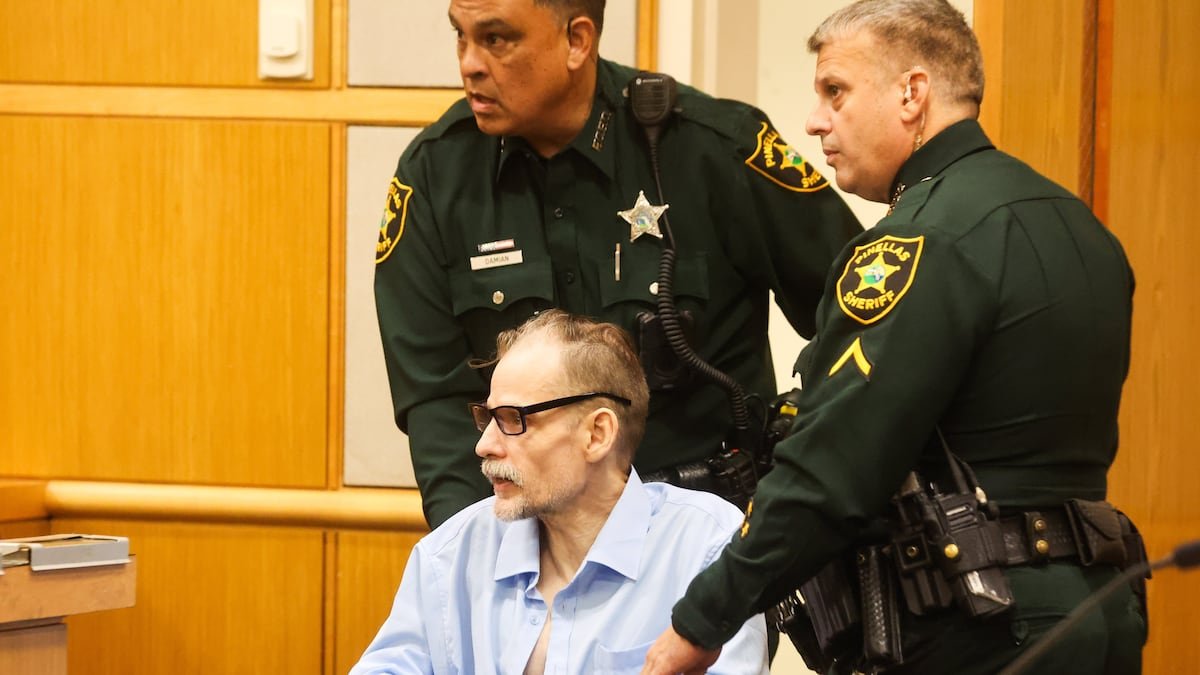
As deputies led Brandon Hitteman into a courtroom on the first day of his murder trial, the frail man began yelling.
“I need a hospital, I need a hospital, I need a hospital,” he shouted. “I don’t feel well, I can’t do this today. I’m terminal, I have a terminal illness. I don’t feel well, I’m dying here.”
His light blue button-down was half undone, exposing his chest. Deputies managed to maneuver him over to the defense desk. Hitteman, 49, immediately collapsed onto the wooden table.
“Folks, I need the emergency room. I need morphine,” he continued hollering. “Your Honor, I need the emergency room, I don’t feel well.”
The judge told deputies to escort him out and have the jail nurse evaluate him. His muffled wails were heard minutes after the door closed.
Hitteman is charged with first-degree murder in the 2002 fatal beating of his girlfriend in a St. Petersburg boarding house. Soon after his arrest, he was found incompetent to stand trial and sent to a state hospital.
What followed were two decades of involuntary commitment to mental health facilities and repeated travel to the Pinellas courthouse for hearings to determine whether he was fit to stand trial. Thirty doctors have evaluated Hitteman in the last 24 years.
Hitteman was returned to the Pinellas County Jail in 2018 after the Florida State Hospital wrote a letter to authorities, saying he “no longer met the criteria for involuntary commitment.”
In 2019, a Pinellas judge ruled that Hitteman was competent to move toward trial. The decision was made after five doctors testified that Hitteman was faking his psychosis.
Over the years, records show, Hitteman has penned letters to the court accusing jail staff of poisoning his food and insisting that his girlfriend had been working for the FBI. Last week, he wrote that his lawyer “is going to kill me.”
On Tuesday morning, Pinellas Circuit Judge Christopher LaBruzzo affirmed the conclusion that Hitteman was sound enough for trial. Out of the jury’s earshot, LaBruzzo told the lawyers they could move forward with opening statements.
“I’m noticing a distinct pattern of what I would call intentional acts to disrupt,” LaBruzzo said. “He knows what’s going on, but he’s intentionally choosing to not participate.”
In a locked courtroom two doors down, Hitteman watched his trial begin on a TV screen.
Prosecutors describe a grisly scene
In the fall of 2002, Hitteman met Pamela Berkebile at Boley Centers, a St. Petersburg mental health facility. They quickly began dating and moved in together at his grandfather’s trailer park.
That October, they rented an apartment at the Harvest House Hotel in downtown St. Petersburg. The couple lived in the only unit on the top floor of the boarding house, according to testimony.
Shortly after midnight on Oct. 15 that year, Hitteman called 911. He said his girlfriend wasn’t breathing.
When St. Petersburg police arrived, they found what appeared to be blood stains on the living room floor, on the wall of the bathroom, on the floor of the closet. Berkebile, 34, lay flat on her back in the middle of the room, with bruises on her arms and legs. Her face was purple and too swollen to decipher, according to photos shown to the jury.
In his opening statement, Assistant State Attorney Richard Ripplinger said the killing was premeditated.
“She had so much injury that she had a broken skull, she had a brain that was bleeding, her eyes were swollen shut,” he told the jury. “This was a prolonged, vicious death.”
Defense attorney Andrew Crawford argued that the state did not provide a motive for the killing.
“This is not the case of a cold, calculated, premeditated intent to murder someone,” he said in his opening statement. “The evidence will demonstrate a complete lack of intent to kill.”
Crawford asked jurors why Hitteman would call 911 if he planned the attack. Or why he agreed to go to the St. Petersburg Police Department to speak with detectives.
When Hitteman spoke with detectives, Crawford said, he told them that Berkebile “conspired with a neighbor to inject his moles with hepatitis B.”
Crawford said the “very odd set of statements” Hitteman made were indicative of his state of mind.
“Please keep an open mind,” he implored jurors.
Because LaBruzzo ruled that Crawford could not use the insanity defense, Crawford is not allowed to tell jurors anything about Hitteman’s battles with incompetency.

Jurors hear what Hitteman told police
The state called several law enforcement officers Tuesday to testify about what they saw in the apartment that October night.
Thaddeus Crisco Jr. was the first officer on the scene. He said police were called for an “unintended death,” but the scene “appeared suspicious in nature.”
Crisco said Hitteman told him that night that he and Berkebile were “play wrestling” when she collapsed. Hitteman threw two cups of water on her because she was unresponsive and he thought she was faking it, Crisco said.
Hitteman told police he tried to give her CPR.
The last witness of the day was St. Petersburg Assistant Police Chief Michael Kovacsev. In 2002, he was the homicide detective who interviewed Hitteman at the station.
Kovacsev said he spoke with Hitteman for two hours that morning. Hitteman again said that he and Berkebile were wrestling. He also told the detective he punched Berkebile “several times in the face,” Kovacsev said.
After a few cigarette breaks, Kovacsev said he turned on the tape recorder. The rest of the interview was played aloud for the jury.
“What led us here today is I was told by Pamela that I was stuck with a needle,” Hitteman said. “I felt that something was going on because I had a hole in me on my knee.”
Hitteman told a disjointed story about Berkebile being “afraid to say anything” at first. He said their neighbor at the trailer park, named Robert Kennedy, had “convinced her to do it.”
“She said she had stuck me with a deadly disease that would kill me — hepatitis B.”
Once they moved to Harvest House, Hitteman said, Berkebile took back what she said about sticking him with the needle.
On the night of the killing, he said, he “hit her with a stick and she said she was going to come clean and tell me what happened.”
“She began to tell me that it didn’t happen and I got angrier. That’s when I choked her,” he said. “When I laid off of her, she was still conscious, she was still awake.”
Hitteman said he used a makeshift noose on her neck.
“I just wanted to know the truth,” he said. “I got some water and splashed some water on her and tried to wake her up. I tried to resuscitate her, and I could not do that successfully.”
Kovacsev asked Hitteman if he had been taking medication for his bipolar disorder. He said he hadn’t taken his medications for a week. At the time, he was prescribed a number of medications, including lithium, Risperdal and Zoloft.
At the end of the interview, Hitteman said Berkebile’s death was caused by his “overexertion.”
“I hope that somewhere in this lifetime I can learn to rehabilitate and never have things happen in life where I have to take things into my own hands,” he told Kovacsev.
‘Everybody’s against me’
During a break in testimony Tuesday morning, the judge asked for Hitteman to be brought back into the courtroom. The jail nurse who evaluated him said he was OK.
Deputies rolled him in on a wheelchair. Hitteman had his head in his lap and was swaying from side to side. His hair was wet from splashing water on himself in the holding cell.
“Everybody’s against me,” he told the judge. “I’m persecuted. They’re trying to kill me.”
He refused to answer LaBruzzo’s question about whether he wanted to watch the trial from the courtroom or go back to his jail cell. Deputies took him back to the locked courtroom down the hall.
Under Florida law, a person is deemed competent to stand trial if they can consult with their lawyer with a “reasonable degree of rational understanding.” They must also have an understanding of the charges they face and how courtroom proceedings work.
The trial is expected to conclude Thursday.



