
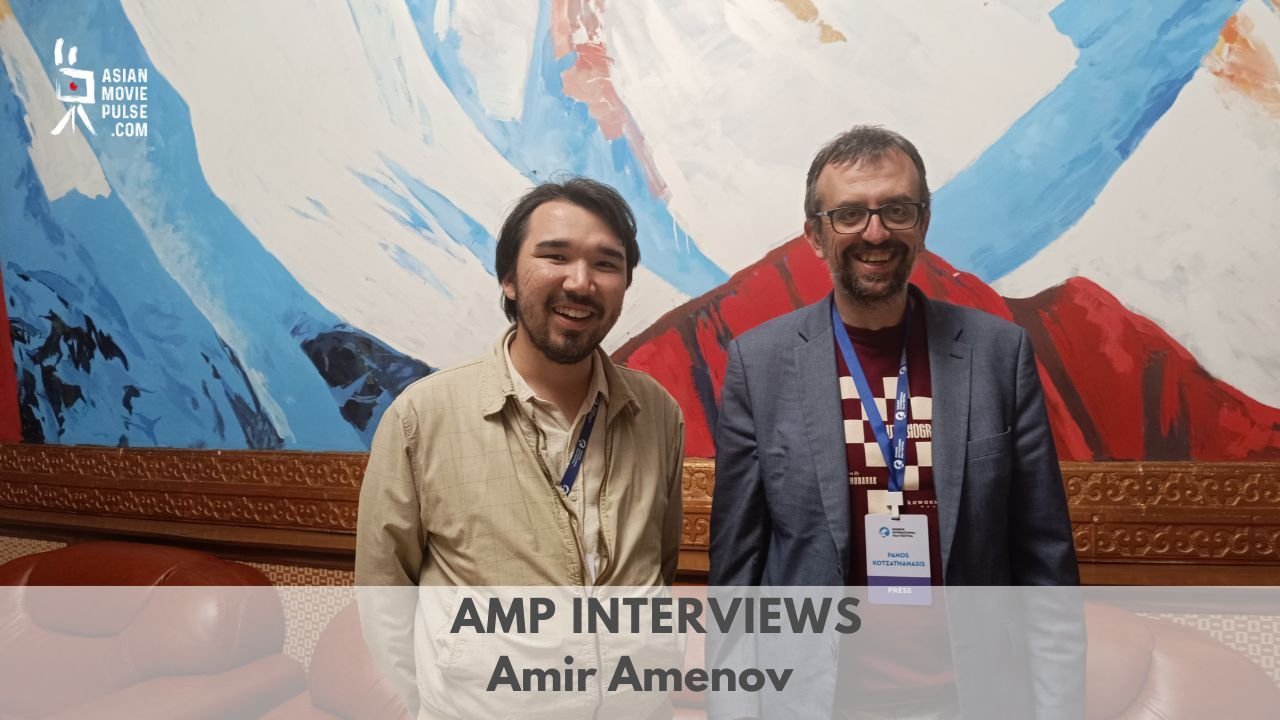
Kazakh filmmaker Amir Amenov spoke to Asian Movie Pulse during the Bishkek International Film Festival about two of his projects presented at the event: the nearly completed “Warm Night, Cold Beer” and the still developing “The Taste of Shawarma After a Tipsy Night.” The first was presented as a work in progress, while the second took part in the script development section.
“The Taste of Shawarma After a Tipsy Night” is a feature-length tragicomedy satire, although Amenov admits that the tone is still being shaped. The story focuses on the relationship between a provincial young man and an older woman from the city, who owns a gallery. However, as he explained, the project is not so much about love as it is about people pretending to be in love. In this sense, it continues a theme that also appears in his debut, where people fall in love not with real individuals, but with the images they create of them.
Amenov explained that, in his first work, the main character does not meet the person he loves in real life, but talks to her through telepathy and imagination. In “The Taste of Shawarma After a Tipsy Night,” the characters are physically present, but still perceive each other as images. For the man to like the woman, she has to fit a version of her that exists in his mind, while the same applies to how she imagines him. At the moment, the project remains in an early treatment stage, with Amenov having started the script twice, once reaching page 20 and another time page 25, while still trying to find its final direction.
The director also mentioned two main inspirations for the project. The first is François Truffaut’s “Stolen Kisses,” particularly the character of Antoine Doinel, whom Amenov sees reflected in many of his friends: men who are lost, constantly moving around, and unsure of themselves. The second and even more important inspiration in terms of tone and mood is Otar Iosseliani’s “Monday Morning,” whose irony and approach to everyday life seem to have had a strong impact on Amenov’s own sensibility.
The more advanced project, “Warm Night, Cold Beer,” follows three friends during one night of drinking together for what may be the last time. One of them is leaving for the army in the morning, while following a family tradition that says a man should first marry and then go to military service, just as his forefathers did during the Soviet era. Another has just been told by his wife that she wants a divorce and is trying to win her back. The third is involved in an impossible romance with a flight attendant, whom he has never met in real life, but with whom he communicates telepathically whenever her plane flies above him.
According to Amenov, the ambiguity of this last storyline remains part of the movie until the end. The audience can interpret the telepathic romance either as something real within the world of the story or as proof that the character may simply be losing touch with reality. In any case, the whole work is structured as a one-night story, while humor plays a central role in the director’s approach.
Speaking about comedy, Amenov emphasized how important irony is to him. He connected this again to his admiration for Otar Iosseliani, whose works often find irony in very small things. For Amenov, humor is not simply a stylistic choice but almost a necessity, since without irony, life would become too depressing.
Amenov also spoke warmly about Bishkek and the festival. Coming from Almaty, he described the city as close and familiar, adding that he and his producer had already brought “Warm Night, Cold Beer” to the first Bishkek International Film Festival, where they pitched it at the South Pitch platform. Three years later, the movie is now close to completion. He also noted that he draws inspiration from Kyrgyz colleagues and directors, mentioning the strong filmmaking tradition of the country.
“Warm Night, Cold Beer” is now in the final stages of post-production. According to Amenov, only a little work remains, including locking the sound and color correction. He hopes to complete the movie within one or two months and is already sending work-in-progress versions to festivals, with the aim of securing a world premiere this year.
The post-production process also involved international collaboration. Singaporean producer Jeremy Chua, who was Amenov’s mentor at the Asia Pacific Screen Lab, has been involved as an associate producer and has advised the team throughout the process and was the one who suggested Yov Moor as the colorist. Moor initially helped shape the visual approach through LUTs prepared before shooting, aiming for expressive color that matched the slightly hyperbolized nature of the story. When scheduling conflicts prevented him from handling the color work later on, the team collaborated with Kazakh colorist Nurtas Mukhamedbay, known for his work on Adilkhan Yerzhanov’s recent movies. After working from the original LUTs and further developing the visual direction, Mukhamedbay completed the current version of the color correction, with only small adjustments still remaining.
Through both projects, Amenov seems to be exploring love, illusion, friendship, and the small absurdities of everyday life, with humor and melancholy constantly intersecting. While “Warm Night, Cold Beer” is almost ready to begin its festival journey, “The Taste of Shawarma After a Tipsy Night” shows a filmmaker still searching, experimenting, and developing a personal tone that moves between romance, satire, and tragicomedy.



