
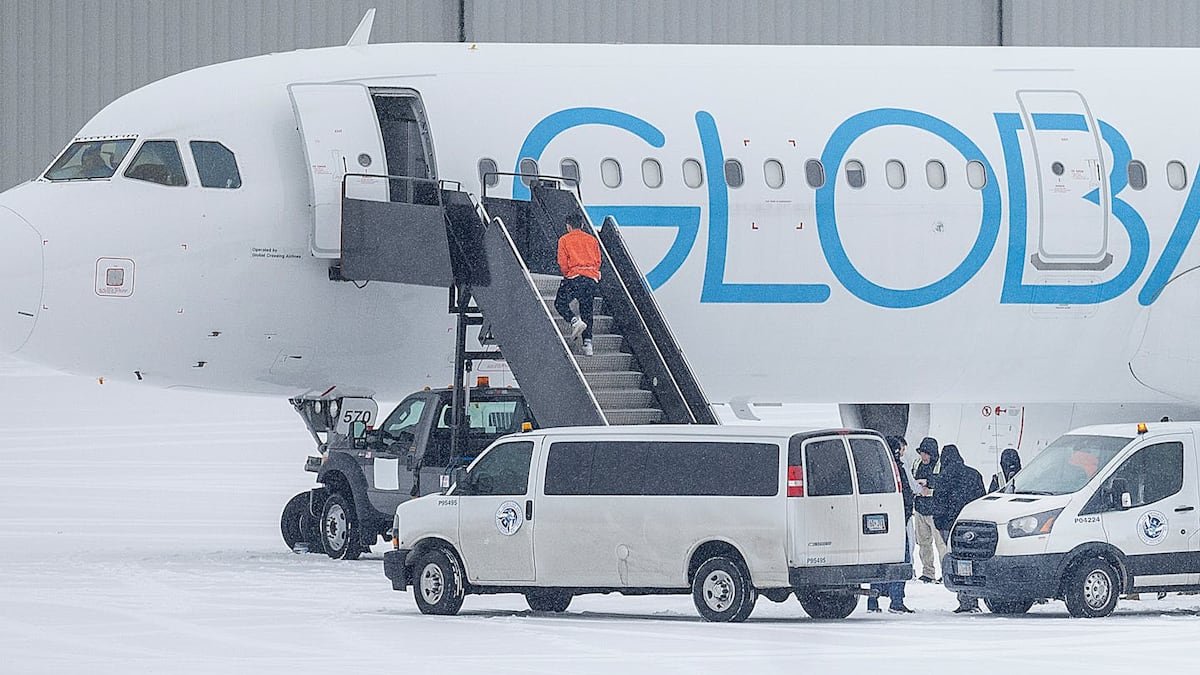
Yasmany Moreno thought he was being transferred. Again.
The 32-year-old Cuban who traveled between Tampa and Miami for work had already spent more than a year in immigration detention centers across the United States. Officers moved him from one jail to another before putting him on a plane in Texas on the morning of July 30.
No one told Moreno, who originally came to the United States on a temporarily protected basis, where he was going until five hours into the flight, when an immigration officer told him they were going to Africa.
“I honestly thought it was a bad joke because the officer laughed, like he was making fun of me,” Moreno said.
A month after arriving in the Central African Republic, Moreno and 35 other immigrants deported on a 21-hour flight remain in Bangui, the country’s capital, without passports and no information about what will happen next. They stay at the Maison Confort, a modest hotel located in a busy neighborhood near central Bangui.
Moreno said they feel forgotten and fear they could be moved to another country. He said African authorities told them they may have to leave the room where they are staying within 90 days. He started an online fundraiser to help himself and other deportees start over in Bangui.
“It is a completely inhumane situation,” Moreno told the Tampa Bay Times via WhatsApp. “What are we doing here? It is a question we ask ourselves every day.”
Deportations to third countries have been criticized by nonprofits and advocates because immigrants can be sent to places where they have no ties and may face safety concerns, violence and language barriers.
The U.S. Department of State has warned Americans not to travel to the Central African Republic for any reason due to unrest, crime, kidnapping, landmines, health, and terrorism. However, the Department of Homeland Security defended the deportations in an email to the Times.
The agency said the Trump administration, including U.S. Immigration and Customs Enforcement, is using “all lawful options” to carry out what it called “the largest deportation operation in history.”
“When an individual is no longer in ICE custody then ICE will no longer be responsible for them,” the agency said. “This is common sense.”
Moreno left Cuba by raft and arrived in the United States in 2016, landing in the Marquesas Keys in Monroe County. He was allowed to stay under the federal “wet foot, dry foot” policy, which let Cubans who reached U.S. soil remain in the country. The Obama administration ended the policy in 2017. Moreno applied for a green card but was denied because his temporary permit had expired.
He’s single and owned a small trucking company in South Florida that transported cargo between Miami and Tampa. He also helped support his parents, who live near Orlando.
Moreno has diabetes and asthma. He said he was sick for four days after the long 21-hour flight with his hands, waist and feet cuffed.
“I miss my family, the people, my friends, the streets,” Moreno said. “I had been in the United States for 10 years. Now, I feel like I’m in prison.”
Arístides Fernández, 37, another Cuban immigrant living in Florida who was sent to Africa, described the situation as a “kidnapping.”
“We feel like that because we did not sign any documents, and we don’t know what to do with our lives,” Fernández said. “No human being has the right to do this to another person.”
Fernández came to the United States after crossing the southern border in Arizona in 2021 with a form allowing the holder to have a temporary driver’s license and a work permit that expires in 2030. He was detained in January during an immigration court hearing in Miami. He spent seven months in jails in different states.

Fernández said he feels like he’s in limbo and has no rights. He does not speak the language and cannot leave the building where he’s staying without asking a guard for permission and paying him $5 to accompany him and the other immigrants for protection.
“It is a punishment that makes no sense,” Fernández said. “There is no other word for it. We have nothing.”
Hector Diaz, managing partner at Your Immigration Attorney, a law firm in Miami, called the situation “a clear abuse of humanitarian rights.” He said the Central African Republic not only lacks an asylum mechanism, but immigrants are also stuck there indefinitely, with no opportunity to present a case for asylum or return to their countries of origin.
“To start to send people to Africa is really outlandish,” said Diaz, who does not represent the deportees. “They are basically in limbo. This raises severe due process abuses, along with very serious humanitarian concerns.”
Daniel Fuentes, 31, another Cuban immigrant held in Central African Republic, has never felt more worried than now. Fuentes, who is transgender, had to cut her hair, and speak and act in ways that do not reflect “who she’s being every day,” Fuentes said.
“Here, the security guards tell me it is better not to go outside because it’s not safe for me,” Fuentes said.
Fuentes, who lived in Miami, came through the southern border in 2024 using the CBP One app, which helped migrants schedule appointments at ports of entry for processing during President Joe Biden’s era.
The CBP One app was canceled by the second Trump administration and replaced by CBP Home to allow immigrants to begin the process of voluntarily leaving the country.
Fuentes said being part of the LGBTQ+ community in Florida is very different from being in Africa. She was arrested in March and spent four months in detention. Fuentes had a humanitarian permit and worked in a beauty salon.
“It is a double challenge to live in limbo and in a country where people do not talk about LGBTQ rights,” Fuentes said. “I can’t wait for all of this to be over.”



