
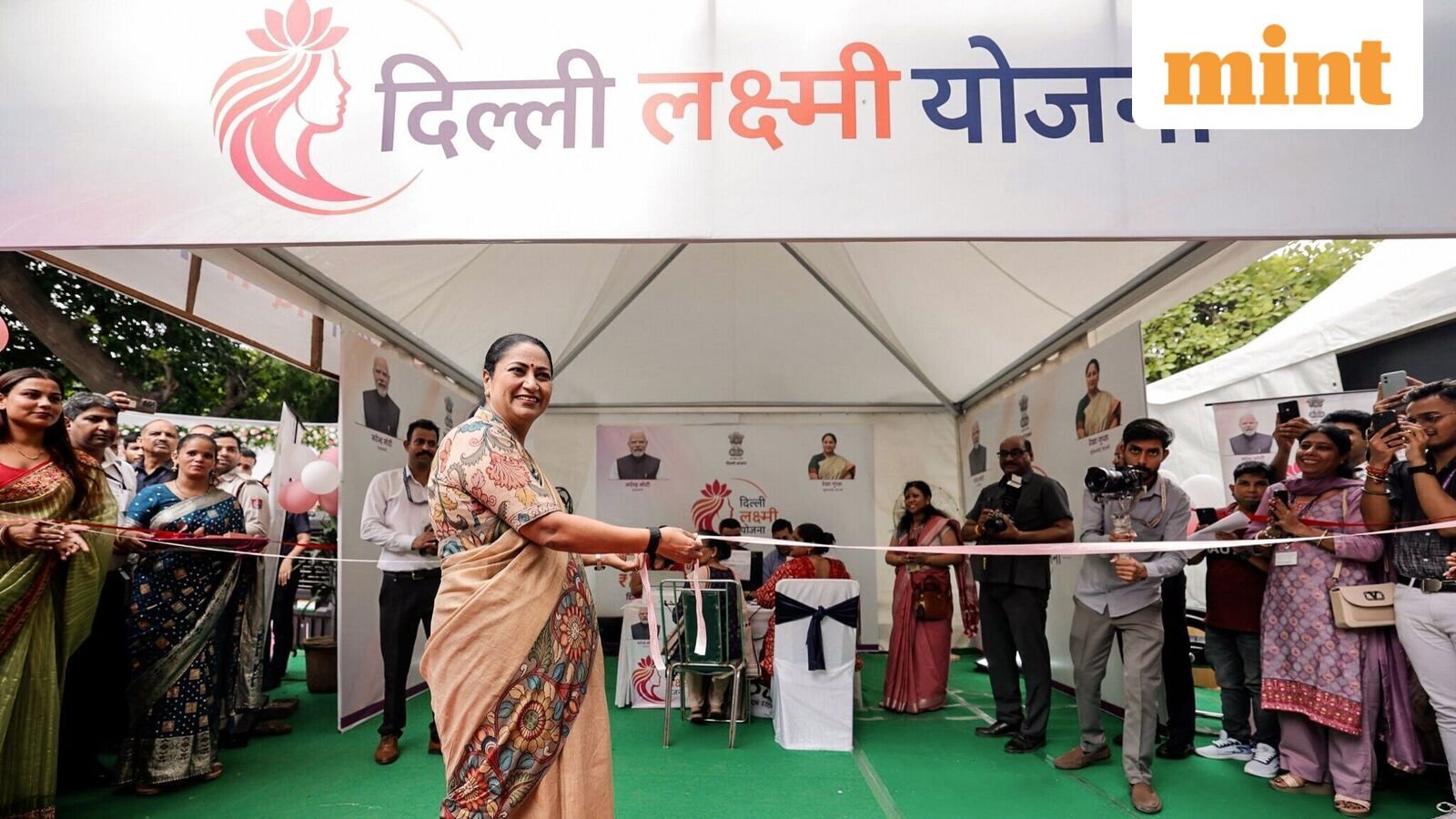
The online registration portal for the Delhi Lakshmi Yojana, under which eligible women in the national capital will receive financial assistance of ₹2,500 per month, was launched by Delhi Chief Minister Rekha Gupta on Saturday.
“The Delhi Lakshmi Yojana is a scheme that will provide economic empowerment to the sisters of Delhi,” Gupta said while addressing a gathering after launching the portal. “The government has allocated a budget of ₹5,100 crore for this. The portal has started from today, and registration has also begun.”
“I think almost 500 sisters have successfully filled their forms on this,” she added.
The Delhi Lakshmi Yojana, originally approved as the Mahila Samriddhi Yojana, was renamed to reflect a broader vision of women’s dignity, prosperity and economic empowerment, Gupta said.
She added that this scheme is expected to benefit around 17 lakh women initially and will be implemented for a period of three years.
Appealing to eligible women to register online from August 1, Gupta said the portal would enable applicants to submit forms, upload documents and choose their preferred financial option by linking either a CBDC wallet or a bank account with the scheme.
Delhi Lakshmi Yojana — Who can apply?
The registration portal for Delhi Lakshmi Yojana — www.dly.delhi.gov.in — was inaugurated today, after the Delhi cabinet, headed by Gupta, approved the scheme on Tuesday.
According to the scheme guidelines approved by the cabinet, women aged between 21 and 60 years with a family income of up to ₹2.5 lakh per annum will be eligible to apply.
Women already receiving benefits under any other financial assistance scheme or pension, taxpayers, government employees, women with more than three living children, families with annual electricity consumption exceeding 2,400 units, those owning four-wheelers, or families with any member in government service or facing a criminal case will not be eligible for the scheme.
The scheme offers beneficiaries two financial options. Under the first, ₹1,000 every month will be credited to a Central Bank Digital Currency (CBDC) wallet for day-to-day expenses, while the remaining ₹1,500 will be deposited in a recurring deposit (RD) or fixed deposit (FD) account.
Under the second option, the entire ₹2,500 monthly assistance can be deposited into an RD or FD account to help beneficiaries build long-term savings with interest.
Every application will undergo a four-stage verification process involving the District Programme Management Unit, the District Women and Child Development Officer and the District-Level Approval, Monitoring and Grievance Redressal Committee before approval, she said.
The verification process will include Aadhaar authentication, Delhi voter registration, family income, electricity consumption, vehicle ownership, pension status and government employment records.
False declarations or fraudulent claims would invite recovery of the assistance amount along with legal and administrative action, Gupta said.
She also said only the eldest eligible woman in a family would be allowed to apply. Applicants or their parents or husbands must have been residents of Delhi for at least 10 years, and the beneficiary must be a registered voter in the national capital.
Digital “negative list”
Gupta said a digital “negative list” would regulate spending through the CBDC wallet to ensure the assistance is used only for essential household needs. The amount cannot be spent on alcohol, tobacco, narcotic substances, lottery tickets, gambling, betting or other prohibited goods and services.
She said the scheme would operate through a fully digital platform that integrates applications, document verification, eligibility assessment, approvals, PFMS integration, banking services, CBDC transfers, and SMS alerts to ensure transparency and accountability.
The scheme would be implemented through the coordinated efforts of the Department of Women and Child Development, the district administration, banking partners, PFMS, UIDAI, NPCI, and other technical agencies, with regular monitoring via dashboards, data analytics, field verification, and third-party evaluations.
She said beneficiaries would also be linked to other government initiatives, including the APAAR ID, ABHA ID, Poshan Tracker, immunisation programmes, the Ek Ped Maa Ke Naam campaign, the Swachh Bharat Mission, self-help groups, and skill development and entrepreneurship programmes, to promote long-term economic empowerment.



