
Published October 6, 2026 11:33AM
SUMMARY:
- The 2026 Ironman World Championship in Kona returns to a single-day event, bringing increased athlete density and concerns over drafting on the bike leg.
- Ironman has adjusted swim wave start times to improve athlete flow and preserve fair competition, particularly for the professional women’s field.
- Anti-drafting technology RaceRanger is deployed for professional athletes to signal draft zones, though enforcement depends on on-course referee calls.
- Future RaceRanger advancements aim to introduce real-time data tracking to assist referees with monitoring, improve broadcast views, and enhance course safety.
For the first time in seven years, the Ironman World Championship has returned to the Big Island as a one-day event, with men and women racing together.
There’s much to celebrate, not least because, as Ironman says, they are welcoming “nearly 3,000 of the most competitive and committed triathletes in the world to compete at the highest level and challenge themselves on the most iconic course in the sport of triathlon.”
But for some competitors, that weight of numbers also poses a problem: How do you ensure fairness in a field more crowded than ever before?
Firstly, the starting numbers aren’t quite as big as first billed (or in some cases, feared).
In 2019, the last time the men and women raced together on the same day, there were 2,446 participants, according to the Government’s State of Hawaii Data Book. Despite the promised larger bump in numbers, Saturday’s starting field will see only around 100 more athletes, according to the final figures released by Ironman.
However, coupled with the switch away from two days to one, different locations, and more capacity for World Championship racing, Ironman is still sensitive to this issue. Its announcement in April last year that we’d return to one day in Kona came with the promise of a “reimagined event format,” with changes that included new start times to promote fair competition across both races.
With athletes paying an entry fee of $1,850 USD and wondering if the steep cost is worth it, Ironman knows it cannot afford to compromise the customer experience. Luckily, the sport has somewhat evolved since 2019. For example, anti-drafting technology RaceRanger is now deployed in the professional races (although not yet used at age-group level), and the draft distances have also changed for the pros, increased to 20 meters from 12 meters at the start of the year.
But no other creative solutions have yet been offered, which begs the question of how the World Championships will play out on Saturday.
It starts with the swim
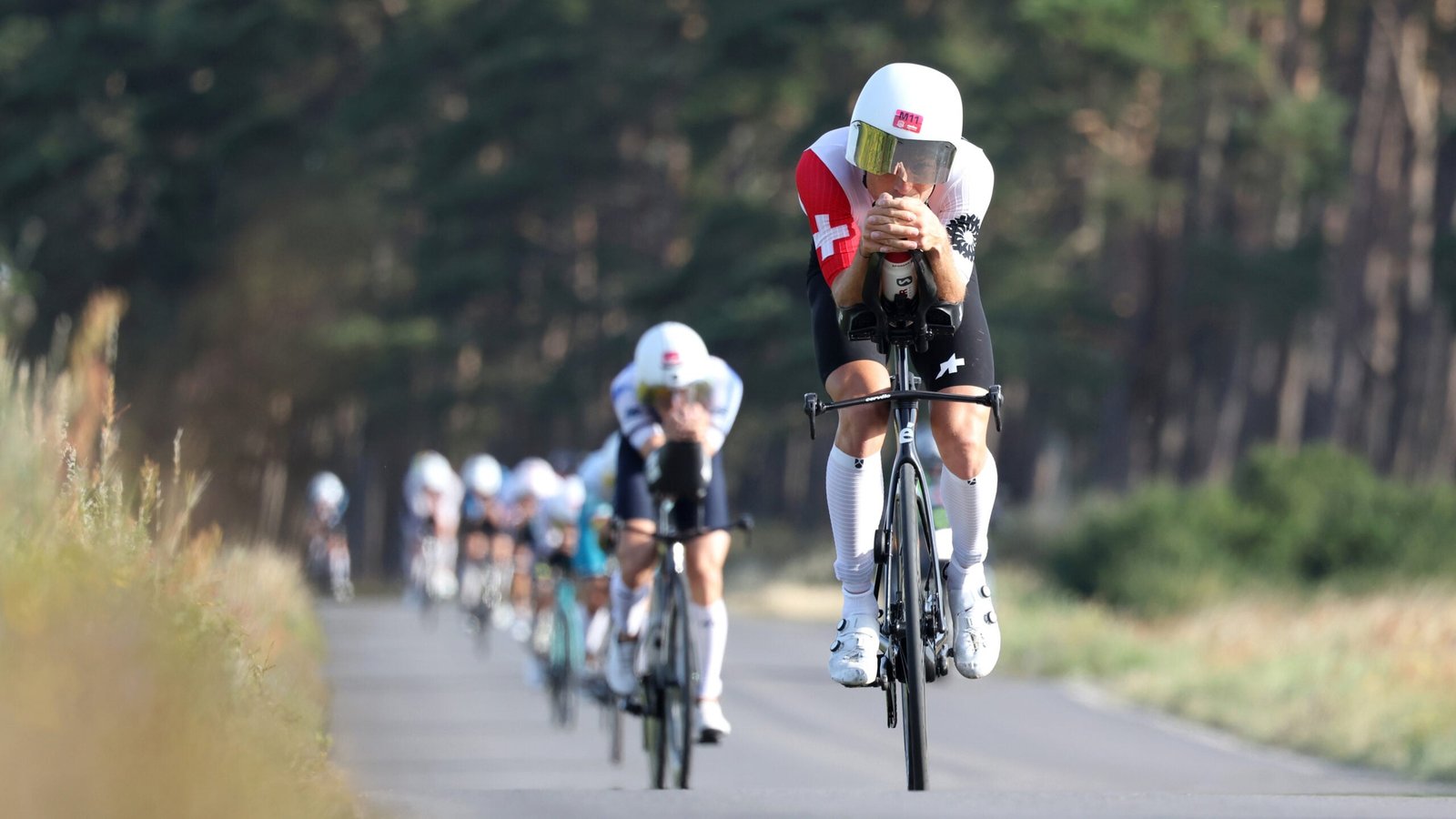
With course density, which leads to drafting, on the 112-mile cycle leg perceived to be the biggest issue, much of the discourse around fair racing understandably focuses on what happens on the bike.
However, how the bike leg plays out in the early stages is also a factor of when athletes finish the 2.4-mile swim, and Ironman has an element of control here in how it schedules its wave starts.
For 2026, the pro men’s cannon will sound at 6:20 a.m., the pro women’s at 6:30 a.m., and older age groups (from female 55-59 and male 60-64 upwards) go next.
The youngest male age groups then start at 7:05 a.m., the women aged 40-54 at 7:25 a.m., followed by the men 45-54 at 7:35 a.m., the remainder of the women (7:40 a.m.), and the final male wave, 55-59, at 7:45 a.m.
Comparing this to 2019, the race starts five minutes earlier, with waves running for 85 minutes (it was 75 minutes in 2019).
The male professionals have an additional 5-minute buffer on the pro women, and the younger age-group men (the cohort most likely to affect the pro women’s race) start 35 minutes behind the pro women. In 2019, it was 25 minutes.
Also, unlike 2019, the order of setting off the waves is more mixed up. For example, seven years ago, all the age-group males went first in ascending age order, followed by all the females in ascending age order.
| 2019 time | 2019 division | 2026 time | 2026 division |
| 6:25 | Pro men | 6:20 | Pro men |
| 6:30 | Pro women | 6:30 | Pro women |
| 6:35 | PC / Open Exhibition / Handcycle | 6:33 | Para / Handcycle |
| 6:55 | Men 18–39 | 6:38 | Women 55+ |
| 7:00 | Men 40–44 | 6:50 | Men 60+ |
| 7:05 | Men 45–49 | 7:05 | Men 18–29 |
| 7:10 | Men 50+ | 7:10 | Men 30–34 |
| 7:15 | Women 18–39 | 7:15 | Men 35–39 |
| 7:20 | Women 40–54 | 7:20 | Men 40–44 |
| 7:25 | Women 55+ | 7:25 | Women 40–54 |
| 7:30 | Legacy | 7:30 | Men 45–49 |
| — | — | 7:35 | Men 50–54 |
| — | — | 7:40 | Women 18–39 |
| — | — | 7:45 | Men 55–59 |
There will be winners and losers from any wave start scheduling, but Jana Richtrova, five-time Ironman age-group world champion, is concerned.
“I don’t have a solution, and I am sure Ironman has a reason for this order, but as a 45-49-year-old female, being sandwiched between the fastest men AGers with small five-minute gaps – this has messy draftiest [sic] written all over it in my [view],” she posted on Instagram.
“I understand the older female/male age-groupers going after pro females as that will definitely give pro ladies a solid gap and clean race but, as a female age-group athlete, I am really bummed. I would rather start late but have an opportunity to have a clean race than start earlier while being intertwined with a sea of men. We have been there and done that.”
Ironman said the start waves have been developed using “historical timing analysis provided by Sportstats, together with learnings from previous Ironman and Ironman 70.3 World Championship events, as well as athlete and community feedback.”
Ironman’s Global Head of Officiating, Jimmy Riccitello, adds: “The race-day plan has been developed around three priorities: athlete safety, the integrity of the professional races, and effective athlete flow throughout the course.
“Particular attention has been given to looking at how we can best preserve a fair and uncompromised women’s professional race while ensuring the safest possible experience for all athletes.”
Riccitello added that an earlier start “for athletes who historically spend longer on the course” had also been intentional to help maximize available daylight and reduce exposure to the most challenging conditions later in the day.
Policing drafting on the bike
Once on the bike, the amateurs must abide by the 12-meter draft rule, while the professionals now have an extended draft zone of 20 meters and also have a longer 45-second window to make the pass. Our analysis earlier this year shows these changes alone would have scrambled both of last year’s Ironman World Championship races significantly.
The central figure in anti-drafting lately has been RaceRanger, the range-finding technology that uses a sequence of flashing lights to alert athletes (and officials) when they’re approaching the draft zone of the bike ahead.
Introduced into Ironman racing three years ago, it’s been used in 43 Ironman pro races this season, and RaceRanger’s front and rear units will be mounted on the bikes of all the pro men and pro women on Saturday, which could be around 100 athletes.
It won’t, however, be on the bikes of the age-groupers, although this is co-founder James Elvery’s vision and why the company sought $1 million of new investment in August. As proof of concept, RaceRanger age-group testing will take place in non-drafting races in New Zealand in January and February.
Sticking with the present, the system is not without challenges for the pro race. However, it’s less about the hardware (RaceRanger in-race tech issues have been minimal), but more about how on-course officials use it.
At the recent Ironman 70.3 World Championship in France, no drafting penalties were issued, and there were complaints from professionals that the rules weren’t being enforced, most prominently from men’s race winner Hayden Wilde, who told multiple media outlets “it was like Christmas out there,” referring to the number of flashing lights he saw as gaps between riders closed on the climbs.
“Many factors influence the number of penalties issued in any race, including athlete behavior, course characteristics and the ability to safely officiate,” Riccitello says. “Based on the RaceRanger data, Nice was a fair race. The course presents unique officiating challenges due to its narrow roads, technical descents and high-speed sections. From a safety point of view, it was not always possible for referees to officiate directly alongside athletes.”
While not an Ironman event, there were similar issues in the French Riviera T100 race a week later, where one athlete clocked up more than 9 minutes of illegal time and 46 yo-yos (where a rider enters the draft zone before pulling back to legal distance) over the 80-kilometer cycling leg without a sanction. T100 chooses to release RaceRanger data publicly. Ironman says its athletes receive post-race drafting data and insights.
“We’ve designed [RaceRanger] to provide clear guidance on what the distance is, and then we leave the decisions completely up to the referees to apply or not,” Elvery explains. “It comes down to them making the calls on the day, and I know it’s not always easy for them to get into a situation to make a call.”
Elvery adds that some courses can be more conducive to drafting than others, and that because the motorbike drivers are conscious they can add to the slipstreaming effect, it can be difficult to get into position to show a card and award a penalty.
“We’re working on making it so that we can feed that information to the referees live,” he continues. “So, they don’t need to be riding amongst it all the time. They can sit back and watch who’s racking up a lot of time, then a tap on the shoulder of the driver, and get themselves in the situation and assess it.”
More on that shortly, but the other element he suggests fans watching the broadcasts should consider is that with the extended draft zone that was introduced in March, the length of time athletes are allowed to make the pass has been increased to 45 seconds.
“That’s actually a really long time for an athlete to make a pass, and rarely would the camera stay on them through that full 45 seconds. [Viewers] can get righteous about what they’re seeing on the screen, when it is just a snapshot in time.”
Along similar lines, the broadcast can distort the colours as well, so an orange light can be mistaken for red, again making it appear that the rider is positioned too close, when in fact they are at a legal distance.
It will be the third year RaceRanger has been used in Hawaii following the individual men’s race in 2024 and the women’s event last year, and, misconceptions aside, there is no argument that with large clusters of professionals leaving transitions together, real estate is at a premium at the start of the bike leg.
“I remember a shot when the men last raced, and they were all coming up a hill, and Magnus [Ditlev] attacked, and it looked chaotic,” Elvery recalls. “So, I’d say there’ll probably be some sort of situation like that. It’s not the easiest thing for the athletes to hear, but the best way to stay out of trouble is, if you’re strong, go to the front, and if you’re not strong, let people who are stronger than you go past in those early stages.”
However, Elvery admits there’s no easy fix for congestion. “This is sort of how we ended up with draft-legal Olympic distance racing back in the nineties,” he says. “What you’re seeing happening used to happen in a concentrated way after a 1,500m swim.” While the Ironman World Championship swim will be more than two-and-a-half times as far at 3,800m (2.4 miles), it doesn’t negate the challenge completely.
While Elvery is clear that he’s the technology provider and not the decision-maker – “That’s where the boundary is” – and that RaceRanger isn’t out to change the rules of the sport, there are elements beyond the visual cues where RaceRanger can assist the officials.
“We gather a lot of data about each race to provide a bit of a story to the referees of how the last couple of years have gone,” he explains, “Let’s say a lot of yo-yos happened at this section of the course, for example, or perhaps you might want to watch the third pack – although race dynamics are different every year.”
“The other thing is that every time an athlete tows a start line to a 70.3 or Ironman, that data is recorded. I don’t know if [Ironman] does anything with it, but they can decide whether they pay more attention to some [triathletes] than others. Not in a way of, ‘hey let’s get him back for that race where he didn’t get a penalty months ago.’ More of a ‘here’s a list of people who perhaps pushed the limits more than others in the past, and you might want to keep a closer eye on them.’”
Drafting off a fellow triathlete is one thing, but with camera crews and race officials out on the highway, there is also the risk of moto drafting assistance. Although it won’t happen in time for Saturday, Elvery explains how his team is working to include a RaceRanger sensor on the back of the motorbike that can relay a message to the driver if they’re too close to a following cyclist.
What the distance needs to be (and whether it changes at different paces), and whether Ironman chooses to deploy it, will be up to the organizer. For now, Riccitello made it clear: “All drivers with access to the professional race receive detailed briefings regarding athlete safety, vehicle positioning and race fairness.
“Clear protocols are in place to minimize the potential for inadvertent assistance, and Kona’s bike course supports the consistent application of those standards throughout the race.”
Currently, RaceRanger is used as a visual guide, but as mentioned above, when the data can be used in real time, it opens up a world of possibilities, from how penalties are issued, to the fan experience, to even pinpoint tracking of athletes on the course.
“It’s very close now,” Elvery confirms. “We’ve had SIM cards in all the devices out in the field, but it’s taken pretty much all of this year to iron out the bugs and make sure that by adding the internet connection we weren’t affecting the existing performance of the lights system and how the recording worked.”
Elvery explains the connectivity issue would cause brief drop-outs on a handful of devices, but didn’t want to risk it happening in a race-critical situation. “We’re doing final testing now, but we’re not going to roll it out in Kona because it wouldn’t be a great move to try something brand new.”
With a solid internet connection, Elvery’s devices can send a once-per-second message to referees’ apps, which are already developed and in use for communications, incident reporting, and penalty management, and will now show drafting data.
It should also be available for the broadcast, so the Ironman tracker that runs across the bottom of the screen will update in real time rather than wait for riders to cross a timing mat on the course, helping inform the commentators and tell the story of the race.
The other aspect of knowing where all the bikes are at any given time is, of course, safety. Being able to spot and get to incidents quickly might not be such a factor on a rolling course like Hawaii, but could play a vital role in a location such as Nice, where there are fast, alpine descents.
As for keeping the racing fair, Elvery says it changes the mindset of the athlete because it introduces the aspect of always feeling monitored.
“It will show the referees the highest illegal scores,” Elvery says, explaining that to prevent overwhelm, the official’s app might present the behavior of triathletes within a mile of the referee over the past 10 minutes, for example.
“Just give them a very clear idea,” Elvery says. “Here’s three or four people. One of them’s 200 meters ahead of you, one of them’s 300 meters behind you. The rest are pretty clean. Just maybe go and have a look at what’s going on there.
“They can go in and assess the situation if they want to, or just come in and show them a card. Ultimately, I’d like the referee to just punch the number into the app, and it would go to the athlete’s device, and there’d be a notification to them that they have a penalty. If not, just before the penalty tent, there’d be some sort of traffic screen that tells them,
“So, we’re not trying to change anything wildly, but I think it will make a really big change because [triathletes] won’t know when the referees are watching them. It’s like sitting for an exam, and the teacher walks out of the room to go to the bathroom, and you can hear them walking on the wooden floor coming back. That’s what it’s like with the motorbikes, whereas if you’ve got cameras in the corner of the room, you know, no one’s going to cheat.”
Ironman says: “We remain in close dialogue with RaceRanger as the technology continues to evolve and may look to explore opportunities to incorporate additional capabilities in the future.”



