
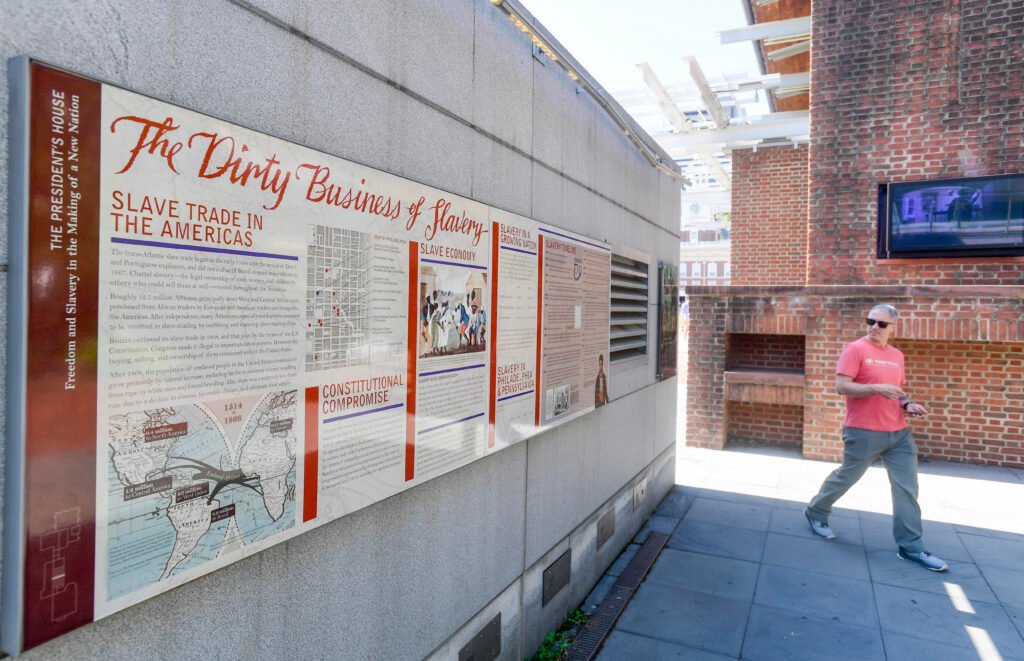
Nearly a month after they were taken down, the federal government re-installed dozens of signs commemorating the slaves that once resided at the President’s House in Philadelphia Thursday, before a court-imposed Friday deadline.
“Today we celebrate the return of our history at this important site,” Philadelphia mayor Cherelle Parker said in a statement. “We are thankful for all the supporters across the city to get us to this point. We know that this is not the end of the legal road. We will handle all legal challenges that arise with the same rigor and gravity as we have done thus far.
Parker was on site when National Park Service employees restored the signs, thanking them and shaking their hands.
“We’re all in the same boat,” one worker told her in a moment captured on film and shared by her office.
Philadelphia sued following the memorials’ removal on January 22, naming the U.S. Department of the Interior, the National Park Service, and their respective leaders Secretary of the Interior Doug Burgum and Acting National Park Service Director Jessica Bowron in the lawsuit.
The city argued the move violated both a 2006 agreement between the city and federal government over stewardship of the President’s House, and the 1948 legislation that created the Independence National Historical Park, which includes the President’s House. That bill directed the Interior Department “to enter into cooperative agreements with the city of Philadelphia to assist in the preservation and interpretation of the property.”
The National Park Service said the signs were removed to comply with an executive order signed by President Donald Trump called “Restoring Truth and Sanity to American History.”
The litigation remains ongoing, but U.S. District Court Judge Cynthia Rufe, a George W. Bush appointee, granted an injunction requiring the federal government to restore the signage as the case moves forward. She imposed a Feb. 20 deadline.
While the Trump administration complied, it has also requested a stay of the injunction, on the grounds it believes it is ultimately likely to win the case. Their lawyers claim the Department of the Interior and the National Park Service have sole authority over the historic site, and said Philadelphia is attempting to act as “a backseat driver holding veto power.”
Moreover, it argues “the Court’s injunction undeniably compels the Government to convey a message that it has chosen not to convey. And to compel speech is an infringement on the right to free speech.”
Congressman Dwight Evans, a Democrat who represents Philadelphia, called on the federal government to drop its appeal in a post to the social media platform X.
“This is a HUGE victory for our city, our commonwealth, and our democracy,” he wrote. “True patriotism requires sharing our nation’s whole history, not a whitewashed version of it. This administration should DROP its appeal of the judge’s order.”
Kathleen Brown, a historian and professor at the University of Pennsylvania has argued that the legacy of slavery is critical in understanding Philadelphia’s, Pennsylvania’s and America’s history.
“I am relieved that historical accuracy has prevailed over political pressure to erase uncomfortable truths,” she said in a statement.
This story was originally produced by Pennsylvania Capital-Star, which is part of States Newsroom, a nonprofit news network which includes New Jersey Monitor, and is supported by grants and a coalition of donors as a 501c(3) public charity.



