
So many of the things we depend on in Florida are hidden from us, out of sight and thus out of mind.
We depend on water from the underground aquifer but seldom give any thought to how we’re draining it or polluting it. We depend on the karst geology beneath our feet to hold us up but, unless a sinkhole opens, we seldom think about it.
Which brings me to the subject of the Oculina Bank.
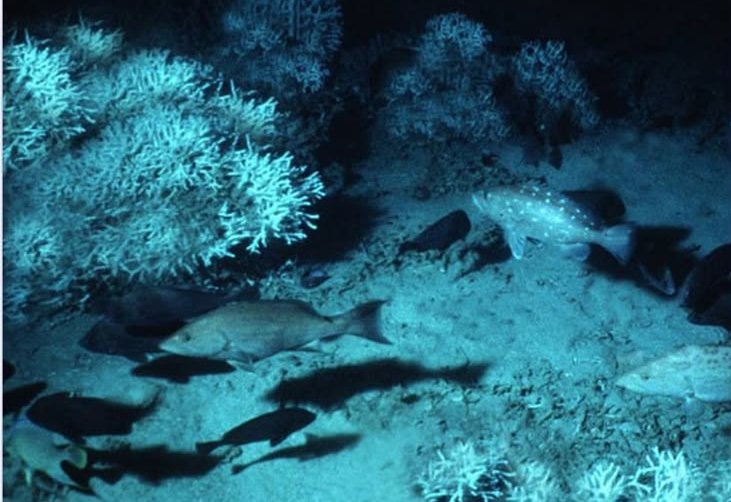
This is not the kind of bank that has an ATM or gives you a toaster for opening an account. It’s a remarkable coral reef about 135 miles off the Florida coast, one that stretches from Fort Pierce to Flagler Beach.
There’s not another reef like it anywhere in the world.
The 130-nautical-mile long reef is made of, and named for, “Oculina varicosa,” aka ivory tree coral. Its tall growth provides a home for thousands of marine species, including shrimp, starfish, and sea urchins, and spawning habitat for grouper and red snapper.
If you like fresh Florida seafood the way I do, then you should thank the bank.
Yet because this important reef sits in water about 200 to 300 feet deep, it’s largely unknown — a hidden gem just like our aquifer and karst.
“A lot of people don’t know that it’s there and that it’s part of who we are and that we’ve got to protect it,” said Mark Perry, executive director of the Florida Oceanographic Society.
Before scientists fully explored the reef’s extent, shrimpers dragged their trawls through it. They destroyed a majority of the coral. That’s why, in 1984, the reef was placed off-limits to that kind of fishing, making it the first marine protected area in the United States. The protected area has been expanded several times since then.
But now the federal agency in charge of safeguarding the Oculina Bank is considering scaling back the protection and letting the shrimpers back in. The shrimpers say they need access because their industry is teetering on the edge of collapse.

“It’s a collision of two vastly different worldviews,” said Shari Anker. president of the Conservation Alliance of St. Lucie County, one of several environmental groups that oppose opening the reef.
The National Oceanic and Atmospheric Administration is seeking public comments on this proposal until Nov. 17.
This is the second time this idea of opening the reef has come up, by the way. When the agency considered this four years ago, the answer was no. But now it’s back again.
The difference this time? The Florida man in the White House, a guy who seems to eat nothing but fast food.
Slower than a fingernail

In the 1970s, scientist John Reed was fresh out of college when he joined the staff at Harbor Branch Oceanographic Institution in Fort Pierce. He became part of a team that used a submersible craft in exploring the waters off the Florida east coast.
“Basically, we were just going offshore and documenting the continental shelf,” he recalled this week.
But the submersible brought into view something they hadn’t expected to find.
“We discovered and documented this extraordinary reef formation,” Reed told me. “We realized this was the only place on earth like it, where the ivory tree coral forms these mounds that go up to 100 feet tall.”
Soon after the discovery, though, he and his colleagues learned about something tearing the coral to bits.
Reed’s first published scientific paper was about that discovery. It detailed how the shrimp boats were destroying this unique coral formation by dragging their trawls through it. It talked about how areas that, in the 1970s, were “teeming with large spawning aggregations of grouper and snapper,” had been damaged and even destroyed by shrimp trawls.
“That coral doesn’t grow back once it’s crushed,” the scientist said.
Even in the places where the coral was merely broken, not crushed, recovery would be a slooooooooooooow process. How slow? As WMNF-FM noted in a September story on this situation: “The coral grows at less than an inch per year. That’s slower than a fingernail.”
With 90% of the entire bank demolished, Reed proposed the federal government make it off-limits to shrimpers to save what was left.
In 1984, the feds approved that plan, ordering the shrimpers out. Then they expanded the protected area in 1994, 2000, and 2014 to include buffer areas around the coral.
Yet some of those prohibited activities continue in the area where they shouldn’t.
A 2005 report showed pictures of an abandoned net wrapped around a section of the reef. A 2015 video by Harbor Branch shows that intruders discarded fishing line, bottles, cans, and even boots inside the protected area.
To Reed, it makes no sense to allow legal access to the shrimp boats that broke the coral before.
“I’ve been fighting to protect this area ever since I first saw it,” Reed told me. “I’ve been fighting them for 45 years.”

On the cliff’s edge
This is a tough time to be a shrimper.
“The U.S. shrimp harvesting industry is experiencing a long-term decline in profits and economic stability, including a $268 million revenue loss since 2021,” according to a federal report released earlier this year.
It’s not due to low demand. “U.S. shrimp consumption more than quadrupled between 1984 and 2023,” the report notes.
Instead, a lot of the slump is thanks to competition from foreign sources, which tend to be farmed, not wild-caught.
Not mentioned by the report: Skyrocketing costs for diesel fuel, thanks in large part to the president’s unpopular Iran War. Diesel reached an average of $6.52 a gallon in September, up from an average of $3.69 per gallon in 2025.
Meanwhile, Elon Musk is responsible for yet another wrinkle. According to WPTV-TV, space launches — most of them by Musk’s Space X — closed the waters off Port Canaveral to fishing 50 times last year.
An added hazard: The string of hurricanes that’s battered Florida’s coastlines in recent years took out a lot of shrimp boats, too. It’s like that scene in “Forrest Gump” where all the competing shrimp boats are destroyed by a hurricane, but put on an endless loop and replayed over and over.
Given the shrinking of shrimping, a lot of shrimpers have chosen to get out of the business entirely. The industry these days is but a shadow of its once healthy self.

“We’re standing on the edge of a cliff,” said Capt. Bob Zales, executive director of the Southeastern Fisheries Association in Panama City. “If you just blow on us, we’re going to fall off.”

That’s why shrimpers want to get back into the area around the Oculina Bank, he explained. They want to catch rock shrimp, not to be confused with the rock lobster featured in a famous B-52s song.
Zales told me the section of the protected area where the shrimpers want access doesn’t have any coral in it for them to damage, “so there’s no reason to prevent us from going in there.”
But that’s not the way Anker, Reed, or Perry see it. They’re worried that dragging shrimp trawls near the Oculina Bank will stir up sediment that will smother the coral.
That’s a legitimate concern, said Sandra Brooke, a coral scientist at Florida State University. The area the shrimpers hope to access are in the buffer zones around the reef bank.
“That’s why this is a buffer zone,” Brooke explained. “It’s not there to protect the corals directly. It’s there to protect them indirectly. You don’t know what the currents are doing at that depth, and if you don’t know where the currents are going then you don’t know where the sediment’s going.”
Common sense caution
The South Atlantic Fishery Management Council considered opening the Oculina Bank once before.
This was in 2022. The shrimping industry wasn’t quite as bad off as it is now, but it was already pushing hard to get back into the protected area.
The South Atlantic Council heard strong objections from its coral advisory panel, a group that includes Brooke. The coral counselors warned about the danger of the trawls spewing fine sediment all over the coral reef.
“The corals are very sensitive to sediment,” she told me.
She pointed out that the sensors for positioning are on the shrimp boats, not on their trawls, which can stretch for 1,000 feet behind the vessel. That means the shrimpers won’t know exactly where their trawls are dragging behind them, much less where the sediment ends up.
In the end, the council voted to recommend the government say yes, but NOAA said no.
Saying yes “would allow rock shrimp fishermen to bottom trawl for rock shrimp in a 22-square mile area where the gear has been prohibited since 2014,” a publication called National Fisherman reported. “As a result, the first marine protected area in the world to protect a deep-water coral reef would suffer from damage, the agency concluded.”
So, why bring it back up again?
Because the current occupant of the White House said so.
In an executive order he signed last year, President Donald Trump said the government “shall immediately consider suspending, revising, or rescinding regulations that overly burden America’s commercial fishing, aquaculture, and fish processing industries.”
The order specifically called for Secretary of Commerce Howard Lutnick to “identify the most heavily overregulated fisheries requiring action and take appropriate action to reduce the regulatory burden on them.”
This isn’t surprising, considering this administration’s hostility toward anything that protects nature. After all, it basically canceled consideration of the Endangered Species Act when approving offshore oil drilling permits in the Gulf of Mexico.
Plus, look at who’s going to be making the decision. Lutnick’s background is in finance, not fisheries. He wouldn’t know a grouper from a groyper.
Although Lutnick is now in trouble over the Nvidia “sex-while-spying” mess, he’ll probably still oversee the agency long enough to make this decision. He seems unlikely to do anything other than what his boss wants him to do.
The president’s favorite seafood dish is the Filet-O-Fish Sandwich from McDonalds. I don’t think he’s worried about whether letting shrimpers invade the Oculina Bank will prevent him from getting that menu item fresh from the dock.
Another indication that the skids have been greased: The fisheries council didn’t ask Brooke’s coral advisory panel for itsf opinion on reopening the protected area.
“We were not invited to be part of the discussion,” she told me. “The reason, they said, is because they already knew what we were going to say. Of course, they also knew what the shrimp advisory council would say and they still invited them to comment.”
Here’s what I found intriguing, though. Other fishing groups have splashed into the middle of this watery war.
After all, there’s more marine life at stake than “another shrimp on the barbie.” Remember how the reef is a key spawning area for grouper and snapper?
As a result, some anglers saw a different angle on the issue.
“To allow shrimping and associated silt plumes from the trawls within 400 yards of the protected area is virtually guaranteed to produce negative impacts,” the Coastal Conservation Association of Florida, part of the largest grassroots marine resource conservation organization of its kind in the country, wrote to the fisheries council. “Common sense would dictate a more cautious approach. … In this case, the benefits of this action do not outweigh the risks.”
I hope a lot more fisherfolk cast a line of protest toward the feds before next week, to tell them to scale back this awful idea.
If they do, maybe Secretary Lutnick will recognize that what’s good for the shrimping industry is bad for everyone else who counts on this reef.
But if Lutnick is still leaning toward the shrimpers, perhaps he should come to Florida and look for himself. I’d recommend he use one of the federal government’s own submersibles and plunge down deep to view the reef that’s currently out of sight.
Maybe that way he can understand why protecting this bank will pay all kinds of healthy dividends.



