
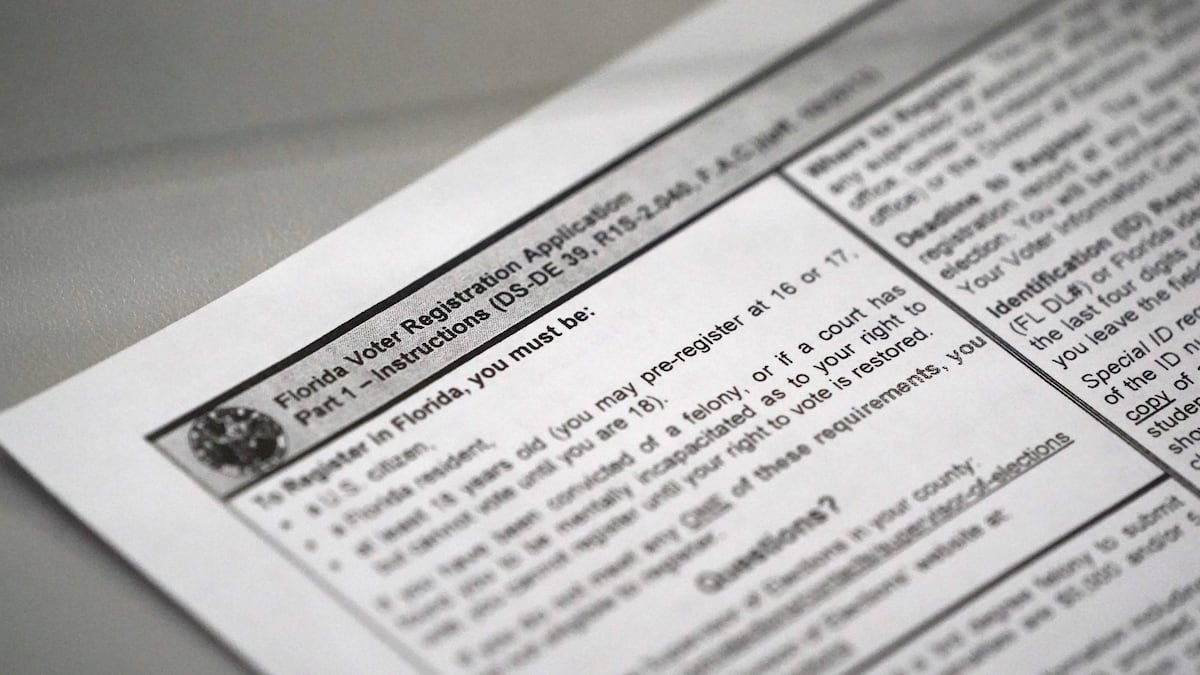
TALLAHASSEE — The Florida House on Wednesday passed legislation that would require voters to verify their citizenship, a move that could result in thousands of Floridians being removed from the rolls.
HB 991 would require new voters and those who update their registration to prove their citizenship with a birth certificate, passport or similar federal ID. It would also require the secretary of state to audit registered voters to check their citizenship status.
New driver’s licenses and state ID cards would also be updated to state the person’s citizenship status starting next year.
The bill would take effect on Jan. 1, 2027. It still has to pass the Senate, where its version has been fast-tracked and is set for a floor vote. The Senate bill, SB 1334, would take effect on July 1 this year, ahead of the midterm elections.
Both bills have to be identical to become law.
The legislation comes as President Donald Trump and Republicans in Congress try to require voters in federal elections in all states prove their citizenship through the Safeguard American Voter Eligibility Act, or SAVE Act. It passed the U.S. House but has stalled in the Senate.
“Just as the SAVE America Act is common sense, this election integrity bill is common sense,” said the Florida House bill’s sponsor, Rep. Jenna Persons-Mulicka, a Fort Myers Republican. “You heard our president (Tuesday) night say that 89% of Americans support proof of citizenship and voter ID.”
The vast majority of Florida voters would likely not be affected by the changes.
The bill requires the Department of State to verify a new or changed voter’s citizenship status with the Department of Highway Safety and Motor Vehicles.
The motor vehicle department already has citizenship information verified for millions of Floridians — anyone who has a REAL ID-compliant driver’s license or ID card already had to show a birth certificate or U.S. passport.
But if citizenship verification is not on file with the state, the Department of State would notify the local elections supervisor. The potential voter would then have to prove their citizenship with the supervisor.
The bill would also require the Department of State to check current voters’ citizenship status with the motor vehicle department. That process could ensnare thousands of Floridians who don’t have REAL ID-compliant IDs in extra paperwork and potentially remove them from the rolls.
People who have a legal name that is different from the one they used on their proof of citizenship — such as women whose last name is different from the one on the birth certificate they presented — would also have to provide documentation proving the name change.
Those whose citizenship hasn’t been verified when they show up at a polling place would have to vote by a provisional ballot.
Rep. Ashley Gantt, a Miami Democrat, argued Wednesday that her aunt would be removed from the rolls despite being a longtime Florida voter with a Social Security number.
Her aunt was born in 1950 in South Carolina, but not in a hospital, and was never issued a birth certificate, Gantt said. Gantt said she’s been trying for more than a year to help her aunt get a birth certificate from that state — even enlisting help from members of Congress in Florida and South Carolina.
“They don’t know what to do, really, so they keep asking us to give them different things and going through all of these hoops,” Gantt said.
“This is what a lot of Black folks who were born during Jim Crow have to contend with,” she added.
Opponents have also pointed to Kansas, where a federal judge concluded that a similar citizenship bill passed there in 2013 “undisputedly … disenfranchised approximately 30,000 would-be Kansas voters.”
The House bill would also prohibit student IDs from being used as a valid ID when voting, a provision not in the Senate bill.
Noncitizens registered or voting in Florida are exceptionally rare. Last year, Florida’s Office of Election Crimes and Security identified “at least 198″ people on the rolls who were “likely noncitizens.” Its 2025 report says that 170 of those people were referred to law enforcement.
Florida has more than 13.3 million active registered voters.



