
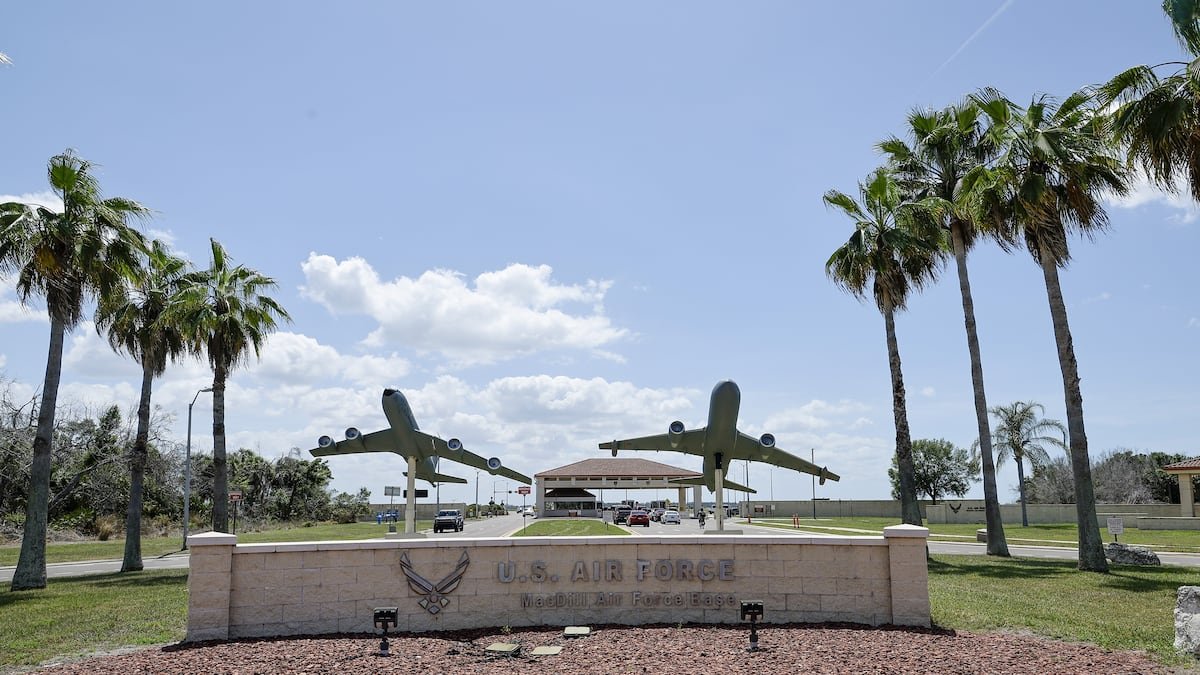
The Trump administration is wielding the MacDill Air Force Base bomb threat in its fight against universal birthright citizenship.
Alen Zheng, who has been accused of planting the bomb that went undetected at MacDill for six days, was born in the United States. His parents were born in China and remained illegally in the U.S. after their request for asylum was denied, according to a news release from the Department of Homeland Security.
That April 3 news release then went further, quoting acting Assistant Secretary Lauren Bis: “This incident underscores the severe national security threat that illegal immigration and birthright citizenship pose to the United States.”
The Trump administration has argued before the Supreme Court that it should be allowed to limit who is afforded citizenship at birth. One key point is that birthright citizenship threatens national security.
The threat at MacDill, allegedly at the hands of a second-generation Chinese American, offers fuel for that argument.
But experts who spoke to the Tampa Bay Times said there’s no evidence linking birthright citizenship and threats to national security, even for Zheng, who is believed to have fled to China. Here’s what to know.
Republicans’ case against birthright citizenship
Birthright citizenship is the premise that a child born in America is a U.S. citizen, regardless of their parents’ immigration status. (There are some narrow exceptions, such as for children of foreign diplomats.)
On President Donald Trump’s first day in office in his second term, he signed an executive order that would have withheld birthright citizenship from children whose parents are in the country illegally, as well as from children of parents who came to the U.S. temporarily, such as students or tourists.
A federal court blocked that executive order. Recently, the Trump administration argued before the Supreme Court that it should undo the lower court’s decision. A decision from the nation’s highest court is expected this summer.
Part of the Trump administration’s argument focuses on national security.
The concern among Republicans is that children from, for example, China and Russia could be born in the United States, raised abroad, and return as foreign operatives, according to reporting from NPR.
Andrew Badger, a defense intelligence analyst who studies China’s espionage efforts, told NPR it’s possible China could take advantage of birthright citizenship to spy on the U.S. But there’s no evidence that’s happening, he said.
Ira Mehlman is the media director for the Federation for American Immigration Reform, which opposes automatic birthright citizenship. He told the Times that even anecdotal examples of children born to undocumented parents engaging in domestic terrorism suggest birthright citizenship should be limited.
“Not every child who is born here to somebody who is in the country illegally is going to grow up to be a spy,” he said. “But it just adds one more concern.”
David Bier is the director of immigration studies at the libertarian-leaning Cato Institute. His organization tracks thousands of domestic terrorism cases, and he said none have involved parents using birthright citizenship to send their children over as spies.
Bier told the Tampa Bay Times that the institute doesn’t track cases like the one at MacDill, where no one was hurt.
Still, he said, “This is the first case where I’ve heard of a child of an unauthorized immigrant attempting something like this, which would make it extremely rare as a percentage of cases.”
What the MacDill threat suggests — and what it doesn’t
There are a few things to square with Alen Zheng’s decision to plant a bomb at MacDill.
First, he is accused of a serious threat against national security. Though the bomb, housed in two 2-liter cherry Pepsi bottles, didn’t detonate outside the MacDill visitor’s center, it targeted the military, said Colin Clarke, executive director of the Soufan Center, a research group focused on terrorism and national security.
“The fact that they put together some kind of an explosive to go after a military base shows that the intent is pretty serious, even if the capabilities aren’t,” Clarke said.
Second, Zheng appears to have received birthright citizenship.
Third, no evidence has been released to suggest that Zheng’s status as the child of undocumented Chinese immigrants influenced his actions.
“It seems highly unlikely that this was state-directed” by China, Clarke said.
He added that he hasn’t seen data that suggests children who were afforded birthright citizenship are more likely to engage in domestic terrorism.
The Trump administration has used the national security argument to justify limits to immigration before, said Juan Caballero, who directs the immigration law clinic at the University of Florida.
The Trump administration moved to “aggressively” revoke visas held by Chinese students last May, arguing that they could gather information while on U.S. soil and report back to the Chinese government. Trump reversed course a few months later, issuing some 600,000 Chinese student visas to maintain university enrollment numbers, according to the BBC.
“I can’t take a stance that immigrants don’t ever pose a risk to national security,” Caballero said.
But the linkage, he said, is “tenuous at best.”



