
Before Tsai Ming-liang made his first feature “Rebels of the Neon God”, which centers on troublesome youth in the city of Taipei, he directed a few television films rooted in social realism. One of them is the 1991, 52-minute-long “Give Me a Home”. Tsai’s early telefilms work partially as a bridge between the First and the Second New Wave of Taiwanese Cinema, changing the audience perspective from the direct social critique into something slightly poetic. “Give Me a Home” stands somewhere in the middle, not only touching on the characteristic elements of the genre, but also significantly introducing the style and themes that would become recurring in the director’s future oeuvre.
The story follows the Chen family – father (Chang Lung), mother (Hsia Ling-Ling), and their three children – all living with other migrant workers in a makeshift dormitory on the construction site where the father currently works. Due to the nature of the job, the family is forced to constantly change places and schools while adapting to highly precarious environments. Their “house” is dark, cramped, and on top of all inherently dangerous: the family has to face both the constant threat of structural collapse and a lack of security, being vulnerable to thieves and intruders. Driven by that, one day the mother decides it is time to find a proper home, but as expected, it is neither easily accomplished nor affordable.
Taiwan in the last decade of the 20th century was a rapidly developing country, with a booming economy and a massive shift towards high-tech industries and hyper-capitalism. This modernization, however, fueled severe wealth inequality and sharp urban divides, leaving the members of the working-class and migrant workers unable to afford the very houses they were building. This crisis had already sparked resistance in the late 1980s with the “Shell-less Snails” social movement, which symbolized ordinary citizens being crushed by skyrocketing housing prices and involuntarily becoming “snails” who could not afford their own shells. The Chen family in Tsai’s telefilm perfectly embodies these snails, desperately striving to alter their social status.
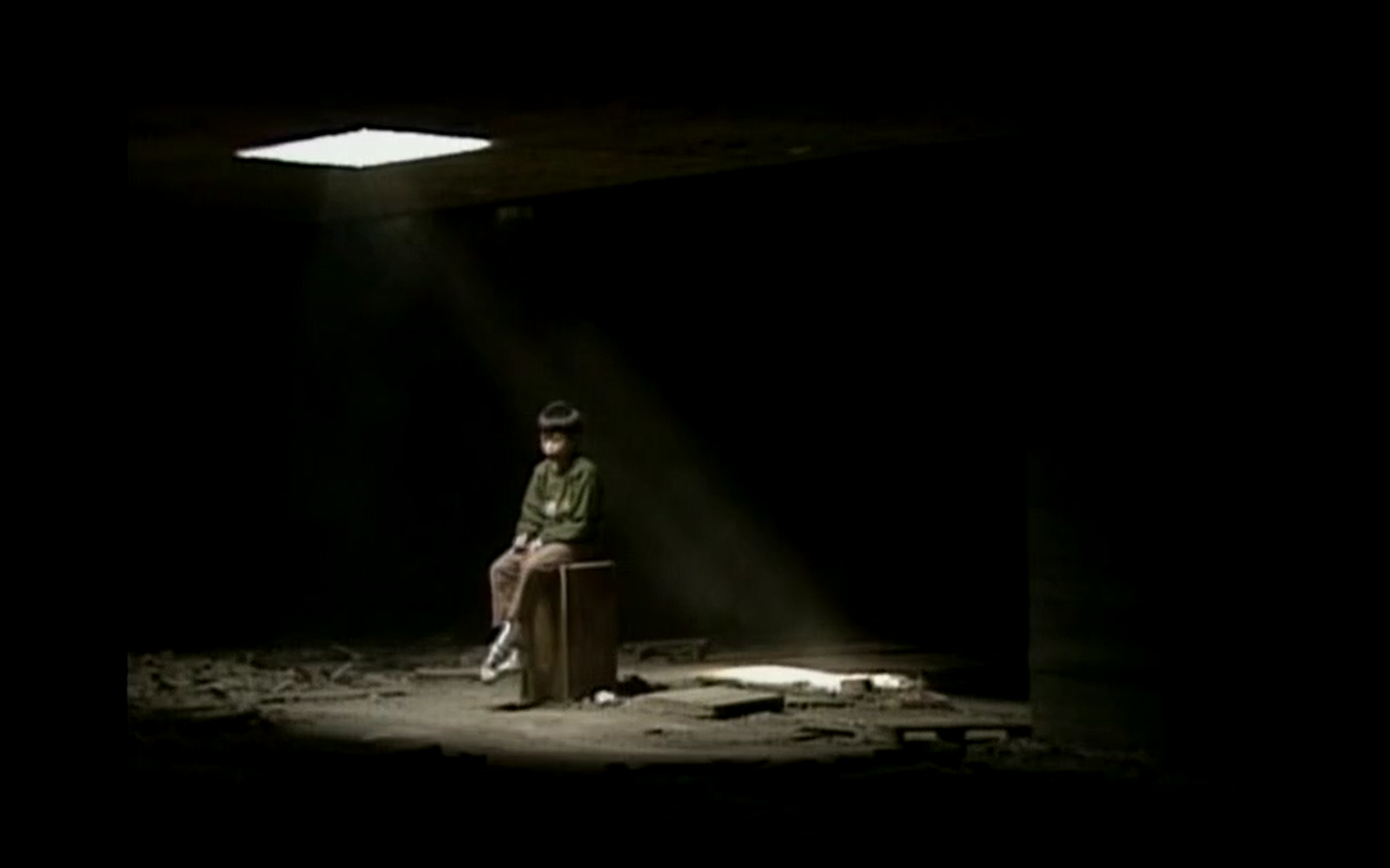
This bleak atmosphere is emphasized by the way the film was shot. The bright, overground scenes offer a deceptive glimmer of hope – the school the children attend seems to promise a prosperous future, while Taipei, though still largely under construction, projects an aura of rapid development, leaving the high-class citizens innocently oblivious to the struggle around them. This brightness stands in stark juxtaposition to the dark, wet, and murky framing of the subterranean house and construction sites where the family’s daily lives unfold. Furthermore, the intentional absence of any non-diegetic sounds only deepens this sense of realism, anchoring viewers in the story and evoking the feel of an observational documentary rather than a standard TV drama.
In his films Tsai frequently employs professional and non-professional actors, and “Give Me a Home” is no different. The mother is portrayed by Hsia Ling-Ling, a well-known figure from 1970s and 1980s Taiwanese television. Despite her background in lighter, commercial series, she delivers a remarkably grounded performance that captures the rawness of social drama. She shares the screen with non-professional actors portraying her family members and migrant workers, whose genuine companionship is highlighted in slice-of-life moments – whether they are cooking and eating together or singing around a guitar on the construction site at night. Those moments allow viewers to connect deeply with the characters, not only forcing them to understand their grueling reality but also wishing for their escape from it.
Tsai’s “Give Me a Home” is a powerful and raw social television drama that portrays the reality of working-class Taiwanese people at the beginning of the 1990s. For a TV production of its era, it is surprisingly bleak – both in its visuals and themes. Yet, through its nuanced narrative structure, it explores a reality that offers glimpses of hope while still leaving its characters in a constant state of anxiousness. Ultimately, it stands not only as a historical document of Taiwan’s rapid urbanization, but also as an illuminating prologue to the director’s career, which would soon redefine societal exploration through his cinematic landscape.



