
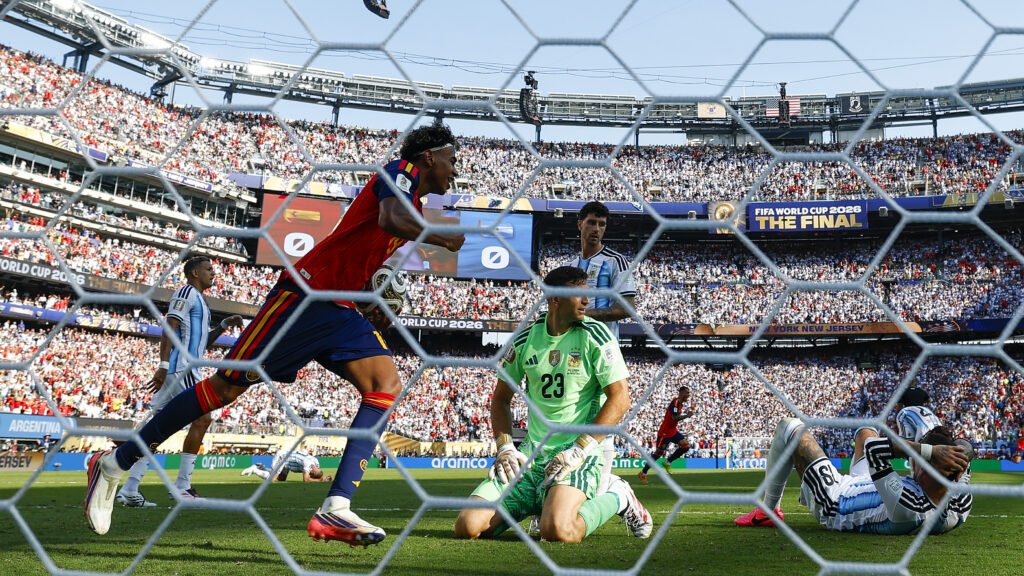
Argentina taught me a lesson about hospitals this summer.
Four years ago, Argentina won the World Cup with a solid team led by Lionel Messi. Messi provided extraordinary talent, but the championship was also built on cohesion, discipline, sacrifice, and players who seemed to understand exactly what they owed to one another. It was a truly well-oiled machine with a genius brain.
This year, Argentina returned with the same coach, Messi as captain again, and many of the same players who won in 2022. The team was still excellent. It reached another final, and Messi, at age 39, remained capable of extraordinary football, evident by the beautiful goals he scored and brilliant assists he provided.
But against Spain, Argentina looked increasingly dependent on defending, absorbing pressure, and waiting for an aging superstar to produce one more decisive moment. Argentina did not register a single shot on target all match, and goalkeeper Emiliano Martínez’s multiple saves were largely responsible for keeping the score close.
Spain, however, was different. The players evolved during the game, controlled the final with style, pressed collectively, and repeatedly created chances before winning 1-0 in extra time. They had superstars on the pitch, like the 19-year-old Lamine Yamal, but they did not shine individually — they appeared as a cohesive team.
As a physician, hospital administrator, and bioethicist watching the game, I found myself thinking less about soccer, and more about health care. Hospitals often make Argentina’s mistake: We confuse continuity with progress. We retain the same leaders, repeat the same improvement plans, preserve the same hierarchies, and continue relying on the same exceptional individuals who helped us achieve our goals before.
I am not naive to the facts that stability is valuable, experience makes a difference, and institutional memory matters. But yesterday’s winning formula can become tomorrow’s blind spot. American hospitals are particularly vulnerable to the mythology of the indispensable physician or leader: the renowned surgeon, brilliant diagnostician, influential department chair, experienced administrator, or clinical leader who can supposedly rescue the organization through individual excellence.
Every hospital wants its own Messi. Extraordinary physicians matter a lot, but their brilliance cannot substitute for a system that works when they are not in the room. Patients rarely experience one clinician. They experience whether the nurse understands the physician’s plan, whether the pharmacist detects a discrepancy, whether case management knows that the discharge decision changed, whether the interpreter is available, and whether the next team receives an accurate handoff.
Patients may stay an extra day in the hospital not because the doctor failed to treat them properly, but because the team collectively failed to communicate a discharge destination in a timely manner. A talented doctor working within a fragmented system may still produce fragmented care.
The strongest hospitals are not those with the most celebrated physicians. They are the ones where information moves cleanly enough that no single individual has to keep rescuing everyone else.
Argentina’s 2022 victory actually reinforces this argument. Messi did not win that tournament alone — he succeeded because Argentina built a team around him. In 2022, Argentina had a team with a common purpose, emotional connection, and willingness to perform less glamorous work.
But organizations often respond to success by preserving their visible components rather than examining the conditions that made this success possible. They keep the stars, retain the structure, repeat the language, and assume the culture will reproduce itself.
The sad reality is that it rarely does. Hospitals make the same error when they copy last year’s strategic plan, retain a familiar committee structure, or continue a once-successful intervention without asking whether patients, employees, technology, or the surrounding environment have changed. They forget that excellence is not inherited. It must be rebuilt and carefully maintained.
The World Cup final also demonstrated what can happen when a strong institution loses its composure. Argentina finished regulation with 10 players after Enzo Fernández received a second yellow card. After the match, a confrontation involving Argentine and Spanish players escalated into a broader altercation that FIFA is now investigating. The Argentines even turned their backs on the winning team as the trophy was lifted. Argentina’s players had competed their way to a second consecutive final, but their increasingly physical approach and the ugly scenes after defeat offer another organizational lesson: Past success does not exempt a team from accountability.
Hospitals, too, can become defensive when their performance declines. Oftentimes, leaders question the data, departments blame one another, and clinicians dismiss patient complaints as unrealistic expectations. Organizations explain poor results by pointing to staffing shortages, difficult patients, unfavorable markets, or imperfect measures.
Again, some of those explanations may be true, but when the explanation becomes defensiveness, the learning processes stop. High-performing organizations must know how to lose: They must be able to acknowledge that a process failed, that another team performed better, or that a long-standing strength has become a limitation. In fact, adopting such mentality is not weakness but it is the beginning of improvement and a sign of strength.
The Argentina’s World Cup lesson extends to institutional decision-making. World Cup fans were frequently angered not only by unfavorable refereeing decisions, but by inconsistency. Similar conduct appeared to receive different treatment depending on the match or moment.
Patients respond the same way. They can often tolerate difficult outcomes when the reasoning is explained. What destroys trust is arbitrariness: One family receives an exception while another does not; one physician follows the policy while another ignores it; one influential patient receives immediate access while others wait. Institutions need to look at consistency not merely as an operational virtue, but as an expression of justice.
The contrast between Argentina and Spain therefore offers more than a lesson about teamwork. It is a warning about organizational complacency. Hospitals rarely decline because their people become incompetent. They decline because yesterday’s strengths harden into today’s blind spots: the experienced leader who now hears every proposal as a threat, the stable structure no one is willing to touch.
The most dangerous version is the hospital whose past success has become its argument for changing nothing. Argentina still had Messi, still had champions, and still had a team capable of reaching the World Cup final, but Spain had become the better system.
American hospitals should pay attention.
Basel Tarab, M.D., is a physician, health care executive, and bioethicist. He serves as director of patient experience at Winchester Hospital, teaches health care administration at Boston College, and is a teaching affiliate at Harvard Medical School’s Center for Bioethics.



