
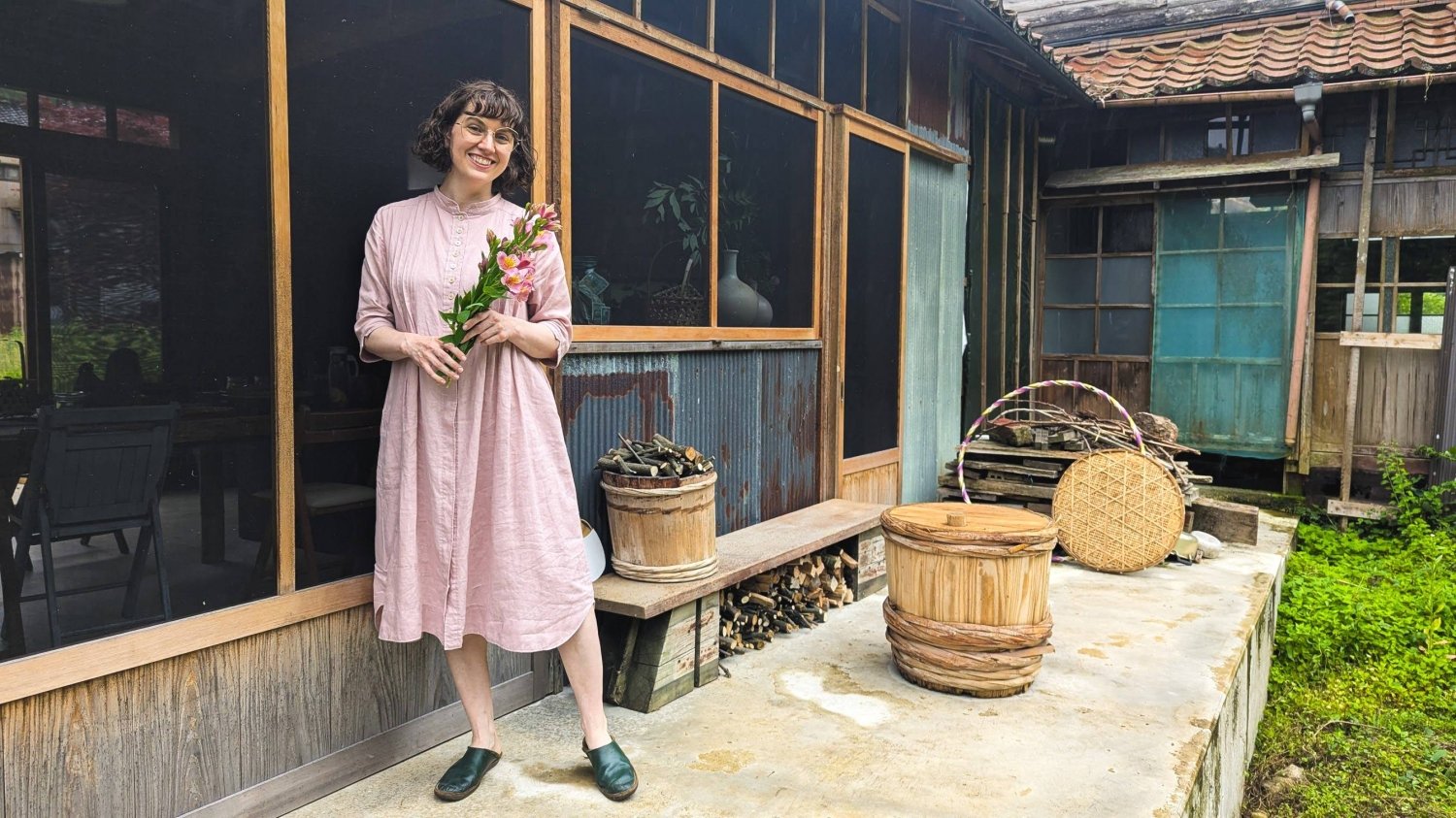
Yamanaka Onsen, Ishikawa Pref. – At the edge of town in the rural Ishikawa village of Yamanaka Onsen, several people approach a rustic kominka that had long been dark until recently. Inside, the murmur of casual conversation bursts into a chorus of friendly greetings as new guests arrive.
The century-old farmhouse, tucked behind a residential area of mostly rickety old homes and one new place still under construction, is accessible by a grassy path. For visitors arriving on foot from the main road, strategically placed signs point the way to the destination in hand-painted Roman letters: Mokkei.
Clad in silvery wood planks and patinaed, corrugated metal with chocolate-hued tiles spanning the roof, the house looks time-worn but stately. There’s a mature red maple and a small vegetable patch out front, with a forest-covered mountain behind it. As a cooking studio and event space, it will serve as both a hub for local knowledge-sharing and a retreat for tourists.
The town’s 1,300-year history includes generations of lacquerware craft, a legendary visit by poet Matsuo Basho in the 17th century and the celebrated hot springs at the center of town, Kiku no Yu.
Eleven years after her first visit, Mokkei’s owner, American author Hannah Kirshner, now calls it home, too. The natural beauty of the area reminds her of the Pacific Northwest, where she grew up. Mokkei is her gesture of gratitude for what Yamanaka has given her.
“As a creative person, I always felt like an outsider,” she says. “And then I came here.”
On a hazy, late-May afternoon with intermittent rain, friends and neighbors stop by Mokkei for an open-house reception. Many of them, from a tea ceremony teacher to a book publisher visiting from Tokyo, have played some part in Kirshner’s journey.
“Hannah has a personality that makes everyone feel comfortable right away,” says Mika Horie, a paper artist who was one of Kirshner’s first friends in Yamanaka. Many tourists who visit her studio have a strong interest in the local culture, which she credits to Kirshner’s writing about Yamanaka.
“Since the establishment of Mokkei, we have also supported short-term artist stay programs, building even deeper cultural bridges,” Horie says.
Mokkei’s airy space is backed by a wall of cabinets where dishes are stacked behind upcycled Showa Era (1926 to 1989) patterned glass. Screen windows on the other three sides let in views of the lush surrounding landscape and a slight breeze. A high ceiling reveals the roof structure with three massive beams spanning the room, while Kirshner’s collection of antique zaru — flat, round baskets used for harvesting and drying herbs, fruits, and vegetables — hangs like artwork in one corner.
Kirshner had spotted the property years ago and dreamed…



