
Topline
With Spain’s first total solar eclipse since 1905 occurring on Aug. 12, the mayor of a tiny village has defended the decision to close vehicle access to one of the most sought-after viewing locations, insisting public safety and environmental protection must come before economic gain. Jabaloyas, in the province of Teruel in Aragon, Spain, is home to just 66 residents. Yet, its highest peak, El Javalón, has become recognized as one of Spain’s top places to experience totality. Beyond a logistical decision, it raises a broader question: what does sustainable tourism look like when a global astrotourism event places a small, remote community at the center of international attention?
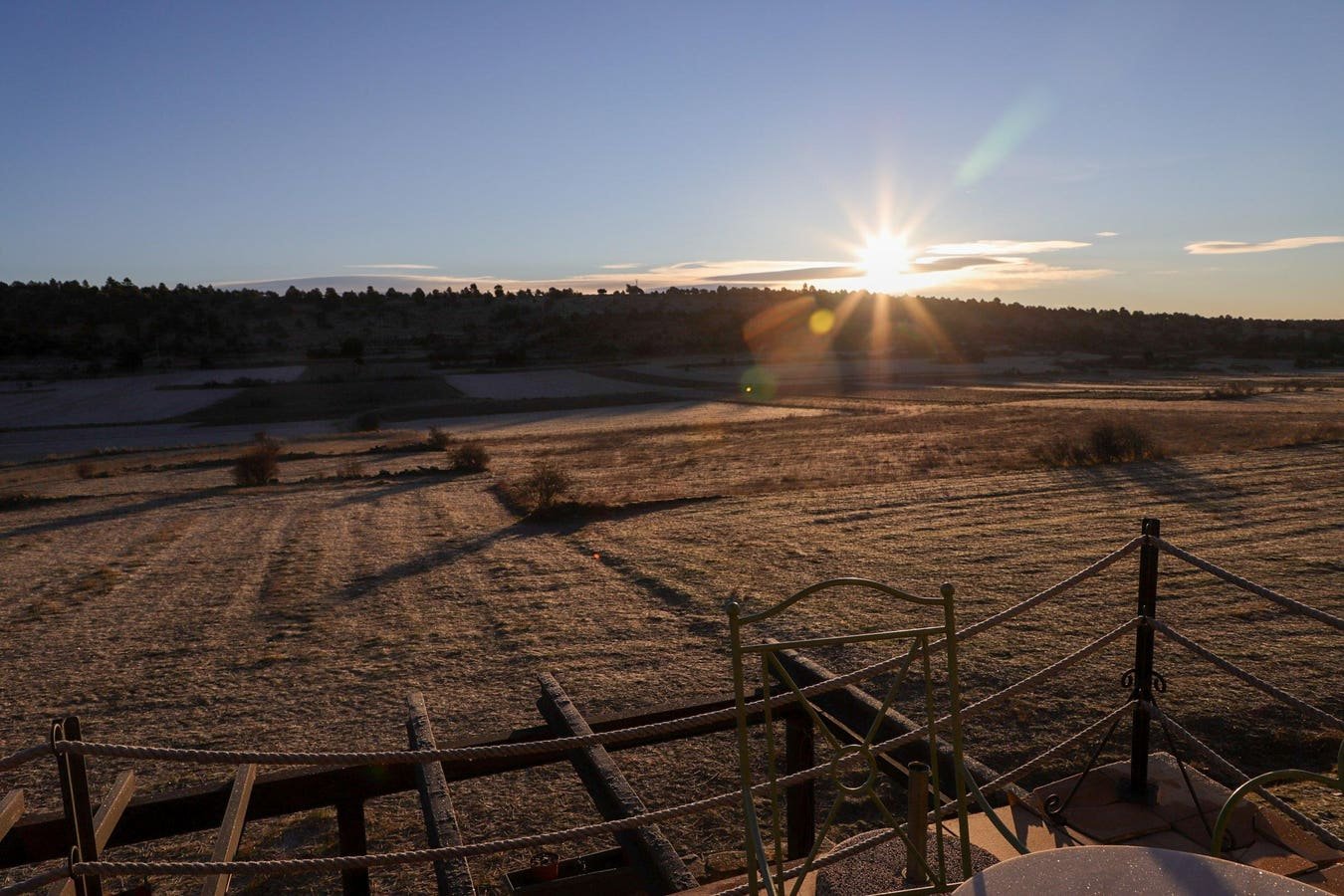
Jabaloyas in Aragon, Spain, will close vehicle access to El Javalón during the 2026 total solar eclipse, putting public safety and the environment ahead of tourism.
getty
Key Facts
On Aug. 12, a path of totality will cross parts of Greenland, Iceland, Spain and Portugal at sunset. From Spain, it will begin in Galicia in the northwest and end in the Balearic Islands in the Mediterranean Sea.
The eclipsed sun will sit very low in the sky as seen from eastern Spain, making a clear western horizon essential. That makes elevated sites like El Javalón a perfect viewing location.
It will be followed less than a year later by another total solar eclipse in southern Spain on Aug. 2, 2027, and a “ring of fire” annular solar eclipse on Jan. 26, 2028.
The tiny village of Jabaloyas in the Sierra de Albarracín mountains will experience 1 minute 27 seconds of totality, when the moon entirely blocks the sun and the sun’s corona becomes visible to the naked eye. On the edge of the town, a warning tells travelers they are entering a land of ancient legends.
At the peak of nearby El Javalón, just outside Jabaloyas, observers will experience 1 minute 26 seconds of totality. Fearing that visitor numbers could overwhelm its infrastructure, authorities have ordered the closure of the 3.5-mile mountain road for 24 hours, allowing access only on foot.
Barcelona, Catalunya’s capital city on Spain’s eastern coast, has in recent years become a symbol of the fight against overtourism.
The path of totality for the total solar eclipse on Aug. 12, 2026.
Michael Zeiler/EclipseAtlas.com
Preparing For An Unprecedented Crowd
El Javalón elevation, combined with its Starlight-certified skies, has placed the village of Jabaloyas firmly on the radar of eclipse chasers from around the world. “We’d known for months that this eclipse was going to be exceptional, but when El Javalón started being singled out as one of the best viewpoints in Spain — we’re a Starlight-certified site, with one of the darkest skies on the peninsula — we understood that the turnout could far exceed what a municipality our size could handle,” said Óscar Castillo, mayor of Jabaloyas, in an email. Although some questioned whether limited vehicle access might have been possible, Castillo said the reality was that a village of Jabaloyas’ size — where just 18 people live year-round — lacks the resources to operate a safe traffic management system. “That road wasn’t built for thousands of vehicles in a single day, and a ‘limited’ access plan would require a traffic and emergency operation that a municipality like ours doesn’t have.” He added that safety has been the only priority. “Closing off El Javalón isn’t about stopping people from enjoying the eclipse — it’s about making sure they can do it safely, and that this historic day is remembered without a single incident to regret.”
Safety And Conservation Go Hand In Hand
In an echo of what hundreds of towns in the path of totality across North America experienced in advance of the total solar eclipse on April 8, 2024, Castillo said the greatest concern is that heavy traffic could leave emergency services unable to reach anyone in need. “The main risk would be the road collapsing under the traffic,” he said about the route up El Javalón. “A jam that keeps an ambulance or firefighters from getting through isn’t a hypothetical — it’s the exact scenario we want to avoid.” However, despite a request to the Guardia Civil — Spain’s national law enforcement agency — asking for a patrol on eclipse day, nothing has been confirmed. “If reinforcements don’t arrive, I’ll close the road myself with stones or trailers,” said Castillo.
The route to El Javalón also passes through the UNESCO-recognized Valle del Cabriel Biosphere Reserve, where wildfire risk and damage to the surrounding landscape are high. More than 300,000 residents and tourists have been displaced across Spain and France due to wildfires in recent weeks.
Visitors Are Still Welcome
The tension between wanting to benefit from the eclipse and safety is obvious. “We all want Jabaloyas to welcome visitors and for our local businesses to benefit from an event like this,” said Castillo. “But a mayor can’t make decisions based solely on the economic impact of a single day. Safety can never be up for sale.”
Despite the vehicle restriction, eclipse enthusiasts will still be able to walk to the summit. At the same time, numerous other viewpoints across Jabaloyas and the wider Sierra de Albarracín region will offer outstanding views of totality. The eclipse also coincides with the village’s annual patron saint festivities, when around 500 former residents return home. “We’d rather have people who stay, who spend a few days living alongside us, than an avalanche of thousands of people for the minute and a half the eclipse lasts,” said Castillo. That distinction, he argues, reflects the difference between sustainable tourism and overwhelming a small rural community.
Further reading
source: https://www.forbes.com/sites/jamiecartereurope/2026/08/04/how-a-village-of-66-in-spain-is-preparing-for-the-eclipse—by-closing-its-mountain/



