
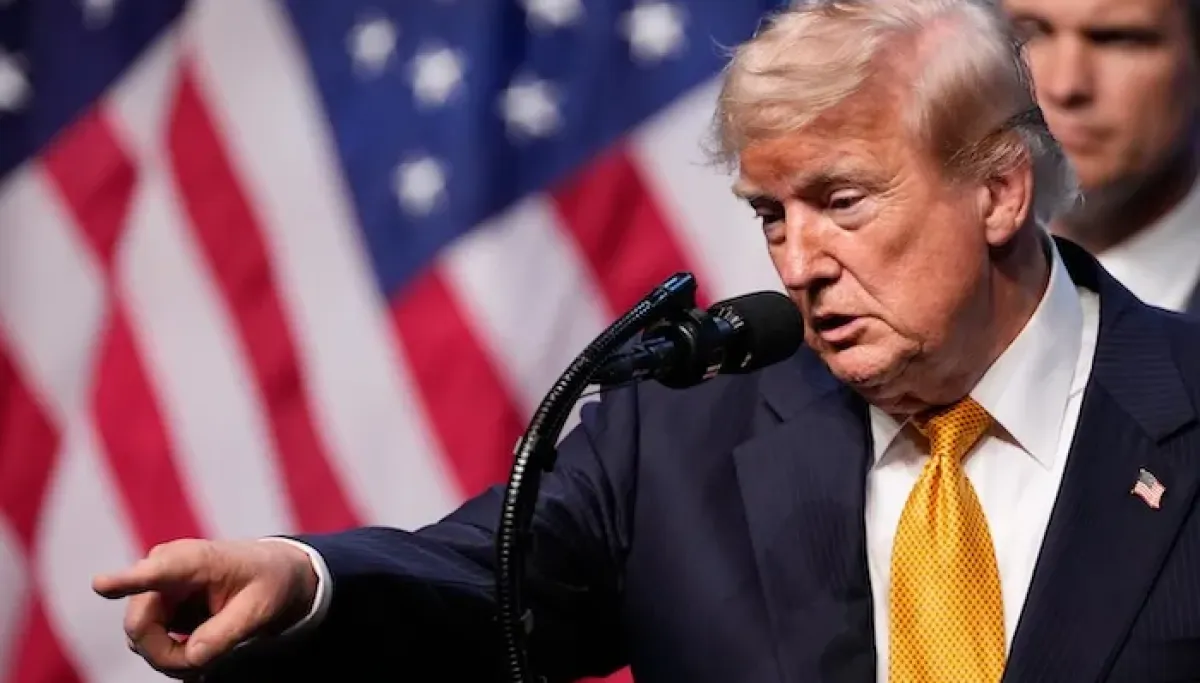
President Donald Trump’s latest turn on Iran suggests how an alleged Iranian assassination plot has added a personal dimension to what allies describe as his yearslong determination to prevent Tehran from obtaining a nuclear weapon.
Trump was in Turkey on Wednesday for a summit with NATO leaders, where he told reporters that, following the latest exchange of attacks between the United States and Iran, the ceasefire negotiations were “over.”
Across multiple engagements with the press, spanning bilateral meetings with Ukrainian President Volodymyr Zelensky, Syrian President Ahmed al Sharaa, and a solo press conference, Trump claimed that he no longer was seeking a diplomatic end to the war and that Iran was once again actively trying to kill him.
“I’m number one on the kill list for Iran,” he said. “There was another list that came out yesterday, and I’m number one on it. I like being number one on TikTok better, but I’m number one on the list for killing.”
The Biden administration uncovered an Iranian plan to assassinate Trump on the 2024 campaign trail. The Trump administration announced in March that it had killed the Iranian officials behind the plan, and four former senior Trump officials suggested to the Washington Examiner that the plot had at least partially motivated Trump’s rationale for launching the war back in the spring.
“It’s not the only thing, but, clearly, it’s personal,” one National Security Council aide from Trump’s first term said Wednesday, pointing directly to the 2024 Iranian assassination plot, itself an alleged retaliation for Trump’s own killing of Iran’s former Quds Force Commander Qassem Soleimani.
A former senior Trump White House aide told the Washington Examiner that the president has been “zeroed in” on preventing Iran from obtaining a nuclear weapon since before he entered office in 2017 and that it was the core driver of the war.
But the aide said the assassination threats have added a personal dimension to a confrontation Trump has viewed as central to his foreign policy for nearly a decade.
White House and Trump administration officials declined to elaborate Wednesday on the new “kill list” Trump referenced in his remarks.
Trump’s comments came in response to a question about his surprise decision not to depart Turkey aboard the “brand new” Air Force One. Earlier in the day, Trump said the plane would fly to an American base in the United Kingdom to be shown off to U.S. military personnel, while he would travel separately to the United Kingdom on the “former” Air Force One before returning to the U.S.
Reports on Wednesday suggested that the new plane, a jet previously gifted to Trump by Qatar and recently retrofitted for service in the executive fleet, lacked certain in-air security systems, specifically missile detectors and countermeasures, featured on the older jets, a difference that hypothetically put the president’s life in danger while flying so close to Iran.
“The new Air Force One is a state-of-the-art aircraft that has been fitted with high-level security protocols that ensure the safety of the President and his staff,” said White House Communications Director Steven Cheung. “As the President has said recently, there are many enemies of America who have their sights on him, and we use every tool at our disposal — including distraction and misdirection — to address those threats.”
Even as Trump emphasized threats against his life, he remained adamant on Wednesday that Iran would not be allowed to obtain a nuclear weapon.
At the NATO summit, Trump told reporters that the U.S. had already effectively obtained Iran’s enriched uranium “because it’s so far underground, nobody’s going to be able to get it except us because we have the equipment that can get it.”
TRUMP SAYS IRAN CEASEFIRE IS ‘OVER’: THEY’RE SCUM. THEY’RE SICK PEOPLE’
Despite the resumption of hostilities, the president downplayed an American ground invasion to recover the materiel and claimed during his press conference that the U.S. is directly monitoring Iran’s nuclear sites, which were buried during last summer’s Operation Midnight Hammer, via Space Force’s satellite network.
The dual focus, Iran’s alleged threats against Trump personally and its nuclear ambitions, underscored how the president’s latest posture toward Tehran blends a long-standing strategic objective with a war that has become increasingly personal.



