
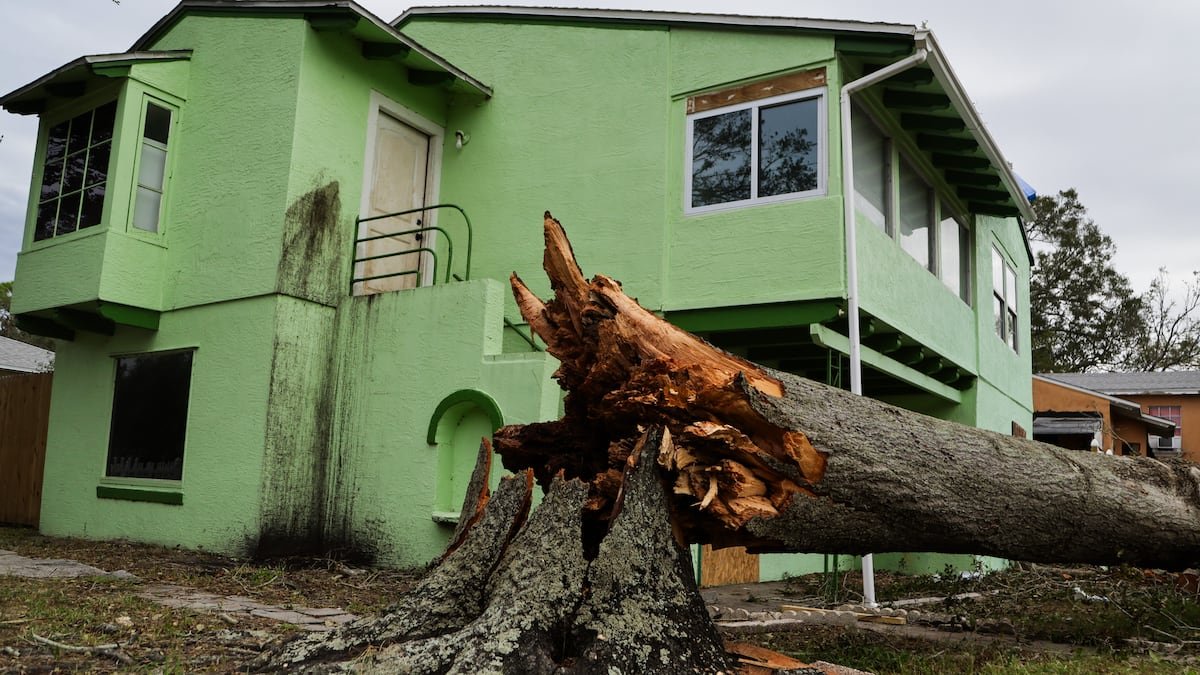
The flooding storm surge and powerful winds of the 2024 hurricane season packed a punch against St. Petersburg’s trees, according to data presented by the city.
By January 2025, about 6% of the city’s trees were felled. And overall, the city lost about 1.8% of its tree canopy coverage, the billowing leaves and branches that shade and cool communities.
In a committee meeting Thursday, Maeven Rogers, St. Petersburg’s sustainability and resilience director, presented the findings to the city’s Health, Energy, Resilience and Sustainability Committee.
The conversation veered into how to grow and maintain the canopy after the hurricanes, and how to do so fairly across the city.
In 2022, the city announced a goal to reach 30% tree canopy coverage citywide.
Around April 2024, the city averaged nearly 29% canopy coverage, though some voting districts fell below that average. By January 2025, the average canopy coverage dropped to about 27%.
“There are neighborhoods that existed before the storm and exist now that lack tree canopy,” Rogers said. “We’re working to create programs right now that would help address that loss.”
Rogers cautioned council members that the data could be squishy. The city conducted the study using a dot method, which takes hundreds of randomized photos within all eight districts of St. Petersburg. City staff then interpreted those photos.
The city of Tampa and Pinellas County used the same method when calculating canopy loss after the hurricanes, Rogers said. Pinellas likely lost about 1.8% of its canopy, and Tampa likely lost about 1.5%.
Typically, lidar data — which stands for light detection and ranging — is used for determining canopy coverage. Rogers said the U.S. Department of Agriculture has the lidar data but has yet to release it.
Canopy loss across the city means less cooling on hotter days, which can lead to higher energy bills, increased air pollution and more stormwater runoff.
The city estimated that a canopy loss of this size could lead to about 19.5 million more gallons of runoff per year — about 20 swimming pools worth of water.

Since the 2024 storms, the city has given out about 3,200 trees and planted another 1,049, Rogers told council members. Other city departments, like engineering and parks, are not included in those numbers.
“We know there’s certain districts that have a disproportionate canopy compared to other districts, so the idea is to focus these programs and giveaways in those districts, and we’re working towards that,” Rogers said.
District 1, which includes Tyrone Square, and District 6, which includes Tropicana Field, had the lowest canopy coverage after the storms — about 19.6% and 19.8%, respectively.
In May 2024, the city held five tree canopy workshops with the intent of deciding how to plant trees where residents needed them most. At one meeting in Campbell Park, which lies in District 6, a resident told the Tampa Bay Times that they had never heard the term “tree equity” before.
“It just never hit me that that is a form of discrimination,” Sofia Forte said at the time. “That’s a sharp reality.”
Corey Givens Jr., the council member representing District 7, said community members worry over the legal, financial and physical liabilities of receiving city trees.
“I want to talk a little bit about those programs, because there’s a lot of people who are talking in the community who are leery about accepting these free trees,” Givens said.
Previously, the city had a right of way tree-planting program. Residents told the city the program had long wait times and was often confusing, Rogers said.
“One thing our office does not want to do in a program like this is create frustration,” Rogers said.
The program was dissolved, she said, and it will be replaced with a “newer, more flexible model.” In the new program, the city will provide options for tree planting and guidance, but it won’t plant the trees.
The city said it’s also looking to identify volunteers and neighborhood associations to help neighbors maintain their trees.
“We recognize that we, right now, given the resources we have, we can’t do it all,” said Claude Tankersley, the city’s public works administrator.
“And since trees are a community asset, there are people, there are volunteers in the community out there that are willing to do the watering.”
The conversation ended with the chairperson of the committee, council member Brandi Gabbard, seeking more granular and updated data on the tree canopy and tree planting efforts.
She was surprised to see so little canopy change in her own community.
District 2 had the lowest canopy cover loss, at 0.4%. In her own yard, she said she had to remove five trees after they began dying from saltwater intrusion and wind damage. She removed the trees months after the study’s completion.
“I just worry that some of these numbers, there may be a bigger impact than what we’re really seeing,” Gabbard said.
• • •
The Tampa Bay Times launched the Environment Hub in 2025 to focus on some of Florida‘s most urgent and enduring challenges. You can contribute through our journalism fund by clicking here.



