
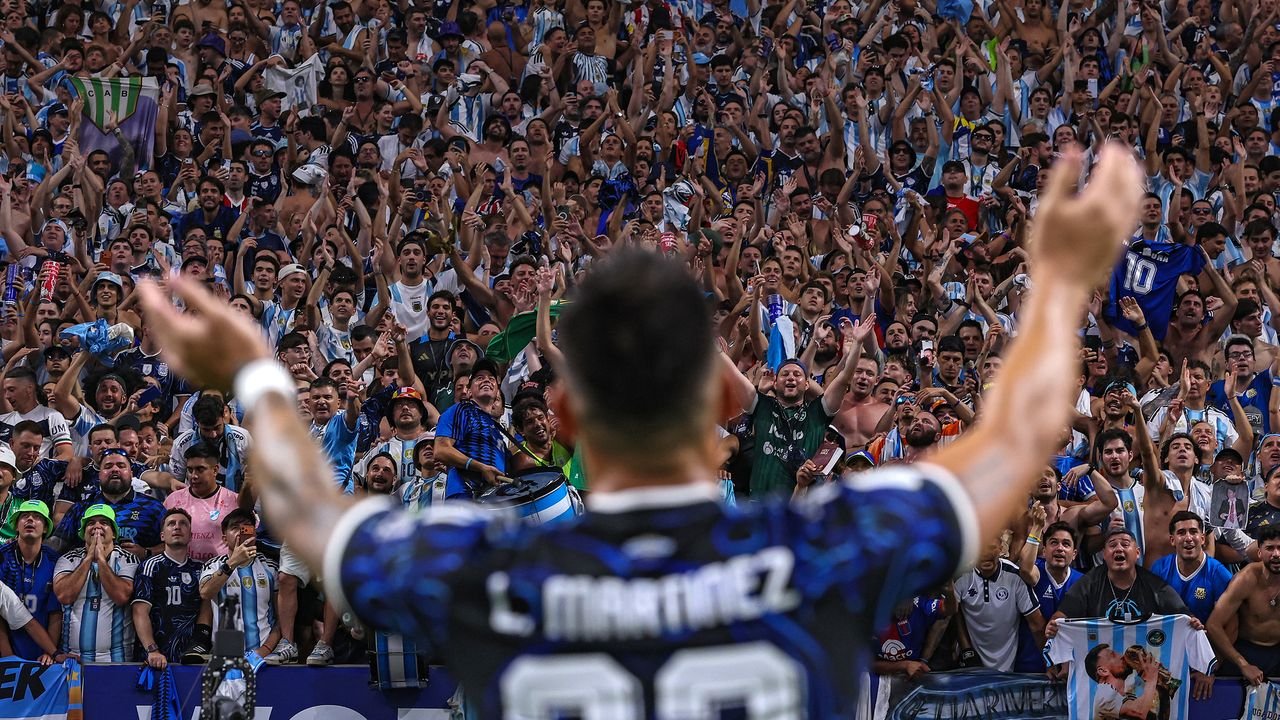
How sad it was, then, to feel this fine air of geographical diversity begin to dissipate, as the competition thinned from forty-eight teams to thirty-two, and thence into the knockout stages, and so on. The problem with the World Cup, in short, is that it’s still not very worldy. Consider the eight teams that made it to the quarterfinal; six of them were from Europe. Africa was represented by Morocco, Asia by nobody at all. What survived of the Americas, of course, was Argentina, which will doggedly carry on pinging the ball around the central midfield in the wake of a nuclear winter. Lionel Messi would skip past an asteroid. So it was that the smart money that had been placed on Japan, Côte d’Ivoire, and other promising squads, in the hope of something other than the obvious, slipped down the drain.
There’s more to it than that, though. With every World Cup, the possibility that a genuine surprise will be sprung, either at the collective or the individual level, is shrinking. (Hence our relief, not merely our delight, at the spectacle of Vozinha.) Any truly exceptional player, from anywhere, is likely to have been scouted, signed up, and shipped to the Premier League, La Liga, Ligue 1, the Bundesliga, or Serie A, long before he takes the field on the global stage; in a sense, indeed, he already is a global figure, because all of those leagues are televised across the galaxy. I was as poleaxed as anyone by the volley that James Rodríguez struck for Colombia, against Uruguay, in the 2014 World Cup, and immediately texted a friend: “Who is this boy? Where did he come from?” Back came a reply: “Been playing for Porto since 2010. Now with Monaco. Try to keep up.” On the strength of that tournament—and, in part, of that volley—Rodríguez was signed to Real Madrid, for a reported eighty million dollars or more. The star had become a supercog. Welcome to the machine.
In other words, there is no recapturing the mythological—and curiously innocent—gleam of earlier World Cup eras. Part of the allure of Pelé, say, was that, unless you lived in São Paulo, and saw him work regular wonders for his club, Santos, you barely glimpsed the guy. It’s true that Santos sometimes went on tour, playing friendlies against European clubs, but, for the most part, only on fuzzy and flickering TV sets, every four years, from 1958 to 1970, did the rest of us have a chance to witness Pelé in his prime. Needless to say, it was precisely such rarity that enriched his lustre. That is unthinkable today. Call it the sporting equivalent of James Bond movies; whereas viewers watching “From Russia with Love,” in 1963, could sigh and say, “So that’s what Istanbul looks like. Lucky 007,” their descendants will yawn and show you the batch of selfies that they took at the Blue Mosque last weekend. In a bold move to stretch the boundaries, some of “Moonraker” was set in space, but that—as yet—is an option unavailable to Gianni Infantino, the balding Bond villain of FIFA. Even if he tried, it would end with Argentina beating Jupiter on penalties. Aliens would weep in the stands.
In one respect, this World Cup was like any other. That is to say, it was preceded by soothsayings of unparalleled gloom, which faded at the first kick of a ball. Although there were sound reasons for boycotting both Russia, in 2018, and Qatar, in 2022, earthlings still tucked their consciences into their back pockets and showed up. As for coming to America in 2026, who would shoulder the exorbitant costs and the travel challenges, let alone the risk of being pulled out of a line at the Atlanta airport, interrogated, and sent back home for joking about penalty shoot-outs? And the answer was: pretty much anyone who could.



