
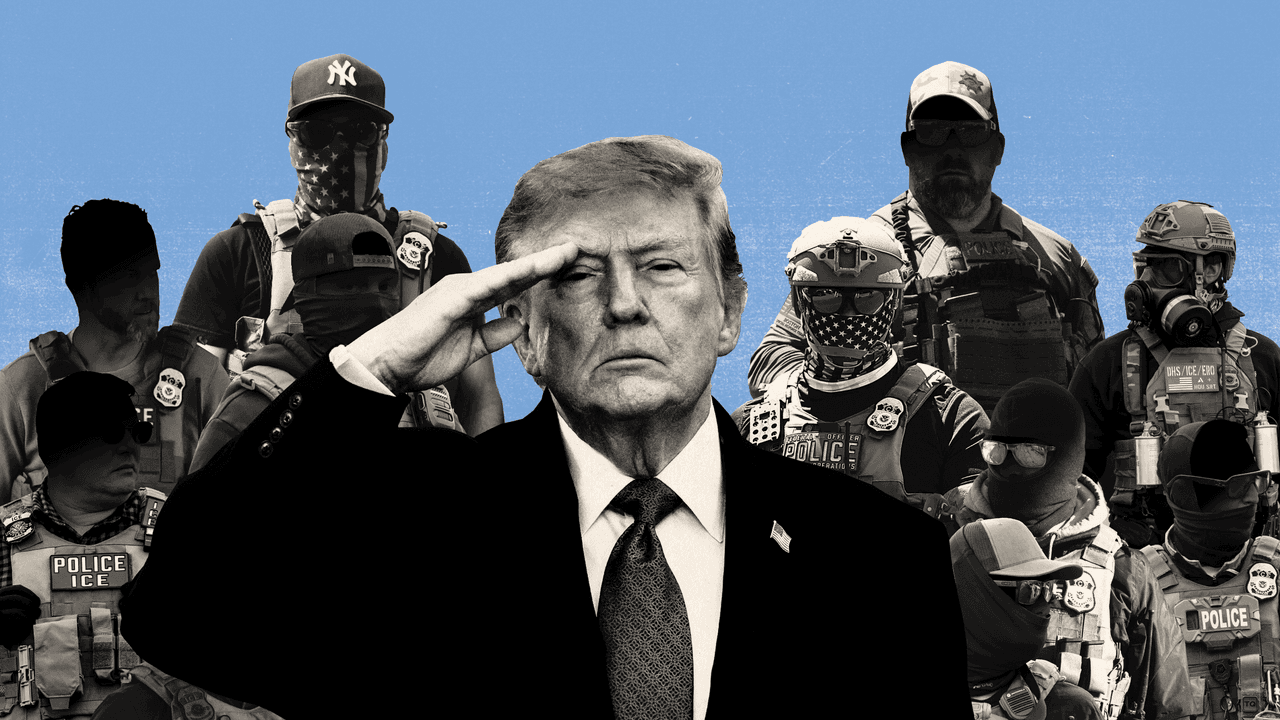
It has taken the Trump Administration less than two years to make violent encounters with federal immigration agents a regular fact of American life. On a single day late last month, a citizen and a noncitizen—one in Illinois, the other in Texas—became the most recent examples of this new reality. That morning, in Evanston, a Black man walking to a pharmacy was left injured and bleeding by the side of a road after a group of ICE officers, mistaking him for an immigrant “fugitive,” threw him to the ground and tried to handcuff him. Once the agents realized that he was a U.S. citizen, they said that they offered him “assistance,” then drove off. A few hours later, in Austin, an ICE officer shot a Venezuelan delivery driver in the back as he tried to flee in his car. He was detained, and partial paralysis had set in before doctors removed the bullet, several days later. Last Tuesday, the Department of Justice announced that it was charging the man with assaulting the officer who shot him.
Almost as alarming as the incidents themselves has been the government’s refusal to acknowledge a pattern of abuse that is clearly metastasizing at the Department of Homeland Security. Since Donald Trump took office last year, agents from D.H.S. have shot at some two dozen people in the United States, killing six of them. The deaths of Renee Good and Alex Pretti during Operation Metro Surge, in Minnesota last January, were a turning point in the public’s awareness of the problem, but their deaths were not the first. Ten months earlier, in South Padre Island, Texas, Ruben Ray Martinez, a twenty-three-year-old U.S. citizen, was shot and killed by an ICE officer—something that the government didn’t disclose for nearly a year, until American Oversight, a nonprofit group, obtained the incident report. In one week this past July, ICE agents killed Lorenzo Salgado Araujo, a Mexican national who had lived in this country for thirty-five years, raising a family and running a building company, and Johan Sebastián Durán Guerrero, a twenty-five-year-old Colombian with a wife and toddler. These incidents were documented as officer shootings. But how, for instance, should news outlets categorize the death, on July 14th, of a Mexican man visiting family in Florida, on a tourist visa, who was hit by a tractor-trailer as he ran from immigration agents?
Not only has no ICE officer been federally charged in these deaths, but the agency has made a habit of casting blame on the people it has appeared to victimize, turning impunity into another form of aggression. The most common claim is that immigrants attempting to escape arrest are “assaulting” officers and, in particular, that motorists are “weaponizing” their vehicles. In many cases, video evidence seems to contradict such accounts; in others, officers weren’t wearing their body cameras. The Times found that the Administration had filed assault charges against more than five hundred and fifty people and that, in about half of the roughly four hundred cases that have been resolved, “juries acquitted defendants, judges threw out charges, or prosecutors withdrew them.”
Because the federal government has largely forsworn—and, indeed, actively blocked—independent investigations of its agents, states have tried to bring their own cases. In August, prosecutors in Minnesota were seeking the extradition of Christian Castro, an ICE agent being held in Texas, who was wanted for shooting a Venezuelan national in the leg during Operation Metro Surge. When Greg Abbott, the Texas governor, refused Minnesota’s request, Castro was released. The Justice Department then charged Castro with making “false statements”—he claimed that he’d been attacked with a broom and a snow shovel before firing—a considerably lesser charge than the ones he could have faced. An Assistant U.S. Attorney in Minnesota, Matthew Evans, told the victim’s lawyers that he’d “objected in the strongest possible terms,” but that the decision had been made in Washington. Evans was fired and is now being investigated for allegedly leaking information about the case.
This all comes at a time when ICE arrests have reached a record high—nearly fifty-one thousand in August alone—with agents conducting operations nationwide at hospitals, at airports, and outside schools. Past calls by Democratic lawmakers for D.H.S. agents to end the practice of wearing masks in public were ignored, and this summer the department announced that it would be purchasing for its personnel twenty million dollars’ worth of gloves that deliver powerful electric shocks. Flush with cash from Congress, D.H.S. is planning to hire five thousand more ICE officers by the end of the year. Recently, it signed seven billion dollars in construction contracts to build more detention centers. Meanwhile, in all but one of the existing two hundred and thirty-nine immigration jails across the country, the A.P. reported, ICE has stopped listing in its online database, known as the detainee locator, the whereabouts of people in custody who have final deportation orders. If people’s names don’t show up in the locator, their family members and lawyers won’t immediately be able to find them. In July, sixteen thousand people arrested by ICE, or about a third of those entering detention that month, had final deportation orders.



