
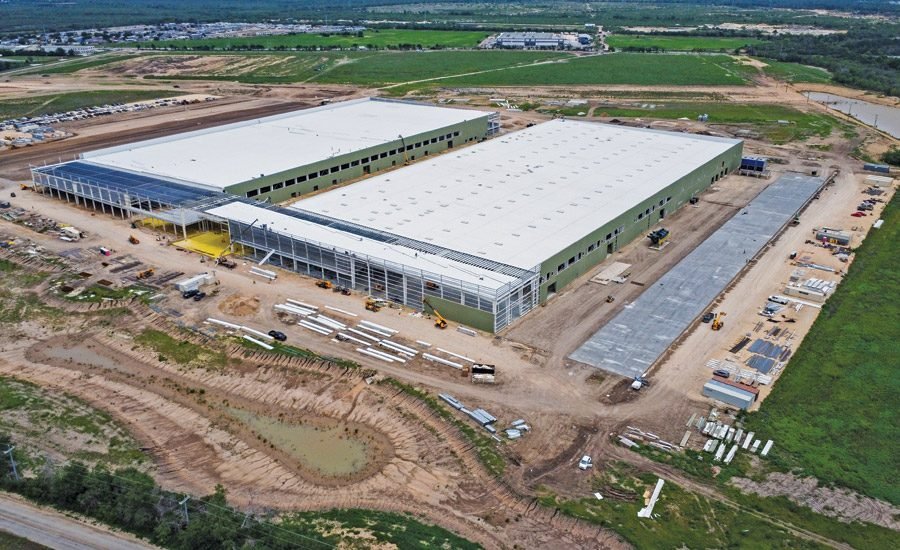
Along State Highway 16 on San Antonio’s South Side, a 50-ft-high steel structure is rising from a grid of 414 concrete piers driven 40 ft into expansive clay soils. Cranes track across the building’s interior. A low hum carries across the site—pumps are running.
British heavy equipment manufacturer JCB bought this 400-acre stretch of farmland with plans for a 500,000-sq-ft U.S. factory. But before construction even started, that number doubled. Today, the 1-million-sq-ft structure is climbing out of the ground—enclosing what will become the company’s most automated factory in its 80-year history, and the first to ensure that the bulk of what it sells in North America is manufactured there.
The decision to double the footprint was formalized in April 2025, when JCB announced the expansion in direct response to the Trump administration’s tariff announcements. CEO Graeme Macdonald said in the company’s release that the tariffs would have a “significant impact” on its business in the short term, but that the San Antonio factory would help mitigate those effects in the medium term. Ben Emery, JCB senior manager of engineering projects and the company’s point person on the ground since preconstruction, frames the scale as consistent with a longer view. “We bought 400 acres and planned a 500,000-square-foot facility,” he says. “Now we’re doing one million square feet, so we can do more, quicker.” The land had been purchased with a 50-year horizon in mind, he adds—the tariff announcement accelerated a trajectory already in motion.
JCB’s San Antonio facility will produce Loadall telescopic handlers and aerial access equipment.
Photo courtesy of Joeris General Contractors
The market logic is straightforward. About 80% of what JCB sells in North America is currently imported. Once the San Antonio plant begins operation with its first product lines—Loadall telescopic handlers and aerial access equipment—that ratio is projected to reverse. “It’s flipped to 85% of what we sell in North America is made in North America,” Emery says. “That releases capacity in our U.K. plants to build more machines for the U.K. as well. So it’s a good growth strategy.”
Joeris General Contractors, the San Antonio-based construction manager at risk, was involved from the start. “We got in at the napkin-sketch stage,” says Rusty Medlin, Joeris vice president of industrial. Preconstruction began in February 2024, with construction starting in March 2025 once the full civil and foundation package was complete. The team received 100% construction documents that August. The project is deep into vertical construction, with phased turnover beginning Sept. 10 and final completion set for late January 2027. To date, the project has logged approximately 438,000 worker hours on site.

The facility is part of the company’s plan to expand its manufacturing footprint in North American.
Photo courtesy of Joeris General Contractors
Forty Feet Down
Building at scale on South San Antonio farmland started with a problem beneath the surface. The site’s expansive clay soils—high-PVR material that swells when wet and shrinks during dry spells—required deep foundations before a single column could be erected. “Coordination becomes critical when you have different packages—a foundation package, a civil package, a site package,” says Reuben Torres, Joeris project executive, noting that the sequencing demands that come with a footprint this large present challenges even before the main construction team is fully mobilized.
For JCB, the conditions were a departure from anything the company had built before. “We had to excavate 6 feet, remove fat clays, compact the base and install 414 piers at 40 feet deep,” Emery says. “That’s not typical for England—we usually use spread footings. It was new for us, but locals said it was normal. Local knowledge has been critical.”
Crews advance interior work inside JCB’s factory, using aerial equipment to install and connect structural steel.
Photo courtesy of Joeris General Contractors
The foundation challenges were only the beginning. Managing traffic patterns, deliveries and trade sequencing across a 400-acre active site required a level of coordination uncommon on more contained urban projects. “Logistics seem simple, but [they are] really not,” says Randen Sheehan, one of five Joeris superintendents on the project. “We have a logistics plan that’s a living document. We adapt every day based on weather conditions, deliveries, staging around the building, how we build the structure and how we accommodate the other trade partners.”
“We bought 400 acres; we’re currently building on 105. The vision is to fill all 400.”
—Ben Emery, Senior Manager, Engineering Projects, JCB
On the day ENR visited, South Texas weather put that plan to the test. After months of drought, a severe storm in early May dropped 3 in. of rain on the site in less than 24 hours, forcing the team to deploy seven pumps, work through the weekend to dewater areas slated for concrete and spread lime to accelerate drying. “We should be back on our slabs tomorrow,” Tim Edward, superintendent, said after the storm. The site’s temporary road network was built to handle the load—more than 250 semi‑trucks of owner‑furnished equipment are moving through the property—and it has held up. “If we didn’t have the road structure that we have, we would still have 12‑foot ruts,” Medlin says. “But the road surfaces are still in good shape.”
Keeping enough workers on site is part of the same logistics challenge, especially with other large projects underway in the area. “With SpaceX, Tesla, Samsung, NXP and the data centers, [workforce] can be an issue,” Sheehan says. To stay ahead of those constraints, Joeris leaned on a trade‑partner network built over nearly six decades in San Antonio. “Joeris has been around since 1967,” Medlin says. “We have over 8,000 trade partners in our database, and we’re just a Texas contractor.” The firm executed design‑assist agreements with all MEP trades, an approach that allowed early vetting of each partner’s capacity for resource and change‑order management.
Construction workers move beneath exposed steel beams as aerial machines support interior build‑out.
Photo courtesy of Joeris General Contractors
Separated By Design
The project team looked to JCB’s Savannah, Ga., facility as a reference for the San Antonio design. Members of the Joeris preconstruction team who toured the Savannah plant returned with a consistent takeaway: learning how to manage heat was one of the biggest lessons, Medlin says.
In response, the design team evaluated four HVAC approaches before settling on a water‑cooled system sized to maintain a defined ambient temperature during a peak August day with the full factory floor operating.
“This facility is going to hire 1,400 people. You can already see the growth around the property—apartments, retail centers.”
—Randen Sheehan, Superintendent, Joeris General Contractors
JCB took the lesson further by separating its process areas into distinct buildings. The paint shop, weld shop and assembly hall are no longer under one roof. “Paint shops get hot, so they’re in their own zone,” Emery says. “Weld shops get fumy, so we have huge extraction systems. Assembly is clean, cooled and in its own building.”
The weld fume extraction system filters air and returns it as clean, cooled supply—rather than exhausting it entirely, which would compound the heat load. For the paint shop, JCB adopted an electric flight-bar conveyor from vendor Thermatonics that allows each part to move independently through the line. “If any one of those has an issue, we can fix that one in isolation, and the rest of the plant can still keep going,” Emery says.
Structural flexibility ran through every major design decision. Column spacing was set at 40-meter spans to allow large equipment to be repositioned without constraint. Crane systems were installed throughout the facility for full overhead coverage. Insulated panel walls are designed for future removal as the assembly hall expands outward. “We design facilities to be flexible and modular because what we make today may change in 10 years,” Emery says.
After May showers moved through the region, an aerial view shows construction activity continuing across the site.
Photo courtesy of Joeris General Contractors
The 400-acre Vision
Emery joined the project as employee No. 4 on JCB’s Texas roster. The local team is now at 50 and will grow to several hundred by year-end. Rather than competing for existing talent, JCB built a pipeline. The company sources welders through San Antonio’s Palo Alto College, which operates a 30-bay welding program, and plans to supply training equipment to area schools. Second-chance employment and ex-military hiring programs round out the strategy. “We’ve been blown away by the talent available,” Emery says.
The broader build-out extends well past the current construction envelope. With a master plan projecting up to 3.5 million sq ft across five or six buildings, the site has significant room to grow. “We bought 400 acres; we’re currently building on 105,” Emery says. “The vision is to fill all 400.”
Community impact is already visible beyond the fence line. “This is a huge opportunity for San Antonio,” says Sheehan. “This facility is going to hire 1,400 people. You can already see the growth around the property—apartments, retail centers.”
What visitors won’t see from the road is what JCB is building inside. Alongside the factory floor, the company plans a two-story permanent display tracing its 80-year history, called “The Story of JCB.” The exhibit is a deliberate statement about what kind of company is taking root here. It remains family‑owned, founded in 1945 by Joseph Cyril Bamford, and chaired by Lord Anthony Bamford since 1975.
Last year, Lord Bamford visited the site during a week that carried unusual weight—JCB was marking its 80th anniversary, which coincided with his own 80th birthday. Before leaving, he planted the first tree on the property. A plaque marks the spot. When the plant is complete, the tree will stand in front of a building with a lake, landscaping and a museum chronicling JCB’ history “It’s more than just a factory—a concrete box on the high street,” Emery says. “They’ll see the lake [and] how much we care about making it a beautiful site as well as a functional site—and we’ll tell the story of that family business.”
Source: www.enr.com



