
Published June 1, 2026 11:01AM
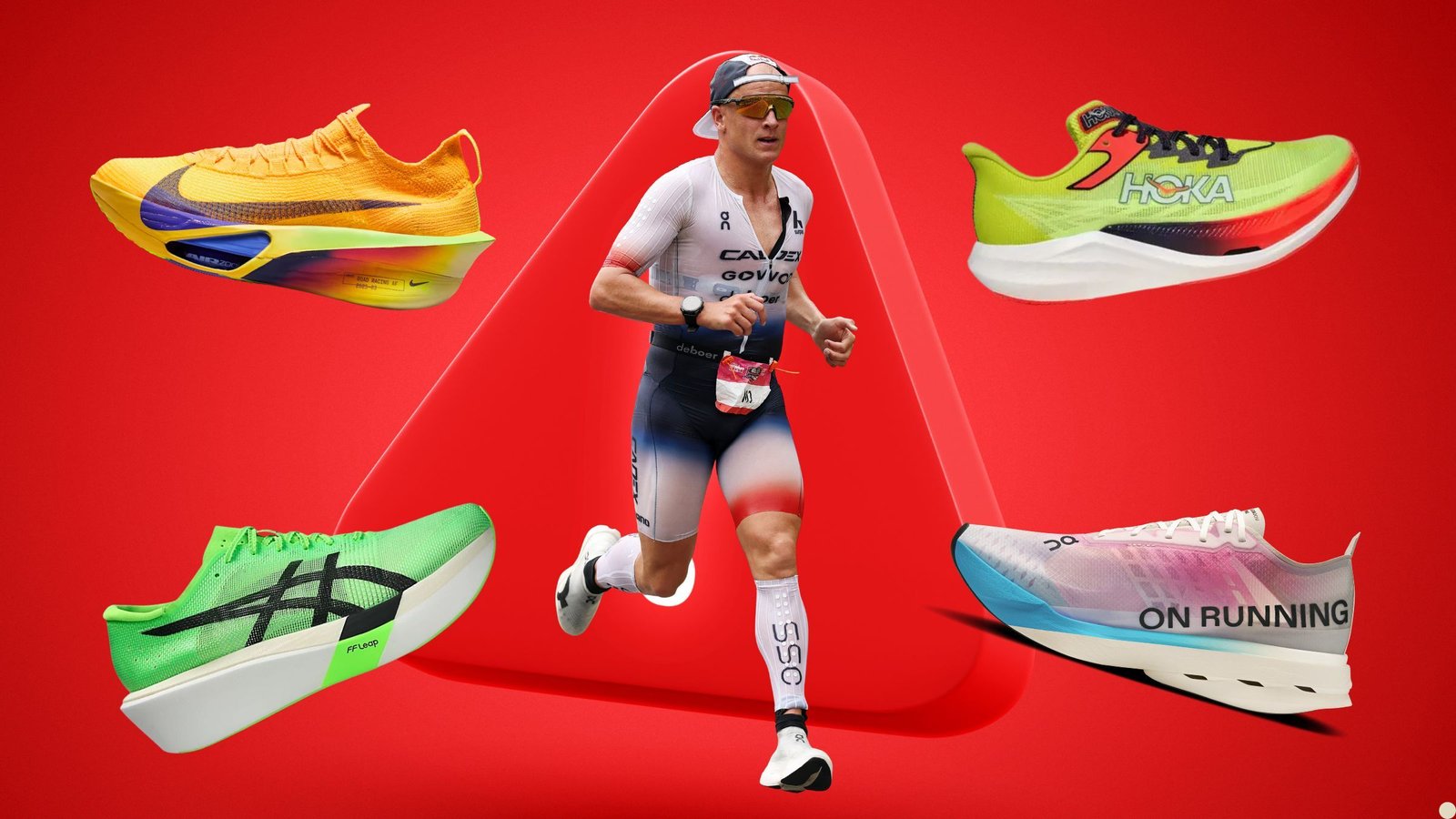
Almost a decade after Nike caught the running zeitgeist with its Vaporflys that boasted a four-percent efficiency improvement, there is no longer any debate that rigid plates and advanced foams in running shoes confer a significant performance advantage to athletes.
Since then, amateur and professional triathletes alike have been forced to up their sneaker game to remain competitive. Some embraced the tech onslaught with gusto, while others begrudgingly joined in for fear of slipping down the age-group ranks.
But the running shoe evolution hasn’t come without cost. Has the strain simply been shifted from our calves to our bank balances? Or should we have more wide-reaching concerns about the potential damage of super shoes in triathlon?
The performance advantage of super shoes
Brands love science-backed marketing, and as such there have been myriad studies looking at how and how much the new shoes boost performance.
For instance, a recent systematic review of 14 studies found that super shoes consistently improve running economy (the oxygen cost to maintain speed) by 2.6-4.2%, and sometimes up to 6%, while also reducing heart rate by 4-5% and increasing lactate-threshold speed, indicating faster movement for less effort.
How do super shoes work? The two main factors are improved energy return from modern PEBA-type foams that compress heavily on landing and then rebound efficiently during toe-off, and embedded plates (often carbon) that act like a lever to stiffen the shoe and help “roll” the runner forward more efficiently, changing the way we run.
This study found that carbon-plated shoes resulted in a reduced cadence but longer strides and a greater flight time, and research also suggests that super shoes may reduce demand on the posterior lower leg muscles and tendons, such as the soleus and Achilles, helping you hold pace deeper into the event.
Edouard Coyon, Global Director of Product at On, says the value of the shoes could be even greater for triathletes than marathon runners, because they can help counter the fatigue built up on the swim and bike legs.
“When a triathlete’s form begins to degrade late in a race, the shoe essentially helps maintain a more efficient running form, preserving a faster pace with less oxygen cost,” Coyon says. “We have witnessed run times plummet spectacularly, catalyzed by Gustav Iden’s historic 2:36:15 marathon split at Kona in 2022, while standard 10k splits in Olympic-distance racing have consistently dropped. We also witness more and more negative splits, with athletes able to accelerate in the second half of the race.”
How Kristian Blummenfelt utilizes super shoes
One athlete who has certainly embraced the super shoe evolution is Kristian Blummenfelt. When Iden scaled new heights on the Big Island, his training partner finished third; Blummenfelt switched to On the following spring.
This year is going well. Having won every major title in the sport from the Olympics to the Ironman World Championship, the Norwegian currently tops the Ironman Pro Series following a win in Texas, where he posted a 2:30:47 marathon after a sub-4-hour bike leg.
The feat would have been almost unthinkable a few years ago, yet it wasn’t just that result that jumped out. It was the triumphant finale to a four-race sequence that started just five weeks earlier in Ironman New Zealand.
“If I would have done that block [New Zealand (placing sixth), Oceanside (first), Geelong (first), and Texas] ten years ago, that would have been a brutal, brutal experience,” Blummenfelt says. “I don’t think I would have been able to do it without the carbon shoes. They make a huge difference, especially in the Ironman. Maybe not quite as much in a 70.3, but definitely for a full Ironman, as the recovery time is significantly shorter.”
Blummenfelt adds that in a typical training block, he would undertake about 80% of the intensity without carbon shoes, maybe wearing them for the last few kilometers of a session to “feel the stride.” For the start of 2026, though, he wore carbon shoes for most intensity run sessions in order to be able to recover quicker.
“I think together with nutrition, like the extra implementation of carbohydrates in the races, where I’m doing 160 grams per hour for most of the race, finishing off the marathon with the softer carbon shoes makes it easier to race more often,” Blummenfelt says. “It also allows me to do race-specific sessions more frequently.”
Age-group triathletes adopt super shoes
“It’s difficult to quantify how much super shoes have improved performance in triathlon, as they not only improve performance on race day, but they have also helped athletes to train more,” Coyon says. “The new generation of foams, being softer and more resilient at the same time, releases stress on the legs and helps recover faster. Athletes tell us they can train more, which leads to higher performance.”
It’s not only the professionals who seem to benefit. Age-grouper Joe Wilson, 50, from Atlanta, Georgia, started racing in 2014 and estimates he’s competed in around 70 events, including two or three Ironman 70.3s each year, and regularly finishes on the podium in his age-group.
Wilson trains around 15-20 hours a week and happily admits “my world kinda revolves around triathlon.” As such, super shoes have long been on Wilson’s radar. “I bought the pair that Eliud Kipchoge wore in the 2016 Olympics,” he recalls, referencing the Nike model that led the Kenyan to gold in Rio on the eve of the run tech evolution.
He also remembers showing up to Ironman Florida in 2019 in Nike Next% shoes, believing he was ahead of the curve only to find most of the field having the same model but in different colorways. The message had landed: it has to be a super shoe or you’re at a disadvantage.
“100%. Even if I’m going to run a local 5km, we’re probably talking 45 seconds faster,” Wilson says. “You put the shoe on and feel like a different person. I’ve always said it feels like cheating.”
Having recently switched to Alphaflys, Wilson believes triathletes should experiment to find the right pair for themselves and that there are likely to be more benefits for faster athletes.
“The more force you put down into the carbon plate, the more it returns,” he argues. “If you’re slower, you’re not putting that much force in and it becomes almost brick-like, you’re not getting any return and at the point where you’re walking the Ironman marathon that could be an issue.”
How to find your best super shoe
But which shoe should you opt for? The best way is to test. Although there are likely to be some practical limitations for most athletes, the accepted benchmark is measuring oxygen cost when athletes run at a fixed speed (such as marathon pace or 10K pace), and oxygen consumption (VO₂) is measured using a metabolic cart. Lower VO₂ equals better running economy, which therefore equals better shoe choice.
But there are alternatives. U.S. Ironman triathlete Ben Kanute set out his protocol in this helpful post where he used the STRYD running pod, with his main metric as power against a set pace.
“I believe testing mechanical efficiency is the best and most accessible way to judge if it works for you,” Kanute says. “In an Ironman, your mechanics will break down, and sometimes even the most metabolically efficient shoe wouldn’t hold up mechanically.” After testing seven pairs of shoes, the Olympian and two-time Oceanside 70.3 champion landed on the Cielo X1 V3.
Super shoe injury concerns
If shoes are revolutionizing the sport, are they also ruining it when it comes to injury? With still relatively new technology, cause-and-effect can be difficult to establish, but Wilson is adamant that a change of shoes was to blame when he found himself flying to Marbella, Spain last fall for the Ironman 70.3 World Championship nursing plantar fasciitis.
“I’d never had an injury in my life, and I used to joke that I can run in any shoe I want!” Wilson explains. “A different shoe [not Nike] changed that for me. It was unstable and my heel kept slipping.”
While Wilson believes the footwear’s instability was responsible for the injury, and there have been other cases, such as British prime time newsreader Sophie Raworth claiming the shoes caused her stress fracture, academic research gives a mixed picture.
This 2023 expert opinion article looked at a case series of five navicular bone stress injuries in competitive runners wearing carbon-plated shoes. The navicular is a boat-shaped bone located on the inner side of the midfoot, just in front of the ankle. Co-author Dr Karsten Hollander, Professor of Sports Medicine, and Hamburg Medical School in Germany, told Triathlete: “Overall, my position has not changed substantially since [the article]. Based on the currently available literature, there are still no clear signals that plated shoes lead to a higher injury incidence or to a distinctly altered injury pattern compared with conventional running shoes.
“That said, the evidence base is still relatively limited, particularly for long-term injury outcomes and for recreational runners. At present, most findings are indirect, and there is still considerable uncertainty regarding potential individual responses and training-related factors.”
Hollander currently has a trial in progress to help find more answers.
It could be that, given the plate seems to transfer the forces from one area of the foot to another; the more rigid the carbon plate, the more that impact is magnified versus a more flexible nylon plate as you find on some shoes.
Another factor to consider is that if carbon-plated shoes enable an athlete to both run faster and feel recovered quicker, training could become more frequent and with more volume, increasing the overall load (and upping the injury risk).
While running shoe brands might not want to draw negative attention, it is a topic they need to take seriously, as highlighted by a lawsuit brought last year by a former Division I athlete who alleged that a popular model of shoe had led to a sesamoid fracture that required surgery. The filing includes claims of negligence and failure to warn the purchaser of potential risks.
Then there are other potential and more immediate injury risks around the potential instability of shoes, such as witnessed at Ironman 70.3 Aix-en-Provence, where South African pro Jamie Riddle took a nasty tumble on smooth paving on a corner, ending his race. While the slip might not have all been down to the shoes, with additional stack height and pliable foam, the potential for a twisted ankle on a slick or twisting run course is self-evident.
“Super shoes have changed performance, but they’ve also changed the stress profile”
What are the experts witnessing first-hand? Foot and ankle surgeon and podiatrist Dr. Daniel Geller is the Chief Medical Officer at Kane Footwear, which specializes in recovery shoes.
“Super shoes have changed performance, but they’ve also changed the stress profile on the athlete,” Geller says. “The Pebax foams and carbon plate systems clearly improve running economy and reduce perceived fatigue, but that doesn’t necessarily mean tissues are seeing less load. Often, it’s just different load.
“What I’ve seen clinically is athletes running faster, longer, and recovering ‘cardio-wise’ quicker than ever: so naturally they’re stacking more volume and intensity with less hesitation. The issue is tissue doesn’t always recover at the same speed as the engine.”
Geller says that is where recovery footwear is carving out a real role, fitting into a modern training ecosystem: softer interface, reduced plantar stress, easier post-run mobility, and less time barefoot on fatigued tissues.
He adds: “Athletes today are spending more cumulative time loading their feet because the super shoe era has shifted the mindset from ‘survive the miles’ to ‘bounce back fast and go again tomorrow.’”
But that may come at a cost. “Super shoes may feel protective because the foam is so forgiving, but they can also alter mechanics enough that we’re seeing different patterns of calf, Achilles, forefoot, and intrinsic overload, especially when athletes ramp too quickly,” he says.
Making smart choices with super shoes
Because of this, Geller believes the rise of super shoes has indirectly increased the demand for recovery tools and recovery footwear: “Not because the shoes are bad, but because performance technology has accelerated training behavior faster than tissue adaptation,” he says.
The reality is that research often takes time to catch up to the real world, and the smarter athletes understand this. Blummenfelt, whose high-volume approach has been lauded and meticulously analyzed, and who has so far stayed clear of major injury, sees that being deliberate on shoe choices can help mitigate the risks.
“I try to avoid using too much of the carbon shoes during training, because I think it’s good for the leg spring stiffness to have a little bit more of a sort of old-school shoe for training,” he explains. “That’s why I use a lot of spikes when I’m on the track, to train up the lower calf muscles and get a bit more of a responsive stride. That way, when I finally do put on the carbon shoes, I actually get the maximum benefit out of them.”

The financial cost of supershoes
If injuries are contentious, what isn’t up for debate is their impact on athletes’ bank balances. Prices continue to climb, driven by the industry’s technology arms race, and wider economic pressures, including disrupted supply chains, higher freight costs and geopolitical instability affecting shipments from China and Southeast Asia, where many of the world’s major brands manufacture shoes and source materials.
You won’t get much change from $500 for the Adidas Adizero Adios Pro Evo 3, worn by Sabastian Sawe in becoming the first man to break the 2-hour barrier for the marathon in an official race, and while that might top out as the current market favorite, a pair of the Puma Fast-R Nitro Elite 3, the Asics Metaspeed Ray or the Nike Alphafly 3, are all around $300.
How long do they last? Outside’s Alex Hutchinson landed on around 280 miles in this article, while pointing out it was an imperfect estimate. But generally, super shoes don’t take you as far as you’d like – at least not while retaining their performance benefits.
Amateur athlete Wilson estimates that he runs around 1,500 miles a year (or 30-40 miles a week), but the vast majority in more traditional cushioned shoes (in his case, the Hoka Clifton). Super shoes are reserved for race day due to their high cost.
“Triathlon is becoming more and more of a barrier to entry,” Wilson says. “I make good money, but I feel poor in this sport because it takes so much money, whether it’s the bike, the entries or the shoes. I cannot justify spending $300 [on shoes], so I buy last year’s model online to keep the price down, and that’s got to last me all year. But they don’t last. I get maybe 100 miles out of them and then the shoe just starts to deteriorate. And when they do, they disintegrate; I’ll be missing half the shoe.”
As a sponsored athlete, Blummenfelt doesn’t have that concern. “I’m probably going through five or six pairs of racing shoes,” he says. “For training shoes, I would probably say 15 pairs, but I’m not wearing down most of them. I’m often running with fresh shoes, because I’m lucky to have a great sponsor and partner.”
The next frontier of super shoes
Whether revolutionizing your sport or ruining your bank balance, supershoes are here to stay, but will the improvements keep coming? How long before we regularly see sub-2:30 Ironman marathons? Perhaps even sub-2:25?
It’s on the way. Coyon says the next frontier of super shoes isn’t about the chemistry of the foam, but biomechanical optimization: “A runner’s weight, cadence, and unique running form dictate exactly how a shoe deforms under impact. By studying these variables, we are able to engineer foam compliance and geometric structures that adapt dynamically to these differing forces, optimizing energy return and maximizing running economy across a broader spectrum of running styles.”
In other words: even faster times are on the way.



