
Published August 3, 2026 06:00AM
I want you to think of something that could be done to improve the design of your bicycle. Don’t think inside the box; think way outside of it. Don’t bound your thoughts by physics, reality, or budget. Think of anything that you could do to the shape, frame, weight, or material that would make your bike faster.
These are the kinds of thoughts that run through the heads of professional bike designers, those who brought us from downtube shifting and steel frames to internal cable routing and carbon speed machines. In the world of brainstorming, there are no stupid ideas because the craziest thought can lead to the most brilliant innovation. But what if I told you some ideas were so wild that they were banned?
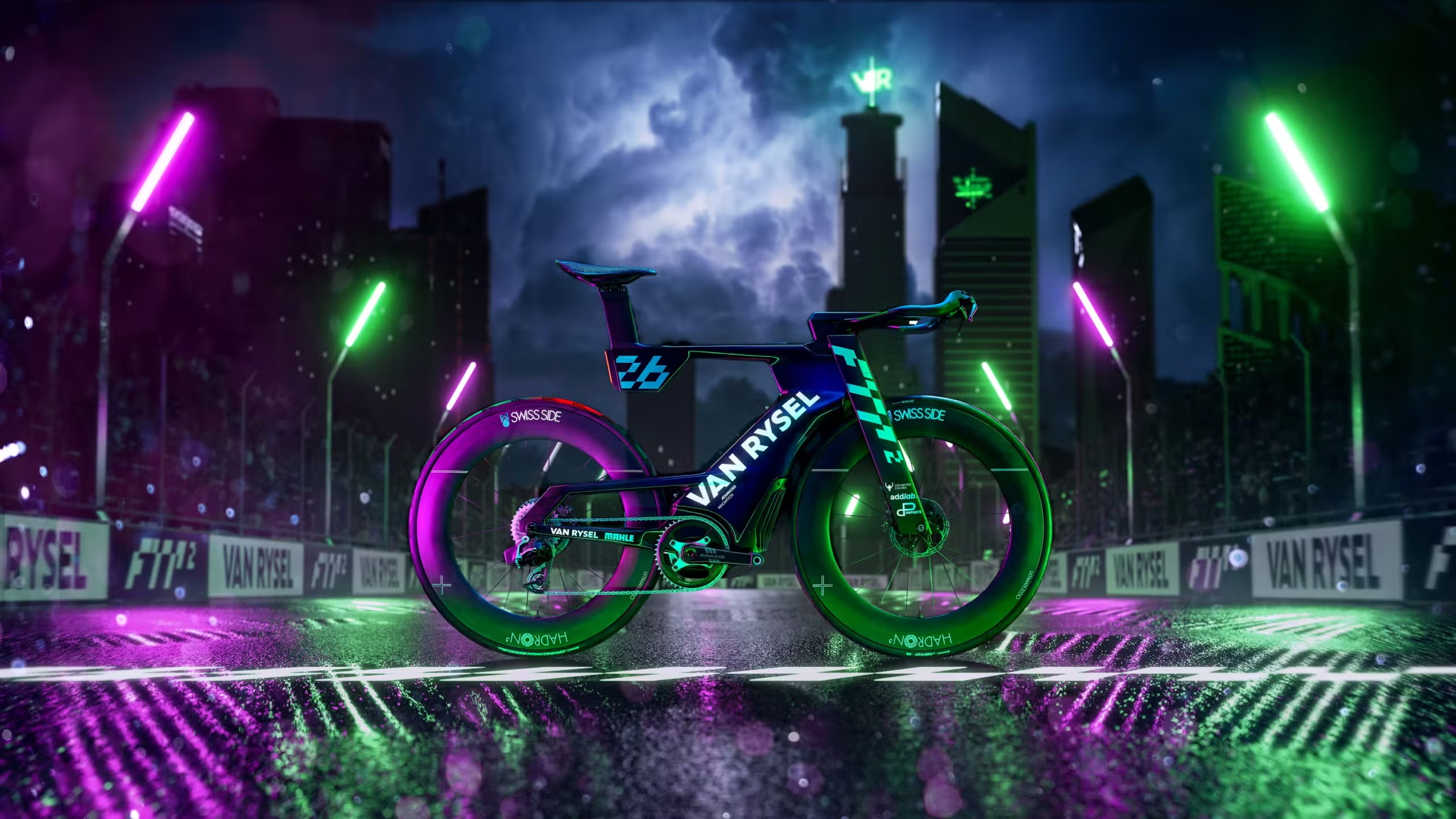
Enter the world of concept bikes. If we compare it to the automotive world, we might picture a concept car, says Wim Van Hoecke, product manager for Van Rysel’s FTP2 and e-bikes. The concept car rolls onto a stage at an auto show with vertical doors, a split roof, and multi-color headlights that look like something you’d see on a UFO. The audience oohs and aahs at the design, but nobody is going to drive home in one.
The concept car exists to push human thinking, to show what’s possible when engineers are freed from the constraints of production cost, regulation, and consumer preferences. It is, in the most literal sense, a proof of concept.
Cycling has its own version of this: a concept bike is a bike built to explore what a bicycle can be, not to meet a sales quota. It is a controlled experiment tested in the real world: sometimes in a wind tunnel, sometimes in a race. Some concept bikes stay concept bikes forever, just an idea in a designer’s mind. Others change the sport, find their way into shops, and eventually become the standard against which the next concept is measured.
The reason you don’t see more of them in road cycling comes down to three letters: UCI. But that’s what makes the world of triathlon concept bikes quite special.
Prototypes vs. concept bikes
First, there’s something we need to clarify: there is a significant difference between a prototype and a concept bike. While the definition may change based on who you ask, it’s safe to say that prototypes are meant to be physically designed and ridden, while concept bikes may just remain an art piece.
Nathan Barry, Senior Design Engineer at Cannondale, says, “In a lot of cases, a concept bike is a design exercise more than an engineering exercise. It is a one-off investigation into design or technology that has no direct intention of ever becoming a commercial product.”
A production bike, one that will be ridden by hundreds or millions of cyclists, has to be reliable to the consumer. It has to be ready to be built, packaged, and delivered to dealers around the world. Many constraints that go into consumer products, and these constraints severely limit the types of bike designs.
Concept bikes are a departure from exactly that. They free designers, engineers, and manufacturers from the typical rules and regulations, and that’s where you get some pretty wacky ideas. Concept bikes don’t always make it to the prototype level, and for several reasons.
First, prototypes must be safe. If someone is going to ride your bike, it needs to be safe, which comes with a long list of testing requirements. Once the prototype is safe, it is test-ridden internally. Barry says that manufacturers like Cannondale gather a wealth of feedback, including feel, performance, and cost. If something feels bad or performs poorly, it’s likely going back to the drawing board. But if those boxes are checked, it’s time to ask the finance and marketing departments for their feedback.
Not only do bikes need to be safe and useful, but they also need to sell. If a bike or product costs too much to develop, then it’s not worth developing. There also needs to be sufficient interest from the public. If there isn’t, the idea will never get off the ground. These are just some of the things that stop concept bikes from becoming reality, but there is also a whole other world of legal ramifications.
The UCI barrier to entry
By definition, it is literally illegal to make a concept bike for road cycling because the bike must be available for sale to the public, Barry says. That’s why we don’t see crazy new designs at the Tour de France. All the bikes you see on television are bikes that you could buy for yourself (assuming you have the cash). You may see some prototype parts, but that takes us back to the difference between concept bikes and prototypes.
Concept bikes, in Barry’s mind, are bikes that you see at a bike show. A beautiful piece of design and engineering that is meant to be gawked at on the showroom floor. It shines under the lights and looks like a dream, but it’s not meant to be ridden outside. A concept bike is, “a vision of something for the future,” Barry says. Not something that is meant to be ridden today.
The Union Cycliste Internationale, or UCI, has governed professional road racing since 1900, and its technical regulations for bicycles are quite strict. Their rules dictate factors such as tube length, minimum weight, frame geometry, and aero bar design. For engineers, UCI rules are simultaneously a challenge and a relief. The challenge is that the creative ceiling is low. It’s a relief that every manufacturer is constrained by the same rules. Designing a bike is simplified in a way, bound by UCI rules.
Triathlon is not governed by the UCI, which means that bike design is closer to the Wild West than your local library. Everyone is trying to build the fastest bike possible, Van Hoecke says, but they still have to be production-worthy. World Triathlon and Ironman’s governing structure impose far fewer geometric constraints than the UCI, which means that when an engineer sits down to design a triathlon bike from scratch, they can let their creative mind go to work. The frame doesn’t have to look like a frame, and the tubes don’t have to be round. The bike just has to get a human body through the air as quickly as the laws of physics will allow.
There is a tiny bit of wiggle room in the UCI rules about prototypes being used in competition. If something is going to be in production soon, but is not quite ready yet, it may be admissible under UCI rules. Think of the new designs and tech that you see being used at races like the Tour de France. Tadej Pogačar might have a prototype part on his bike, but just because you can’t buy it yet doesn’t mean you won’t be able to one day. Similar trickle-down effects happen in triathlon: think Kristian Blummenfelt’s prototype Cadex, which was first spotted at the 2021 Ironman World Championship in St. George and became available to the masses in 2022.
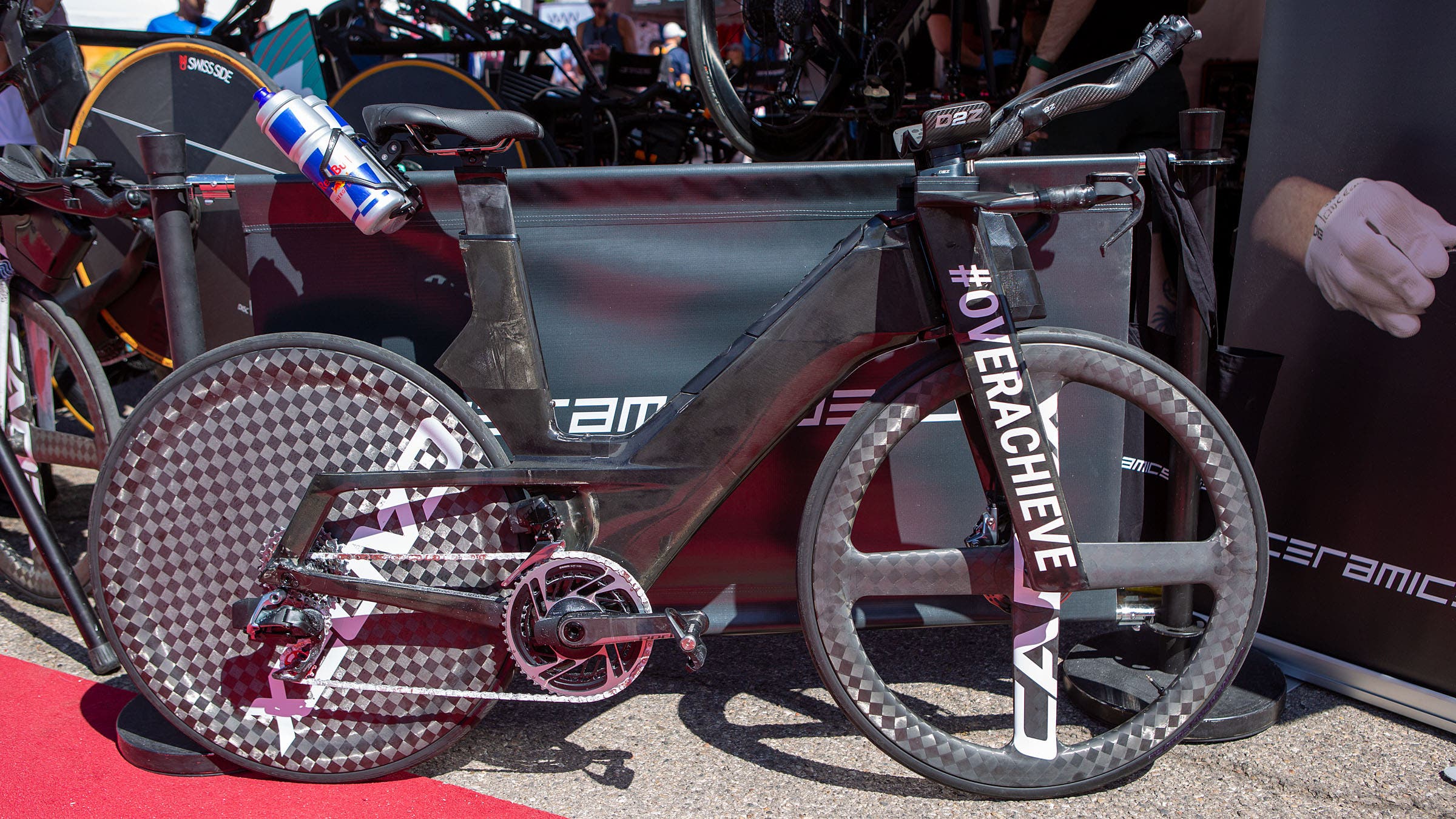
Data-driven, equipment-obsessed, and financially motivated triathletes will do anything for marginal gains, and that’s why they are the ideal early adopters for engineering experiments. When a manufacturer builds something strange and asks their audience to trust it, triathletes say yes while road cyclists respond with a million questions. That cultural openness is what makes triathlon the ultimate playground for concept bikes. But not all concept bikes are meant to be ridden, and that is a very important distinction.
When it comes to putting concept bikes into practice, Barry mentions a very important question: “Who is your audience?” In other words: are you thinking of a concept bike for designers, engineers, and product managers, or are you thinking of a concept bike that one day might be molded for public consumption? This is the difference between internal and external-facing designs, and this determines the path a concept bike will follow in its future.
Barry says that manufacturers like Cannondale focus less on concept bikes as an entity, and spend more energy on developing new technology. Instead of designing a concept bike from scratch, they work on retrofitting new ideas into old or existing products. It’s a streamlined approach to the idea of a concept bike, one that might be less creative but more realistic and useful. Some ideas use the same design but a new technique or material, and when the product is good, it may be considered for prototyping.
You won’t be surprised to hear that not all concept bikes make it to the road. In fact, some of them never make it off the blank sheet of paper. The idea might be brilliant, but it might not be ready for public consumption.
The bikes that stayed on paper
Not every concept makes it. Some of the most visionary bikes in history are museum pieces, famous because they were too radical, too expensive, or banned before anyone could ride them competitively.
Concept bikes often begin as plastic models, not necessarily intended for consumers. Instead, they are designed to explore “new ideas that might become interesting in the future,” Barry says. Many concept bikes are not rideable. Instead, they are completely one-offs, ideas put to paper that will likely stay there.
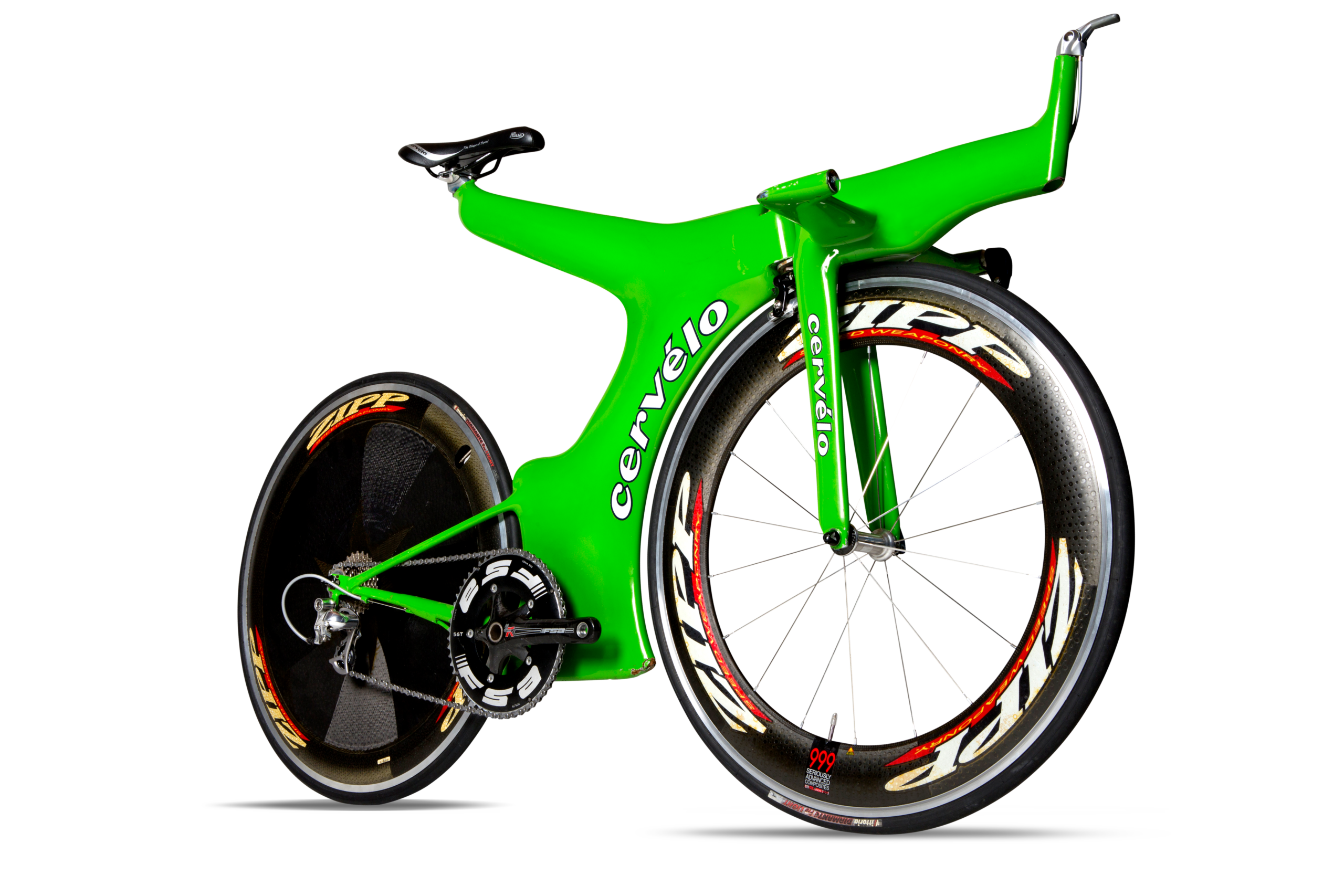
Take the Cervélo Barrachi, for example. The acid-green bike still looks futuristic today, and bears a resemblance to Cervélo’s radical P5X time trial bike. Back in 1995, the bike’s design was beyond comprehension. It abandoned the double-triangle frame entirely, used integrated handlebars, and mounted 1x (pronounced “one-by”) gearing. The idea was brilliant, but it could not be validated by results. The UCI introduced strict rules regarding frame design and made the Cervélo Barrachi one of the most famous race bikes never to be ridden professionally.
But the bike became a conceptual blueprint for the future. When you can’t race your best concept bike, you mold it until it fits within the rules. Twenty years later, the company released the P5X, a triathlon-specific bike that looked like a descendant of Cervélo’s firstborn.
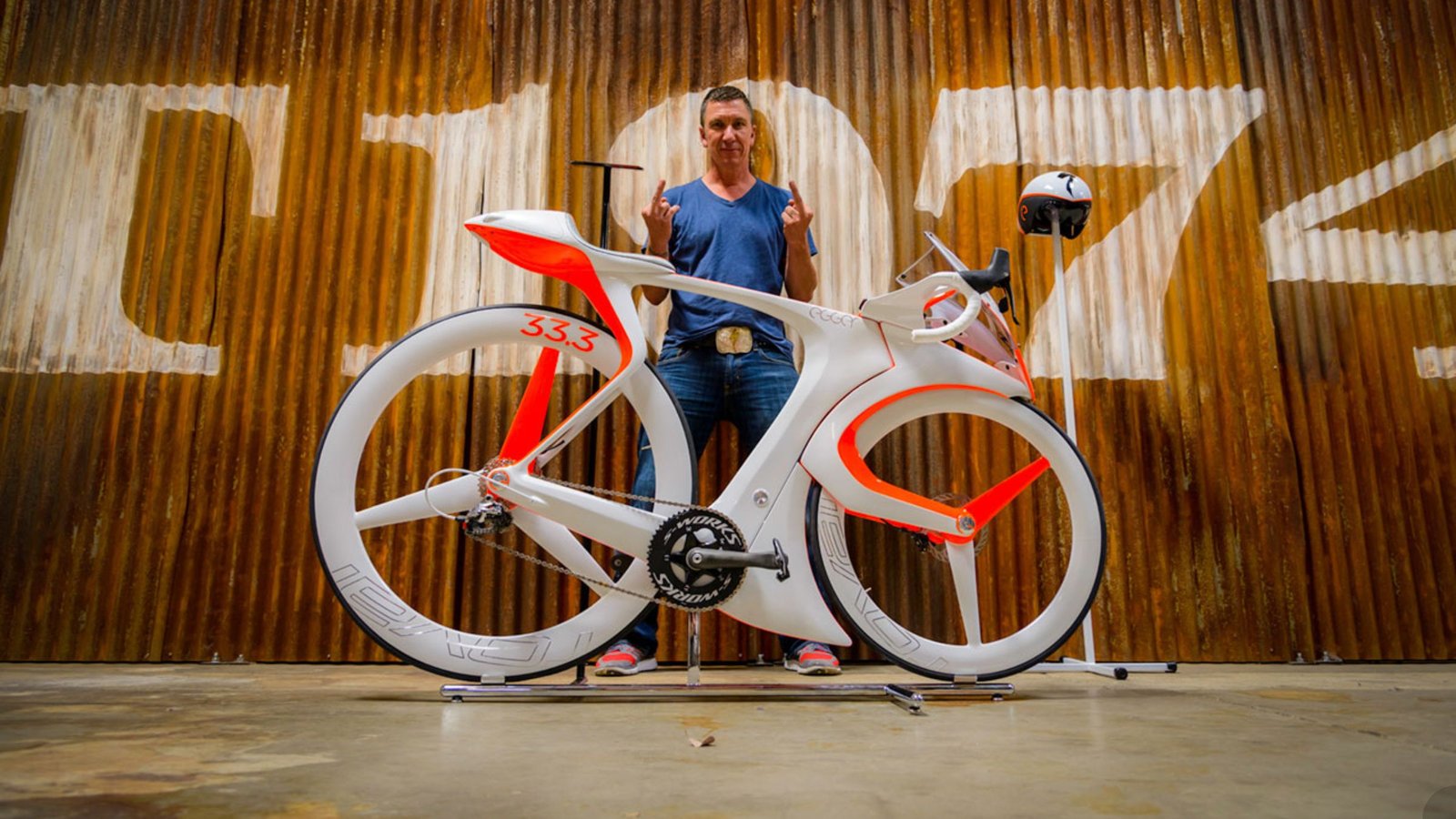
Specialized took a more theatrical approach with the fUCI concept bike, the name itself declaring the exact intention of its design. The fUCI bike featured a fully enclosed rear wheel, integrated storage areas, and a riding position so aggressive it would almost certainly be illegal in competition. The bike never went into production, but it forced us to ask the question: what would bikes look like without UCI rules?
The concept bikes that actually made it
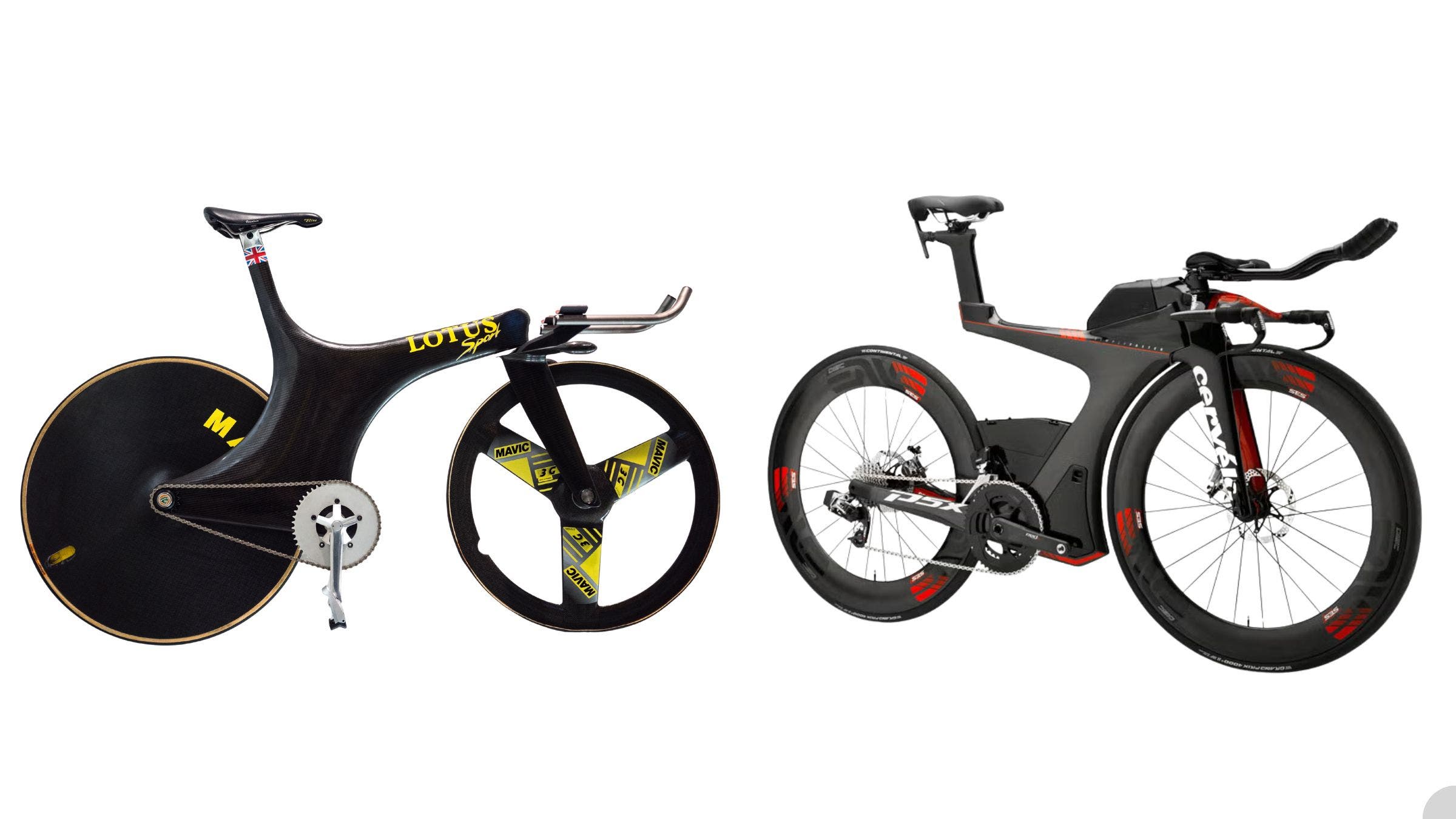
The more interesting story – the one that matters to the triathlete standing in a bike shop – is when a concept makes it to reality. Some concept bikes are so good they actually make it to the production line, and the Lotus Type 108 is one of them. The aim was to create a track pursuit bike that prioritized aerodynamics in a single, low-drag frame. British manufacturers rejected the design, banned by the UCI, shelved, revived by Lotus, and then raced at the 1992 Barcelona Olympics by Chris Boardman.
That single race proved that concept bikes can make it into the real world, and when they do, they are incredibly fast. The Lotus Type 108 paved the way for future designs, such as the Cervélo P5X. It was illegal under UCI rules, but it was a triathlon bike meant to be ridden. But being rideable isn’t the only factor for concept bikes to make it competitive.
According to Barry, when a company is considering the idea of a concept bike, there are many questions to weigh up: What does a beneficial outcome look like? What might we learn from the process? What time and costs are involved, and could this investment be better spent elsewhere? Often the development of a new technology can be isolated from the requirements of a complete bike concept. While speed is a great thing, many more factors go into getting a concept bike off the page and into production.
What concept bikes mean for everyday triathletes
Most triathletes will never race a concept bike, but the technology in your current bike likely traces its lineage to one. Integrated cockpits, new tube shapes and profiles, internal cable routing, and carbon frames were once just concepts. Then they became reality, and sometimes, they turned into the new industry standard.
Concept bikes aren’t only thought experiments – they are how cycling moves forward. UCI rules may hamper progress, but triathlon provides the freedom that road cycling doesn’t, meaning that innovations are often seen first in triathlon. Somewhere right now, an engineer is looking at a concept bike that doesn’t exist yet, thinking about the triathletes who will ride it before anyone else will.
One day, its design features will make it to the Tour de France. But first, it will appear in triathlon.



