
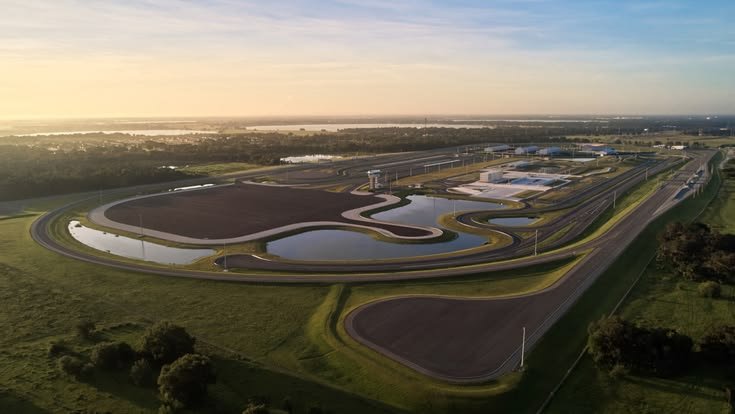
The Skytrax facility in Auburndale is where the Florida DOT plans to test its “flying car” technology — if it ever gets any. (Photo via FDOT)
I watched a lot of cartoons as a kid. None was more visually stunning than “The Jetsons.” It focused on a family coping with life in a streamlined future filled with snazzy gadgets.
George Jetson, for instance, commutes to work in a flying car that’s quieter than your average vacuum cleaner. When he lands, George folds his vehicle up into a briefcase he then carries into his office. No need for roads OR parking!

Apparently, Gov. Ron DeSantis and his Department of Transportation secretary, Jared Perdue, fell under the spell of this cartoon, too. Now they want to make it real using millions in federal funding intended for a different purpose.
The Miami Herald broke the story over the weekend. The headline said, “Florida wants to use cash meant for electric car chargers on flying cars instead.”
There’s just one problem with this plan: Flying cars do not exist.
For years the Florida DOT has been sitting on $197 million in federal grant money that it was supposed to spend on new chargers for electric cars and trucks. Now, the Herald says, the DOT has plans to steer (sorry!) that money to something bizarre. It wants to “build what it calls an ‘Aerial Highway Network’ that includes places the futuristic aircraft can charge, take off, and land.”
In the secret nine-page plan that the Herald got hold of, the DOT says the state is taking “a bold step in building an entirely new mode of transportation.” My hard-headed Cracker forebears would call this “buying a pig in a poke” — throwing money at something that’s not real.
“The Florida Department of Transportation will not waste taxpayer dollars and spend it on everyday passenger vehicles,” the DOT wrote in its flying-cars-are-cool report.
Of course, that’s exactly what the DOT promised the federal government the agency WOULD do with that money. It promised to spend it on chargers needed for the growing number of everyday electric vehicles.
The agency never mentioned that it would instead blow that cash on some cockamamie contraption conjured up by a 1960s Hanna-Barbera cartoon. They never brought up their plans to build 32 landing pads across the state and use state funds to supplement the federal grant.
I suspect DeSantis and Perdue know this looks bad. They’ve been trying for months to hide the DOT document from the public.
As the Herald explained, “The state’s flying-car pivot only came to light after the Miami Herald filed a records request in January, which went unfulfilled until the newspaper’s lawyer got involved.”

“It’s a complete misappropriation of these funds,” said Stephen A. Smith, executive director of the Southern Alliance for Clean Energy. “This just shows how of touch their decision-making is.”
Smith suspects he knows who the beneficiaries will be. It’s not the average Florida driver. Instead, he said, “This is a giveaway to the people who need it the least.”
Roads vs. politics
The millions of taxpayer dollars at stake here came from one of the worst-named bills ever considered by Congress.
The Bipartisan Infrastructure Law, which passed in 2021, included language to expand the nation’s fast-charging network for electric cars and trucks. The provision called for adding more chargers within a mile of all interstate highways. That would help EV drivers travel greater distances without getting stranded.
It wasn’t intended as a total government giveaway. Businesses that received the funding, such as Buc-ees and Wawa, would get enough to cover about 80% of the costs. They would be required to put up the other 20%.
Florida’s DOT submitted a plan for spending the money properly, and the federal government approved it. After all, drivers in Florida have really fallen in love with EVs.
A report last year noted that Florida leads all other Southeastern states in the number of EVs sold — roughly half a million in 2024. This is a good thing.
It’s not just that EVs are cleaner for the air and offer a way to combat that thing about the climate that DeSantis doesn’t want us to mention. Given the soaring cost of gas since the start of the Iran War, you can understand why drivers might prefer vehicles that don’t require a second mortgage to fill the tank.

“Every time the gas prices go up, I say thank you that my price is always the same,” said Leighanne Boone of the Sustainable Tallahassee Ride Electric Club. “I plug in every night.”
What Florida lacks is sufficient public places for rapid charging on the road. As the Herald pointed out, “Florida boasts the second-highest number of EVs in the country but still falls behind the national average on chargers per vehicle.”
“We definitely need more charging infrastructure,” Boone told me. Range anxiety is a deterrent for potential buyers, she explained. Greater availability “will encourage the average driver to go electric.”

Instead of spending the money for more chargers the way it promised, the DOT put it aside. Meanwhile, the agency set up a website called “Roads Are Not For Politics.” Contrary to its name, the site features a list of culture-war complaints, such as “COVID tyranny.” It also offers off-base criticism of EVs.
In the DOT press release about this (which has since been removed), DeSantis said, “We listen to Floridians and meet their needs. Roads are not for politics.”
Except they weren’t listening to Floridians OR meeting their needs. They were playing politics. And now they want to go back on their word to the feds and spend the money on something that hasn’t been built yet.
And I mean spending a LOT. The DOT’s secret plan estimates that each of the 32 landing pads would cost about $5.6 million to build. That’s after going through testing at the DOT’s 775-acre Auburndale test track, the Suntrax Center.
The plan calls for building these landing pads near airports, luxury apartment buildings, and golf courses. All that’s missing is a listing of such hoity-toity locations as Miami’s Indian Creek Island, aka the “Billionaires’ Bunker,” and the Ocean Reef Club in North Key Largo.
Meanwhile, the growing number of EV drivers have to keep scanning the exit ramps and hope they spot a place to pull over and charge.
“It’s disappointing,” Boone said.
Former trailblazer
I watched a Florida DOT video touting this flying car foofaraw, complete with AI mockups of what they might look like. The video didn’t mention where the money would come from, just how groovy it would be.
“It’s an opportunity to introduce a new mode of transportation to the world,” Perdue said, as giddy as Olivia Newton-John soaring into the clouds in John Travolta’s flying car at the end of “Grease.”
Florida once fancied itself as a trailblazer in aviation.

In 1914, Tony Jannus flew a local politician from St. Petersburg to Tampa via seaplane, inaugurating the first regular commercial airline service in the nation. The ticket cost $400 and the ride lasted 22 minutes. No word on whether the airline lost the passenger’s luggage.
That same year, the Navy established its first flight training base in Pensacola. It’s still there. The Blue Angels stunt flying team is based at NAS Pensacola and recently sent hats, tents, and chairs flying during a too-low practice run over the beach.
So perhaps it makes sense that the DOT’s looking to the skies, now that our roads are so consistently clogged. It’s as if the agency is giving up on ever freeing our asphalt from those frustrating traffic jams.
“As Florida’s surface transportation networks reach capacity, and right of way is constrained,” it says, “additional modes of transportation are required to maintain economic development goals as well as quality of life for residents and visitors.”
People — especially people stuck in traffic — have been dreaming of taking off in flying cars for years. But we’re still waiting for the Jetsons’ car-briefcase combo.
“NASA had an air taxi program they were working on back in the 1980s,” recalled David King of Arizona State University, a transportation planning expert. So far, the only place you can see any “air taxis” is in the Bruce Willis science-fiction movie “The Fifth Element.”
Glorified helicopters
I had a lengthy conversation with King, who displayed an encyclopedic knowledge of the “flying car” phenomenon. It’s been a hot topic in Arizona in recent years, he said, and now has begun showing up in other states.

“There’s a lot of enthusiasm about this,” he told me. “Strangely, it’s become a partisan Issue. It’s been seized on by people who think government shouldn’t be involved in mass transit, but it’s all about an unproven technology that, as of August 2026, is not currently available.”
While flying cars sound good on paper, King said, there are lots of details still to be worked out. For one thing, he said, forget about them relieving highway congestion.
The perpetually-under-construction Interstate 4, for instance, draws 180,000 to 200,000 vehicles a day. If and when the flying taxis DO appear, they can’t carry much, he said. Because of the weight of the battery, they can carry no more than three passengers and one pilot.
All the trucks have to keep their tires on the ground. These flying cars can’t carry freight the way 18-wheelers do.
You won’t travel far in your glorified helicopter, King said. Because the batteries are depleted after 40 minutes, “they just won’t stay in the air too long.”
Traveling to and from the 32 launch pads will still require use of land vehicles, he pointed out. And you may have to travel quite a ways because of the Federal Aviation Administration.
“As of now, the FAA will not approve any operations over populated areas,” King told me. “You can’t just put one of these things in the air and start flying.”
King used a transportation-related metaphor to describe the Florida DOT’s secretly swiping EV money to use for flying cars: “They’re putting the cart before the horse.”

Try a trebuchet
This kind of creative accounting has been a hallmark of the DeSantis administration.
I’m not just talking about the Hope Florida scandal. You remember that one — $10 million from a Medicaid settlement wound up in the hands of political consultants hired to counter the drive to legalize weed.
Remember, too, how DeSantis took $20 million from a disaster relief fund designed to cope with hurricane damage and instead used it to build a destructive immigrant detention camp in the Everglades. A lot of the no-bid contracts went to his donors, too.
Speaking of donors, don’t forget how he cajoled the Cabinet into spending $83 million from the Florida Wildlife Corridor fund on four acres of land in Destin that was nowhere near the wildlife corridor. The seller just happened to be one of his campaign contributors, making this transaction look more like a payback than a payment.
Usually when I call the governor’s office seeking a comment on one of these scandals, his spokespeople don’t even acknowledge receiving the inquiry. But this time, to my surprise, I got an immediate reply.
One of the governor’s spokespeople said he would refer my question to Perdue of DOT. And he did, too. I never got a response from Perdue’s people. Maybe they’re standing on a launch pad in Auburndale, waiting for George Jetson to pick them up for work.
Because I am at heart a problem-solver, I have a proposal for DeSantis and Perdue. It’s based on something that happened when my kids were in Boy Scouts.
A couple of teenage Scouts built a medieval siege engine called a “trebuchet.” It’s basically a fancy catapult. The boys would roll it out at various events and use it to hurl things like a Barney the Dinosaur toy a long distance.
I think the DOT should spend $1 million of its EV funds to build at Skytrax the most impressive trebuchet ever constructed. DeSantis and Perdue can put a Hot Wheels toy in the pouch. DOT employees can hurl the payload as far as possible and claim they finally created a flying car.
Then they can spend the remaining $196 million on what they SHOULD have spent it on in the first place.



