
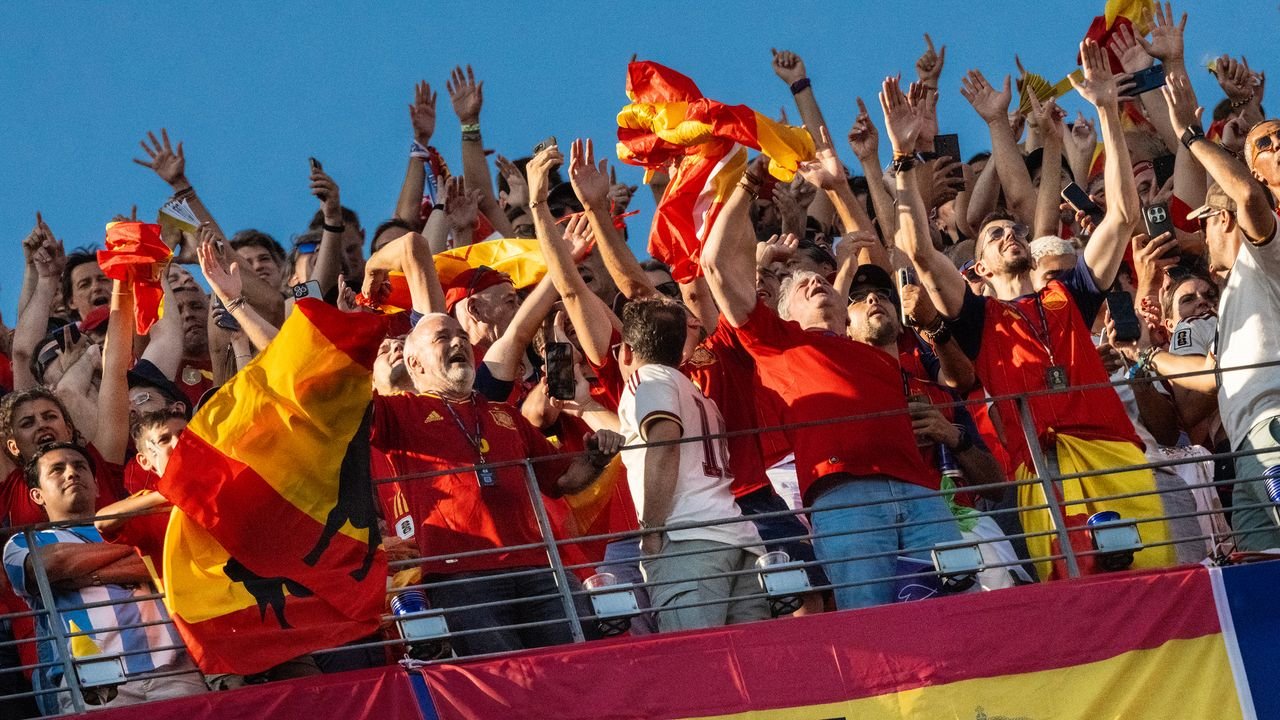
Not all the world was here, even if it felt like it. FIFA’s high ticket prices and the Trump Administration’s border policies made sure of that. There were well-publicized cases, like the exclusion of Omar Artan, a Somali referee, on account of “derogatory information” allegedly discovered by Customs and Border Protection officials, and the harsh treatment of the Iranian team, which was not allowed to train in the U.S. Other absences were also noticeable, if harder to prove. Midway through the tournament, I spoke to Ronan Evein, from Football Supporters Europe, a fan-representative organization, which had struggled to find fans from the Middle East and Africa who had obtained visas for the tournament. “Retrospectively, it’s clear they had no intention of letting people in,” Evein said. He connected me to Mehdi Bouazza, a regional manager at an insurance company and one of the leaders of the Sbou3a (Lions) supporters group, which usually brings the drums and the noise for the Morocco team. Bouazza told me that he was one of at least twenty thousand Morocco fans who travelled to Qatar, in 2022, where the Atlas Lions reached the semifinals, but that only two of his friends had managed to travel to the U.S.: one already had a visa, and the other was an influencer.
“We contacted them by e-mail,” Bouazza said, of his tribulations with the U.S. Embassy in Rabat. He tried to organize a meeting with the Ambassador. “But no responding.” We were speaking on the day of Morocco’s quarterfinal match against France, which Bouazza was planning to watch at J’Adore, a café in the city of Meknes, where he lives, instead of chanting with the rest of the Sbou3a from behind the goal at Gillette Stadium. “I want to be with my friends, supporting our country live,” he said. I asked Bouazza which teams he thought might win the World Cup. “Morocco,” he replied steadily. “And Morocco.” The Atlas Lions lost 2–0. “Football is football,” Bouazza texted afterward.
The tournament played out as FIFA hoped that it would. The stars—Kylian Mbappé, of France; Harry Kane, of England; Messi—came and scored. The four teams that reached the semifinals were the four top-ranked teams in the world. The penultimate stage of the World Cup presented two basic soccer archetypes: the game of control, of possession, of inevitability, as played between France and Spain; and the game as a repository of history and feeling and moments, as played by England and Argentina.
I was in Atlanta for the second semifinal. Between the ages of six and eighteen, I had my heart broken four times by England’s successive soccer failures at international tournaments, so I thought I had learned not to hope. Still. Downtown Atlanta was a parade of Messi shirts. Even Argentina’s fans could not tell to what extent their team’s support was real or made up of opportunists who had come to see the great man. I met Jesica Sola Konz, a nurse from Minnesota, who had bought her ticket two days earlier. Konz grew up in Rosario, Messi’s home town, in central Argentina, but had never seen him play. I asked her how she was feeling. “Humble,” she replied. After reports of a lousy atmosphere during Argentina’s narrow victory over Egypt, in the round of sixteen, there were rumors that hundreds of hard-core supporters had been flown to Atlanta, to pep things up in the stadium. “You will recognize who’s Argentinean by the ones who are actually jumping,” another fan told me.



