
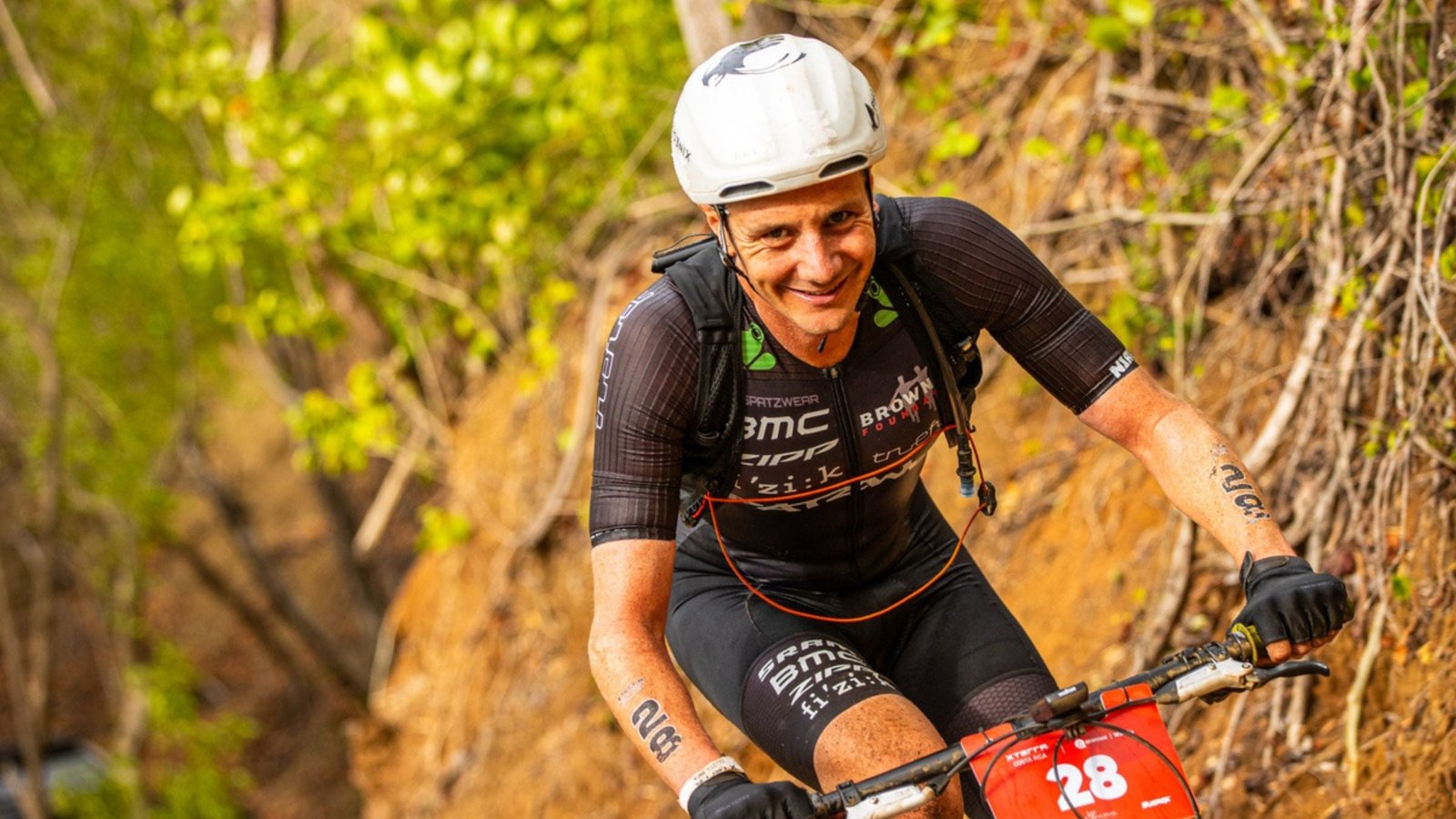
Two-time Olympic champion Alistair Brownlee opens up about stepping away from professional triathlon, finding joy in racing XTERRA and Norseman, and building access to endurance sports.
Two-time Olympic triathlon champion Alistair Brownlee is returning to his off-road roots with events like XTERRA, Norseman, and local fell races. (Photo: Jesse Peters/XTERRA Americas)
Published August 26, 2026 06:00AM
WHAT TO KNOW
- Two-time Olympic triathlon gold medalist Alistair Brownlee is returning to his off-road roots with events like XTERRA, Norseman, and local fell races.
- Stepping away from professional triathlon in late 2024 allowed him to prioritize adventure, community, and diverse race formats.
- Through the Brownlee Foundation and TBF Events, he and his brother Jonny continue expanding free youth access to multisport competition.
Long before the Olympic medals and world titles, Alistair Brownlee was an 11-year-old lining up for the Bunny Run above Haworth in West Yorkshire. The prize was a chocolate egg.
It was a fell race, the distinctly British form of mountain running that sends competitors over steep, muddy and often unmarked terrain. Brownlee grew up with it. He raced cross-country and cyclo-cross, rode mountain bikes and kept returning to the Yorkshire fells. Even after he and his younger brother, Jonny, became professional triathletes, they continued entering local fell races when their schedules allowed.
The career that followed made Brownlee one of the greatest triathletes of all time. He won Olympic gold at London 2012 and Rio 2016, becoming the first and still only triathlete to defend an individual Olympic title, along with two world championships and a record 22 wins at the top level of World Triathlon competition.
The professional calendar left little room to chase every start line that looked interesting, but the off-road remained part of his training. As early as 2008, Brownlee said he hoped to try XTERRA one day.
When XTERRA Weston Park opened a few hours from home in 2023, the timing worked. “XTERRA has always been on my radar,” Brownlee said. “I’ve always run on the trails and ridden my mountain bike, but I’ve really enjoyed having the excuse to do more of it in the last few weeks.” He won his debut, and was a natural fit within XTERRA’s 30-year off-road history.
When Brownlee stepped away in November 2024, he called it his “transition from professional triathlon.” He has since finished third at Yorkshire’s Three Peaks Race, won the 600-kilometer Dales Divide, and placed second at the legendary Norseman triathlon, choosing races without a professional calendar.
Participating at XTERRA Costa Rica in August, Brownlee led a 5K Golden Social Run with former Costa Rican Olympian Leonardo Chacón, signed autographs and joined the professional athlete panel. “Costa Ricans and many of the nationalities here love triathlon, so there is a real community feel,” Brownlee said in Las Catalinas. He placed ninth on Sunday after “an unfortunate puncture,” which he said “was annoying in the short term,” before adding, “I could relax for the rest of the course, look around a bit more, not worry about it and enjoy it.”
The focus on joy and community also runs through the Brownlee Foundation, which Alistair and Jonny founded in 2014 to offer children free access to triathlon. By its 100th event in June 2026, it had introduced more than 92,000 children to the sport. Its 2026 program includes 17 free events for more than 17,500 children. The brothers have since extended that work into race ownership through TBF Events.
Brownlee spoke about returning to off-road, the freedom to race outside one format, and what organizing events has taught him.
An interview with Alistair Brownlee

Did you come into sport through fell running, cyclo-cross and cross-country? How do they compare with the trail running and mountain-bike aspects of XTERRA?
I’ve been lucky enough to do most endurance sports from a young age. It’s true that I started mostly with off-road disciplines, but that was a long time ago! I think it’s hard to compare these events because every course is different. The thing that is the same is the sense of adventure and fun, which is why I’m doing XTERRA.
At the 2025 Three Peaks Race, you placed third against dedicated fell runners. What did returning to that environment reconnect you with from your earliest years in sport, and does XTERRA bring back any of that same feeling?
The Three Peaks Race has been an important event in my mind for as long as I can remember, so it was very special to be able to do it last year.
Since then, I’ve done some local running events too, and I love the simplicity: just turning up, entering the race and that’s it. Although XTERRA is not quite as simple, I love the sense of adventure and exploration alongside the competition. And just have fun, enjoying sport.
You’ve been dabbling in a lot of new formats lately, including Norseman and XTERRA. How has this changed the way you experience the triathlon world?
I’ve been lucky enough to do a lot of different formats recently, as well as running and all different kinds of things. Specifically in triathlon, I think it’s been great to try different forms of the sport. That’s something I’ve tried to do pretty much throughout my career, and I think it highlights how diverse the sport is as a whole and how it can mean very different things to different people.
You and your brother acquired a race series in 2024. How’s that coming along, and how does participating in races like XTERRA inspire you in your own event management?
In 2024, we acquired some races that are now called TBF Events, the events section of the Brownlee Foundation. Any profit made goes back into the Brownlee Foundation. We will have raised a significant amount of money this year, as well as putting on four events.
It is really about two things. The first is providing racing opportunities for people wanting to compete and making them accessible for people to go to. We saw many local races disappear recently, so we think it’s important to help with this. Secondly, it’s about raising money for the Brownlee Foundation, which helps children to do free triathlons. It’s quite an amazing ecosystem.
Hopefully, racing in other races around the world is an inspiration for how to improve our races. Certainly having been involved in organized races gives me much more respect for how hard it is when I turn up at events.
What was the biggest surprise about transitioning from traditional to off-road triathlon, and what advice do you have for age-groupers making the jump?
I wouldn’t necessarily say there is a transition. Off-road is probably the most diverse form of triathlon. You have everything from super-technical mountain-bike routes to things that are more gravel, from trail runs that are not so technical to runs that are more like fell running than anything else.
I’m a big proponent of doing things you’re afraid of and just entering for fun. It gets you away from the cars as well. So yeah, go for it.
For athletes ready to take Brownlee’s advice, the 2026 XTERRA World Tour continues through to November with XTERRA Cabo on Nov. 21 after reaching Ruidoso, New Mexico, for the XTERRA World Championship, Oct. 8-11. Alongside the championship race, the weekend also includes a public 5K trail run and an Open Sprint Triathlon.



