
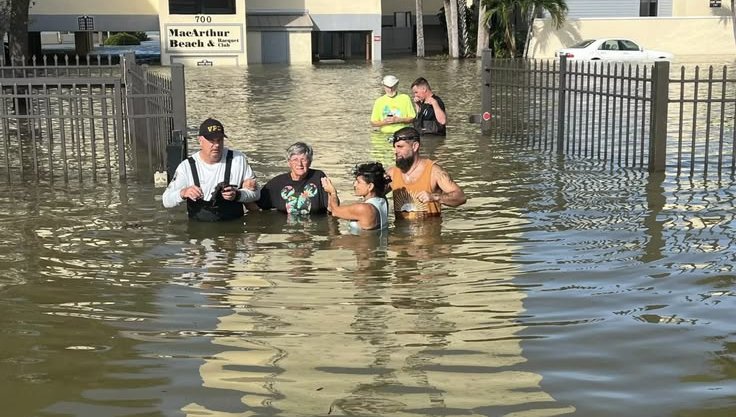
Florida has sued a company that issues climate change assessments of property risks including flooding that the state alleges are deceptive, deviate from the federal flood insurance assessments, and are depressing home sales.
First Street Technology Inc., the complaint filed Friday alleges, posts “alarmist” risk data and “is marketing fear to advance a climate activism agenda while exploiting the same fear to line their pockets.” The venue is state trial court in Polk County.
First Street promises “validated and proven methodologies to ensure model accuracy. We measure and predict the impact of a peril based on the underlying physics of how an actual event would transpire.”
However, Florida Attorney General James Uthmeier says in a video posted to X, “First Street rates certain properties as major flood risk. The FEMA rates the same properties as minimal flood hazard, the lowest federal classification. Those inflated scores have real consequences. Homes take longer to sell. They sell for less, insurance costs rise, and when homeowners try to correct obvious errors, First Street refuses.
“Their models are speculative, based on undisclosed choices, and frequently contradict official data. They claim transparency and peer review, yet underlying details are hidden behind a paywall, and independent analysis shows major discrepancies,” he says.
He demands “clear disclosure that the reports are subjective, uncertain, and may be contradicted by other credible sources. Florida homeowners deserve facts, not alarmist scores that hit their property values and their wallets. We are holding First Street accountable.”
The company’s risk assessments cover floods, fires, wind, air quality, and heat.
The Phoenix sought comment from First Street but has not heard back. Uthmeier, a former Gov. Ron DeSantis aide appointed to his position by the governor last year, is running for election in his own right.
First Street is entitled to monetize and treat its data as proprietary and withhold it from public view. However, it is deceptive for First Street to claim transparency while cloaking its data behind a paywall.
“Deciding to buy a home these days is hard enough without dealing with fake flood risk. Yet that is exactly what First Street forces on Florida homebuyers. Sellers suffer, too — stuck with perfectly good homes tainted with First Street’s climate chicanery,” the complaint says.
“First Street seeks to add alarming climate risk factors to the homebuying decision and to profit from risk scores that use faulty models to exaggerate the risk. These faulty risk factors unnecessarily intimidate buyers and increase their insurance costs, resulting in lost sales for sellers or at least the ability to sell for full value,” the document continues.
Deceptive acts alleged
Uthmeier’s office alleges two counts under the Florida Deceptive and Unfair Trade Practices Act for “unfair and unconscionable practices” plus deceptive practices, punishable by disgorgement of ill-gotten gains, civil penalties of $10,000 for each violation, and $15,000 for each violation that victimized or attempted to victimize a senior citizen or person with a disability, plus the state’s attorney fees.
“CEO Matthew Eby wants to personalize the threat of climate change by quantifying the risk to the individual’s wallet,” the complaint alleges. “Eby sees climate change activism as a marketing problem. As Eby described in 2023, ‘If we can make it personal for them, if we make the impacts here and now, that’s what we’ve found as marketers is the best way to convey the impact of something as big as this.’”
The complaint points to a sample evaluation warning that the county involved had experienced flooding, hurricane, or tornado winds, and that a facility nearby emitted toxic pollution.
“Not only is the information provided by First Street vague; it is also misleading. A key insight provided for this specific property is ‘this county has flooded in the past.’ The property is in Pinellas County, which indeed had extensive flooding in 2024 due to back-to-back hurricane impacts. The devastation in the Tampa Bay area was national news, “ the complaint says.
“However, this property is located inland, approximately three miles from the coast, and did not experience flooding in 2024. Nor has it ever flooded. A person from New York looking to purchase the property may not be familiar with the exact geographical area and assume that First Street’s county-wide assessment of prior flooding impacts this property.”
The complaint alleges the company’s claims that its weather models had been peer-reviewed were false. As for the company’s claim to transparency, the complaint alleges it has refused to let independent third parties view data necessary to review site-specific findings.
“First Street is entitled to monetize and treat its data as proprietary and withhold it from public view. However, it is deceptive for First Street to claim transparency while cloaking its data behind a paywall,” the document says.
Analyses’ uses
Sites including Realtor.com, Redfin, and Zillow have used First Street scores in its property listings, the complaint says. Zillow stopped including them after real estate agents in California complained they deterred property purchases but they’re still used by mortgage lenders and insurers, it notes.
“Zillow’s study found that only 52 percent of homes given a high flood risk assessment eventually sold, whereas 71 percent of homes given a low flood risk eventually sold. Though that gap between sales has existed ‘since our analysis began in 2018, the gap has widened in recent years,’ Indeed, ‘Zillow’s analysis shows that high flood-risk homes have had a consistently lower chance of selling since at least 2018, the earliest data available,’” the complaint says.
“However, Zillow listings still contain a ‘climate risks’ category that directs users to First Street ‘flood, wildfire, and other predictive climate risk information,’” it continues.
Furthermore, in Florida First Street’s analyses differ from FEMA’s national flood hazard evaluations, the document alleges, as well as with the company’s competitors. Its data place Orlando at risk for coastal flooding and Lake City for poor air quality, although the latter city in May “received national recognition from the American Lung Association for low ozone and particle pollution.”
Orlando sits about 45 to 60 miles from the nearest coastline, the Atlantic Ocean.
Homes rated by the company with a high flood risk linger on the market, the complaint says, noting a 1.5 % slowdown in sales over the year ending in August. Sellers have posted FEMA floodplain maps on their listings to counter the First Street analyses, it adds.
“A property owner can pay First Street for purportedly better data for their own use but cannot fix the score that prospective buyers, lenders, and insurers see,” it asserts.
“Florida has the highest home insurance premiums in the nation — an average of $8,292. Floridians cannot afford increased insurance premiums based on conjecture and speculation without appropriately robust scientific backing,” the document asserts.



