
By Jacques Abou-Rizk/Medill News Service
ALEXANDRIA, Va. – Some time since President Donald Trump’s second term began, the White House removed a reference to April’s Arab American Heritage Month from its website.
Former President Joe Biden’s 2024 proclamation now only exists in internet archives. As the month nears a close, Trump has ignored what many Arab Americans see as recognition for their contributions in America.
Despite that snub, and even as the war in the Middle East continues, communities across the country celebrated the ninth annual National Arab American Heritage Month, including in Alexandria, Virginia, recently.
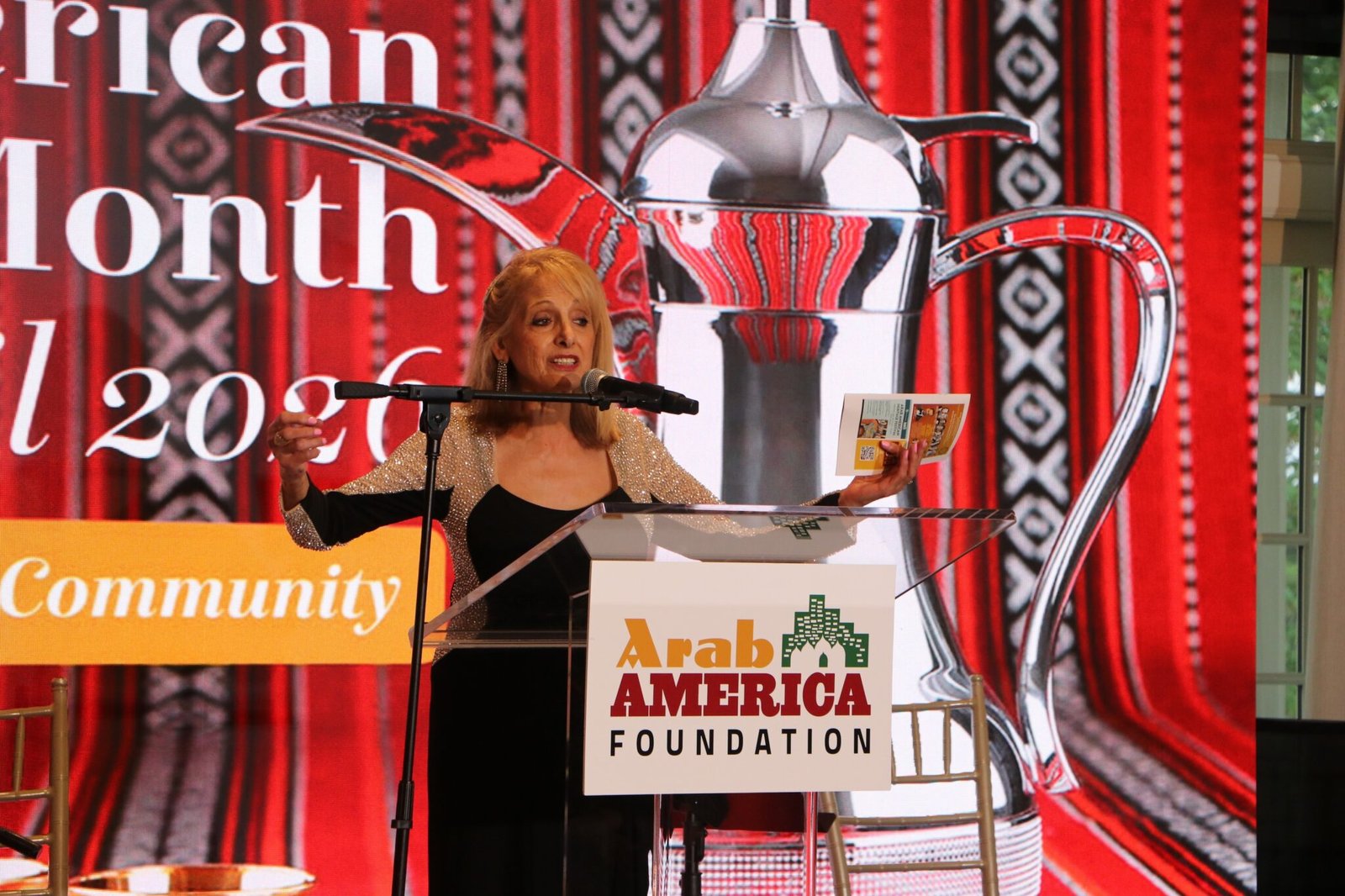
Amal and Warren David, co-founders of the Arab America Foundation, a 501(c)(3) dedicated to promoting Arab heritage, brought together hundreds of Arab American leaders, professionals, artists and activists in the Washington, D.C., suburb on April 16 for the national commemoration.
“We want to be joyful. We want to say we stand tall,” Amal David said to the couple hundred guests dressed in tuxedos and authentic Arab clothing at the Belle Haven Country Club. “Of course, we feel with our people, but it’s a form of showing resiliency.”
The night brought together the diversity of the Arab American community. Members have roots in 22 nations in the Middle East and North Africa that speak Arabic and make up the Arab world.
More than 3 million Arab Americans live in the United States today, approximately 134,000 of them in Virginia, the 10th-highest Arab population in the country. While more than 90% of Arabs worldwide are Muslim, nearly two-thirds of Arab Americans identify as Christian.
Biden vs. Trump administration
Before Trump took office in 2025, Biden recognized the holiday every year of his term.
For example, in 2022, five years after the Arab America Foundation designated the month and began pushing for federal recognition, the Biden administration, Congress, the State Department and 48 states all recognized April as Arab American Heritage Month.
But by 2026, the numbers had diminished. More than 30 states and 18 cities or towns, including Alexandria, released their own Arab American Heritage Month proclamations as of April 17. Only five states have permanent statutes for the April celebration.
Amal David said the Arab America Foundation approached the Trump administration last year in hopes that he would issue a proclamation, but the group did not hear back. On April 15, U.S. Reps. Rashida Tlaib and Debbie Dingell, both Michigan Democrats, also re-introduced a resolution to recognize April as National Arab American Heritage Month at the federal level.
The White House did not respond to a request for comment.
In attendance at the Alexandria celebration was Arlington Councilman Abdel Elnoubi, an Egyptian American. He said he was not surprised with the lack of federal recognition from the Trump administration, but it’s part of the reason he continues to promote Arab Americans.
“I think especially with what’s happening in the world right now, it’s even more important and critical for us Arab Americans to be present, to be part of the conversation, to show our heritage and to show our contributions to this society more and more,” Elnoubi said. “Because the more people get to know you, the less they fear.”
Arab Americans have made profound contributions across science, technology and the arts. Dr. Michael DeBakey, a Lebanese American, invented the artificial heart, Farouk El-Baz, an Egyptian American, pioneered the use of space photography, and Dr. Mona Hanna, an Iraqi American, helped expose the water crisis in Flint, Michigan.
This year’s national celebration in Alexandria starred Yasmin Elhady, comedian and host of Hulu’s “Muslim Matchmaker.” The night was emceed by Emmy Award-winning journalist Ameera David, with music by vocalists Usama Baalbaki and Nibal Malshi. The two performed Arab classics alongside Alexandria Poet Laureate Emerita Zeina Azzam, a Palestinian American.
Trump appointments
The American-Arab Anti-Discrimination Committee noted in April 2025 that the Trump administration had exceeded previous presidents in the number of Arab Americans in senior positions.
Notably, Martin Makary, a British American of Lebanese background, leads the U.S. Food and Drug Administration and Massad Boulos, a Lebanese American, is the president’s senior adviser on Arab and Middle Eastern Affairs. According to the Arab American Institute, Trump received 43.2% of the Arab American vote in 2024.
“Having Arab Americans at the table brings needed perspective and strengthens decisions that impact all communities,” a statement from the American-Arab Anti-Discrimination Committee last year read. “We look forward to working with current and future appointments of highly-qualified Arab American professionals in the Trump administration, and we encourage the administration to continue this trend.”
However, some Arab Americans cautioned that the U.S. role in warfare in the Middle East runs counter to their desire for peace in the region.
Iran is not an Arab nation, but many Arab nations have been brought into the conflict. The U.S. government assists Israel’s military more than any other country, including $3.8 billion allocated annually through 2028. Israel bombed Lebanon, an Arab nation, earlier this month until a ceasefire was announced.
“We deserve to see a stable, peaceful Middle East, and unfortunately our government continues with involvement over there and has not helped and has not brought us closer to that,” Elnoubi said. “So I really hope to start seeing a shift in our foreign policy.”
Issam Andoni, chairman of the Arab America Foundation board of directors, said Arab Americans have succeeded because they support one another.
“While it (may) look simple, I know very well that every one of you knows how hard it is,” Andoni said. “We come from different countries. We have different backgrounds. We have different beliefs … but as Arab Americans, we decide to come together and unite ourselves.”



