
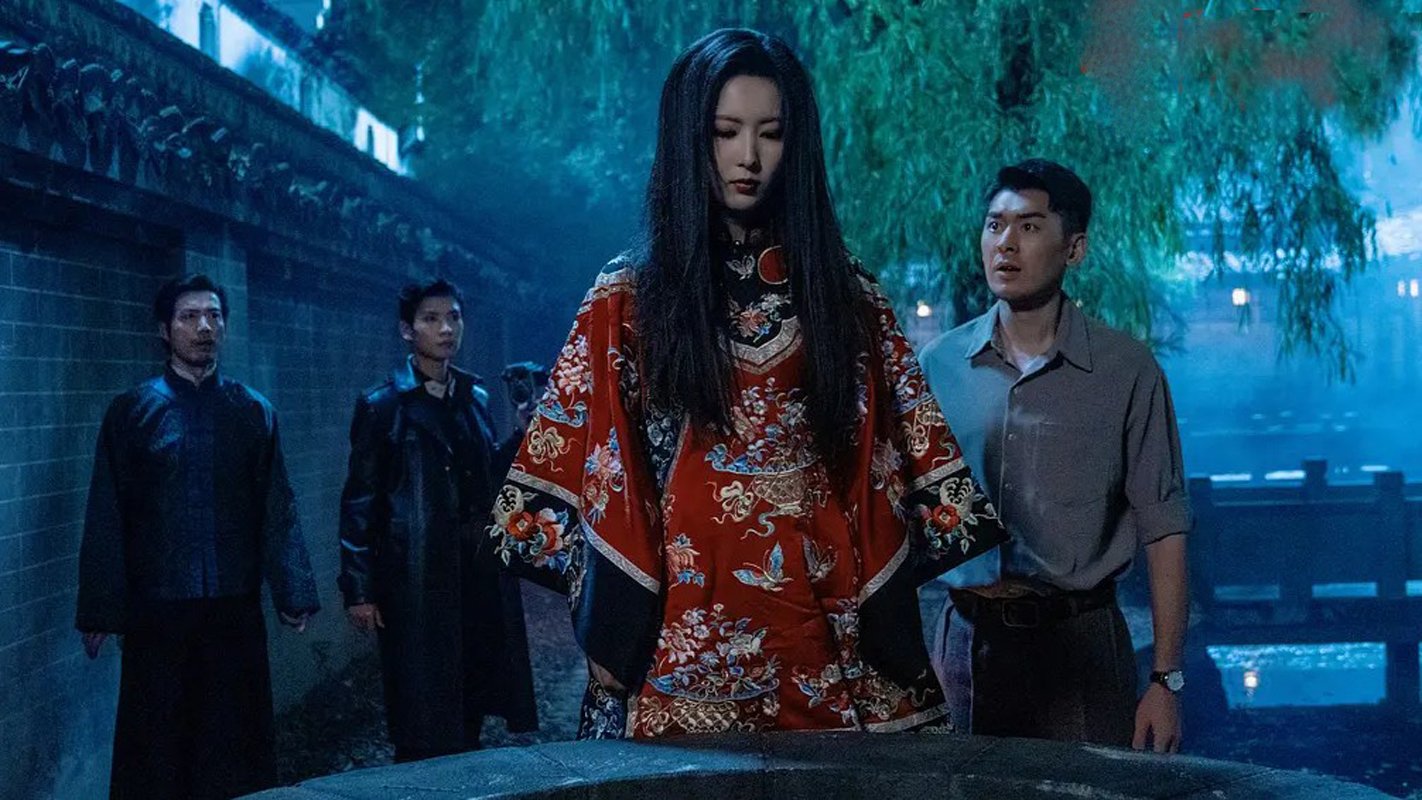
Xu Jun and Liu Ming Liang co-wrote and co-directed “Red Wedding Dress,” a period horror story set in Republican-era Laoyang, a small town in southern China. Dai Wen Cai works as a foreman for the wealthy Liu family, and when bandits ambush him during a delivery, he hands over all the money he has collected. Unsatisfied, they proceed to raid the Liu household, an incident that seems to trigger a series of increasingly strange events within the mansion.
Grandpa Liu Qing Shan (Yuen Cheung Yan) attempts to protect his family by summoning feng shui master Li Cheng Feng (Zhang Bo Nan) and exorcist Leng Yi Ran (He Yu Chen), particularly after his daughter-in-law begins exhibiting signs of possession. Although other exorcists and even a Christian priest fail, Leng and Li eventually manage to suppress the entity using a talisman.
As they remain in the mansion, further unsettling details emerge. A large doll seated on a rocking horse appears to exert influence over the household, a foul odor permeates every room, and the young grandson begins sleepwalking at night. When Liu Zhen Tian (Zhu Jia Zhen) shows Leng a room where a woman in a red wedding dress appears after dark, she experiences disturbing visions, including that of a woman being assaulted. He also reveals that his daughter died following an encounter with a burial doll, which the family, rather inexplicably, has kept chained inside a shrine room instead of discarding. As Leng and Li investigate further, they uncover increasingly complex truths about the Liu family and the secrets hidden within the house.
What stands out most is the film’s intricate narrative structure and the extensive backstories assigned to its characters. At its core, the story revolves around a haunted house and a vengeful female spirit, a premise that is far from original. However, the directors enrich it through the incorporation of various elements of Chinese folk culture, including ancestral grave rituals, paper burial crafts, feng shui practices, and spiritual mediums. The use of the red wedding dress and embroidered shoes is particularly prominent, while the eerie wedding procession through a dark forest that opens the story effectively sets the tone for the imagery that follows.
The visual aspect emerges as one of the production’s strongest assets. Li Jun’s cinematography, marked by a striking use of red hues and carefully composed frames, enhances the overall atmosphere, while Zhang Chang Xing’s detailed art direction of the Liu mansion adds further depth. Notably, this is Xu Jun’s most financially successful work to date, with a sequel, “Red Wedding Dress: Paper Bride,” already following, once again featuring He Yu Chen in the lead role. At the same time, the convoluted narrative and layered character histories can prove difficult to follow.
The performances are generally solid across the board. Yuen Cheung Yan stands out as Liu Qing Shan, bringing gravitas to the patriarchal figure. A veteran Hong Kong actor, stuntman, and fight choreographer, and the younger brother of Yuen Woo Ping, this is also among his final appearances, as he passed away in early January 2026 at the age of 68. He Yu Chen is memorable as Leng Yi Ran, with her piercing gaze enhancing the character’s presence, while Zhang Bo Nan, as Li Cheng Feng, delivers a more average performance in comparison.
Due to the strict censorship regulations in mainland China, the filmmakers avoid presenting the narrative as a straightforward supernatural horror involving real ghosts. This decision arguably contributes to the overly complicated human-centered plot. Nevertheless, the production ultimately succeeds through its strong atmosphere and polished technical execution.



