
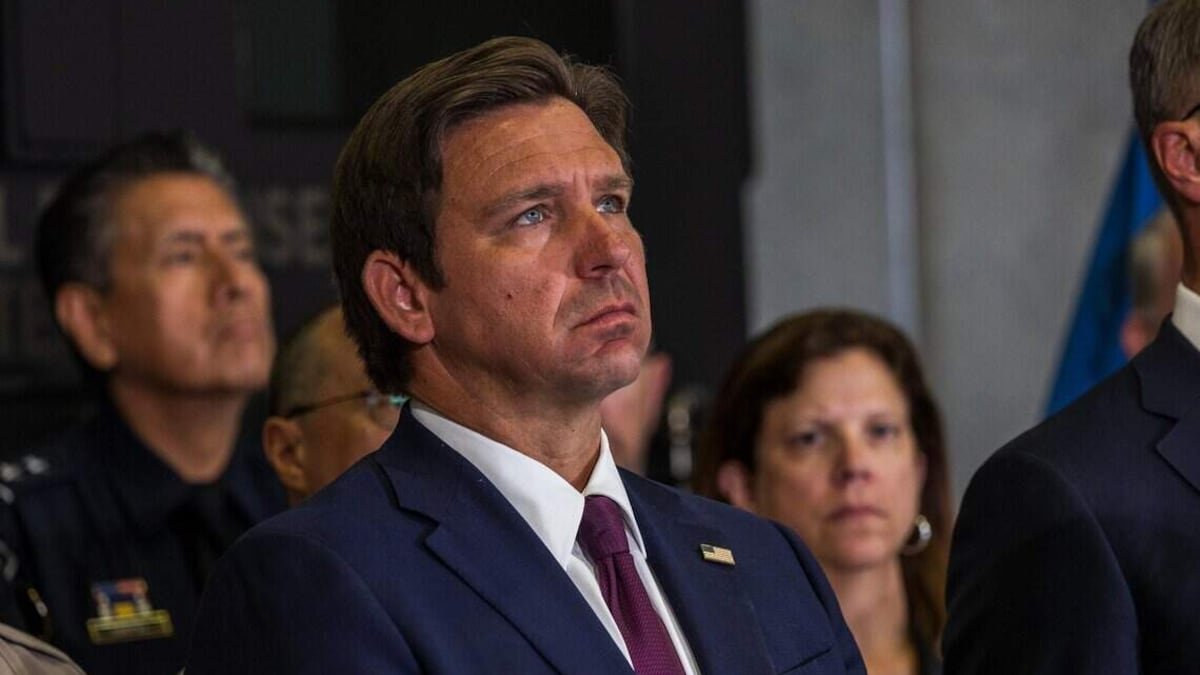
While Donald Trump’s MAGA movement woke up to ruins from Tuesday’s nationwide wave of support for Democratic candidates, Florida Gov. Ron DeSantis’ political star rose dramatically after Republicans narrowly evaded the same fate in Florida.
Since the election, the governor — who was on the outs with Trump and key figures in his administration after DeSantis’ bruising 2024 presidential run — has been positioning himself as the conservative oracle of the post-MAGA moment.
After Trump, “I think we’re going to move into an ideas-based future because I don’t think there’s anybody that would be able to take up all the oxygen in the room the way the president can,” DeSantis said on CNN this week. DeSantis himself is known to be wonky, frequently waxing poetic about his conservative policy ideas in ways that didn’t appear to resonate in the 2024 cycle.
For years, DeSantis has been fending off the MAGA machine, a rebellious Legislature and claims that he, the erstwhile “future of the Republican Party,” will have nowhere to go post-governorship. Tuesday night’s elections pulled DeSantis away from lame-duck limbo and thrust him into wall-to-wall national media speculation that he will run for president again.
When asked by CNN if he was planning a 2028 run, he didn’t rule it out: “The dust is settling. I’m gonna look at that; I haven’t planned anything because I just think that this is a very uncertain time.”
Seven political operatives working with Republicans who spoke with the Times/Herald, including some who dislike DeSantis, all agreed: His political capital to mount such a run shifted overnight.
Instead of the governor who went against Trump and failed, he’s now the face of the final large GOP stronghold state left standing ahead of a 2028 presidential run with difficult electoral math for Republicans. When he hands the keys to the Governor’s Mansion to Byron Donalds on Jan. 5, it will be with a Cabinet of Republicans DeSantis appointed who managed to win election in a blue wave, and 1.5 million more registered Republicans than Democrats.
“After Tuesday night, Gov. DeSantis is uniquely positioned to be a critic of the D.C. GOP’s failure on policies — and make the case that a Florida Governor is what is needed for 2028,” said Brett Doster, a longtime GOP consultant supporting DeSantis who’s advised Pam Bondi, Mitt Romney and, most recently, gubernatorial candidate Paul Renner.
What remains an open debate is how much the revival of his clout will translate to real political power post-MAGA.
What happened in Florida?
This week, national Democrats wrested control of both the U.S. House and Senate, flipped Texas blue and gained federal ground in nearly every red state in a seismic transfer of power away from Republicans.
Now, even if a Republican wins the presidency in 2028, they’re all but guaranteed to have an opposing branch of Congress, DeSantis has noted. The path to a Republican presidential victory in 2028 is also significantly dimmer.
Without a massive bank of reliably red Electoral College votes from Texas — which has gone to Republicans in every presidential cycle for the past 50 years — Florida going red is mathematically essential for a GOP presidential win.
That fact raised DeSantis’ political heft, particularly because he has consistently drawn higher approval ratings than Trump in Florida, according to polls.
And he managed to maintain Florida’s red firewall Tuesday.
While Florida Democrats showed record turnout, are poised to win four congressional seats redrawn by DeSantis’ office in ways that favored Republicans and managed to break the Republican supermajority in the state Legislature Tuesday, they didn’t pull off a statewide win.
That gave DeSantis the ability to take a victory lap after Tuesday’s national GOP collapse. He attributed Florida Republicans’ ability to withstand the “extinction-level event,” in part, to Republicans’ voter-registration advantage over Democrats.
READ MORE: DeSantis’ election post-mortem: ‘Extinction-level event’ if not for Florida
Florida has the fourth-lowest voter-registration rate in the country, with 67% of voting-age Floridians registered, according to Kaiser Family Foundation data compiled in 2024. While in office, DeSantis has signed laws restricting third-party voter-registration efforts that Democrats have long relied on. Florida Democrats also received little national investment this cycle compared to Texas.
“We built up a lot of trust with our voters over the years, we have a reliable Republican voting base,” DeSantis said on CNN this week. Plus, “We had an important property tax amendment on the ballot and were able to turn out enough voters to be able to get these guys across the finish line.”
Even though DeSantis’ redistricting effort favoring Republicans fell flat Tuesday, the amendment he spearheaded did not. Amendment 3 garnered 62% of the vote, more than any Republican candidate on the statewide ticket, giving him another avenue to point to a win out of Tuesday’s national defeats.
DeSantis v. Trump
Before Tuesday, DeSantis’ position in a political world dominated by Trump was complicated, rife with frequent ups and downs.
A trailblazing Republican, DeSantis’ star power first peaked when he challenged Trump for the presidency in 2023, quickly whipping Florida into ground zero for conservative policies that Trump — after his win — would adopt federally. But his bruising defeat the following year in Iowa brought on the full force of the president’s scorn.
Trump, who had raised DeSantis out of relative obscurity in 2018, later ridiculed the governor at every turn, accusing him of desperately needing a “personality transplant” and running ads on the governor’s eating habits.
And while relations have improved between the two — DeSantis gifted Trump a coin emblazoned with “you missed, bitches” last month — some of Trump’s Floridian advisers have maintained vendettas against the governor.
After Tuesday’s national rebuke of Trump’s administration, DeSantis’ on-again-off-again position with the president could present more leverage for him to communicate to an electorate angry at Trump.
Complicating his message, however, is the question of whether Tuesday’s results were a temporary rejection of Trump the president, or a fundamental rebuke of policies that DeSantis has been part and parcel to carrying out.
“There’s a lane there, I’m not denying that,” said Jacob Perry, an independent consultant and anti-Trump former Republican. But “MAGA hates him so the MAGA world is gonna shiv him first opportunity.”
Plus, “if you were already opposed to the things Trump is doing, then where’s the daylight?” he asked. “If you think the immigration stuff went too far, wait until you hear about Alligator Alcatraz. If you hate corruption and you want to take a stand against that, wait until I tell you about” Hope Florida.
Former U.S. Rep. Matt Gaetz framed DeSantis’ recent comments as political opportunism — noting that the governor was barely involved in most down-ballot races, including Gov.-elect Byron Donalds’.
“You are about to see from Ron DeSantis a display of populist nationalism that speaks to the frustrations that were evident in the midterm elections,” Gaetz, once a DeSantis confidant, said on One America News. “Know this: A good amount of that is an act.”
“The notion that Ron DeSantis is our populist hero that’s going to lead us out of this is nonsense.”
DeSantis has also burned bridges in the Republican political and fundraising world in the past that make a 2028 presidential run “delusional,” as two GOP consultants described it to the Times/Heralde, regardless of what happened this week.
But Brock Juarez, DeSantis’ former deputy chief of staff, had glowing praise for his former boss. He told the Times/Herald that while he has no insight into the governor’s future plans, DeSantis would be “one of the greatest presidents this country has ever had.”
“DeSantis is doing what he has always done by leading through the uncertainty and speaking clearly about the direction the Republican Party needs to take,” Juarez said.
Who will carry on the MAGA mantle?
DeSantis isn’t the only one saying he saw Tuesday’s results coming — or claiming he has the political diagnosis for Republicans ahead of the 2028 presidential election cycle.
As the blue wave crashed down nationwide, Vice President J.D. Vance, widely anticipated to be a GOP front-runner in 2028, seized on the party’s catastrophe. Within hours, he’d posted a lengthy — and controversial — postmortem of his own, rivaling DeSantis’ in his criticism of Republicans’ actions.
It was a rare, solitary step forward for the vice president, who, like DeSantis, has acknowledged that carrying on the Trump legacy is a monumental task.
While both insisted the GOP casualties lay largely at the feet of brutally high gas prices, inflation and overall affordability gaps, they each had other wide-ranging speculations — all of which blamed D.C. Republicans.
DeSantis suggested the destruction was the result of GOP incumbents focusing on culture-war issues, stock trading and voting to keep the Jeffrey Epstein files secret. Vance blamed the Iran war and ties with Israel.
And as Trump continues to stay quiet on a successor, both Vance and DeSantis have demurred on whether they’d launch a 2028 presidential bid.
“I really have not made up my mind about what to do in 2028. I just haven’t focused on it,” Vance said in an October interview.
DeSantis had similar thoughts. During his CNN interview Wednesday night, he harped on the viability of any nationwide Republican running for office in two years, insisting that any candidate would have to survey the political “landscape” as the date draws nearer.
For his part, though, “I’ll be a free man come Jan. 5 — not that I’m counting down to that.”



