
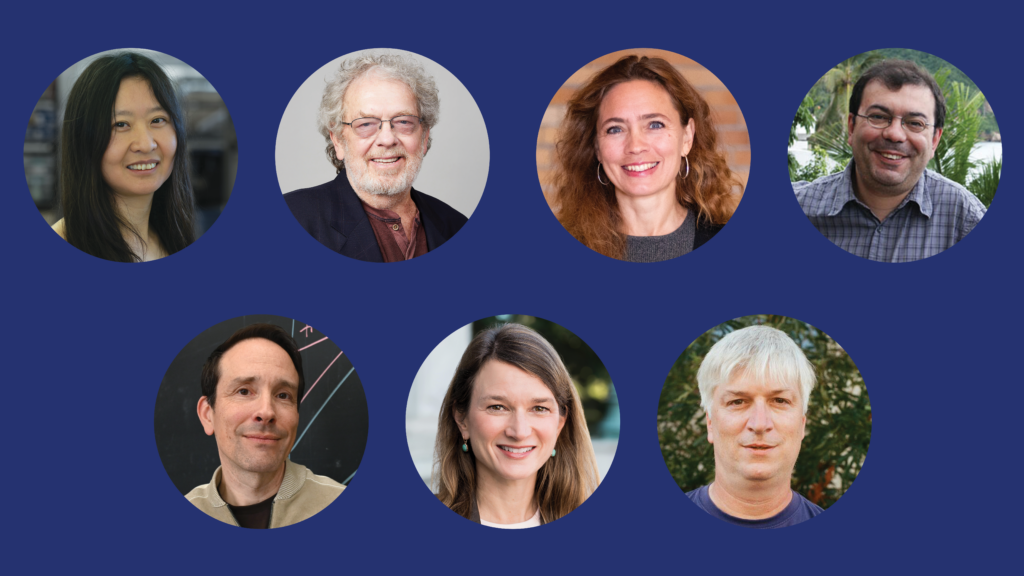
This week, seven UC Berkeley faculty — representing academic fields from philosophy to molecular biology to engineering — were named members of the American Academy of Arts and Sciences.
The Academy, chartered in 1780, was established to recognize accomplished individuals and engage them in addressing the greatest challenges facing the U.S. The 252 new electees encompass leaders in academia, the arts, industry, journalism, philanthropy, policy, research and science, and include the actor Jodie Foster and author Barbara Kingsolver.
“We celebrate the achievement of each new member and the collective breadth and depth of their excellence — this is a fitting commemoration of the nation’s 250th anniversary,” said Academy President Laurie Patton.
Induction ceremonies for new members will take place in Cambridge, Massachusetts, in October 2026.
Read more about Berkeley’s members of the American Academy of Arts and Sciences below:
Sarah Anzia is Chancellor’s Professor of Public Policy & Political Science, teaching in both the Goldman School of Public Policy and the Travers Department of Political Science. Her research examines the politics of public policy in the U.S. with an emphasis on state and local governments and how interest groups, political parties and election institutions affect policy outcomes. She is the author of Local Interests: Politics, Policy, and Interest Groups in US City Governments (University of Chicago Press, 2022) and Timing and Turnout: How Off-Cycle Elections Favor Organized Groups (University of Chicago Press, 2014). She has also written extensively about public-employee pensions, public-sector unions and women in politics.
Raphael Bousso is a professor and Chancellor’s Chair in the Department of Physics and a member of the Leinweber Institute for Theoretical Physics. A theoretician, Bousso is seeking a unified theory of our universe that includes both quantum mechanics and general relativity, known as quantum gravity. His work focuses on the interplay between spacetime geometry, quantum information theory and relativistic field theory. Key topics include quantum black holes and the information paradox, holographic entropy bounds and the fundamental relationship between energy and quantum information. He leads GeoFlow, a multi-institutional consortium of theorists and experimentalists working at the interface of quantum information theory and condensed matter physics.
Michael Hutchings, a professor of mathematics, specializes in low-dimensional and symplectic topology and geometry. He is known for proving the double bubble conjecture on the shape of two-chambered soap bubbles and for his work on circle-valued Morse theory and embedded contact homology, which he defined.
Paolo Mancosu is Willis S. and Marion Slusser Professor of Philosophy. In his work, Mancosu pursues the philosophy of mathematics and logic. He has been pivotal in reorienting the philosophy of mathematics towards a discipline more attentive to mathematical practice itself. His contributions include the study of mathematical explanations, diagrammatic reasoning, purity of methods and the concept of mathematical infinity. Across this body of work, he combines perspectives drawn from the history and philosophy of logic and mathematics as well as from contemporary mathematics and mathematical logic. Beyond philosophy, he has also written several books uncovering the publication history of Doctor Zhivago, drawing on archival research to illuminate the novel’s complicated journey through the Cold War era.
P. David Pearson served as dean of the UC Berkeley School of Education from 2001 to 2010, and today is the Evelyn Lois Corey Emeritus Chair in Instructional Science. He began his career as an elementary school teacher, and across a span of decades,has been a deeply influential scholar, especially in the sphere of teaching children to read. Pearson has written and co-edited several books about research and practice, most notably the Handbook of Reading Research (Routledge, 1984). He served on the board of directors for the International Reading Association and the American Association of Colleges of Teacher Education, and as president of the National Reading Conference and the National Conference of Research in English. He has also served as an adviser to the U.S. National Academy of Science and the Children’s Television Workshop (now the Sesame Workshop), plus many school districts and state agencies. In 2012, the Literacy Research Association established a scholarly award in Professor Emeritus Pearson’s honor.
Kristin Persson is the Daniel M. Tellep Distinguished Professor in the Department of Materials Science and Engineering and a scientist at Lawrence Berkeley National Laboratory. In her research, she uses machine learning, experimental data and computational databases to design and create new materials for energy applications, such as highly efficient batteries, photovoltaics and catalysts. Persson is also the director of the Materials Project, a multi-institution, multi-national effort to compute the properties of all inorganic materials and provide the data and analysis to materials researchers free of charge.
Doris Tsao is a professor of neuroscience and of molecular and cell biology, a Howard Hughes Medical Institute investigator and a member of the Helen Wills Neuroscience Institute at UC Berkeley. She is known for brain-mapping studies in the macaque, a primate, that led to the discovery of six “face patch” regions of the inferotemporal cortex that are activated more strongly when the animals are shown pictures of both human and monkey faces. She and her colleagues found a simple code that allowed them to reconstruct in detail a face shown to a monkey simply from the electrical activity in a few hundred neurons. They also discovered the unique code the brain uses to encode familiar faces, providing new insight into how the cortex encodes memories. Tsao is now addressing a broader question: how the brain represents the entire 3D space around us.



