
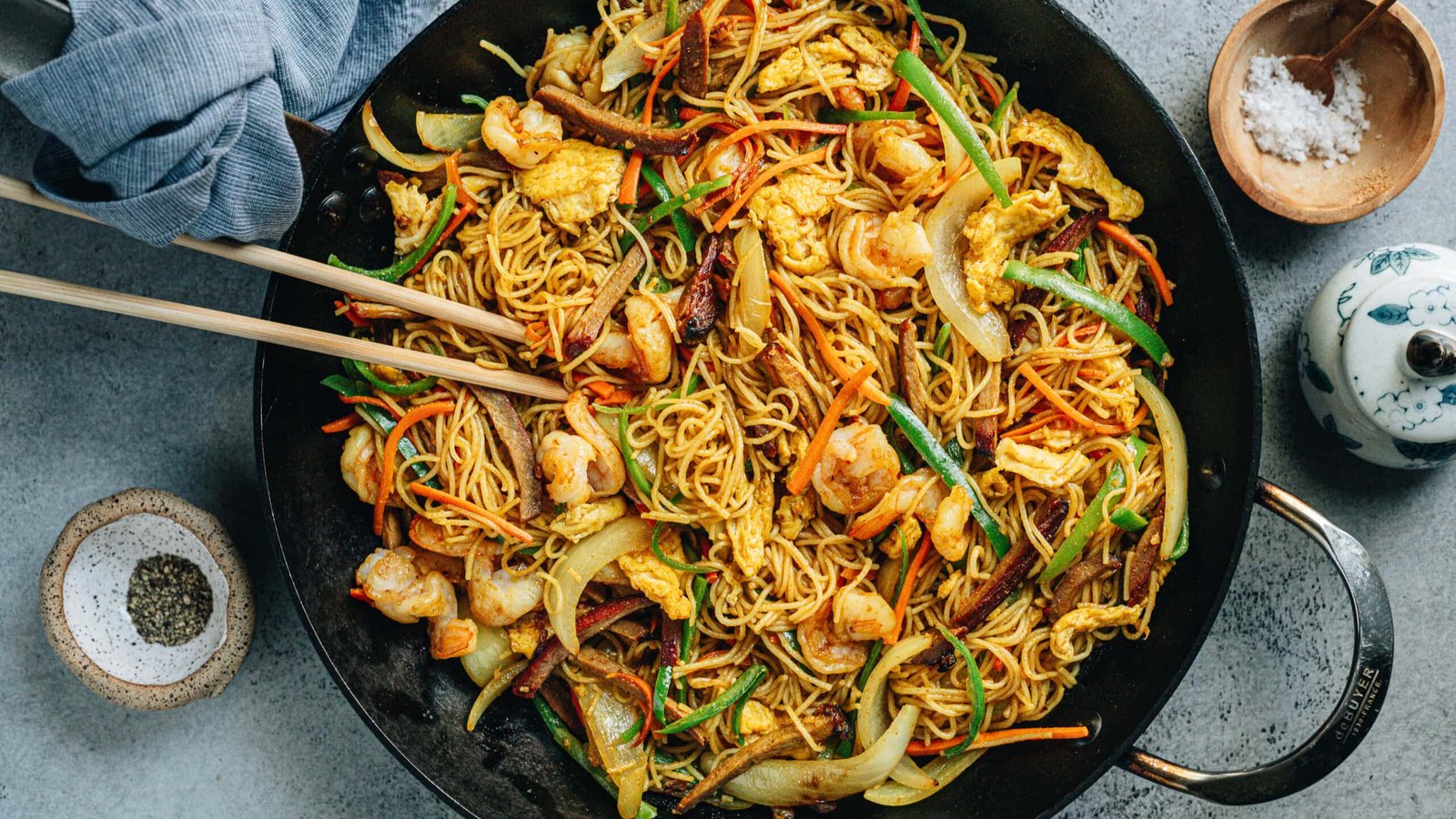
Despite the name, Singapore noodles are not from Singapore. The dish is most likely Hong Kong in origin, possibly Malaysian, and it has been on the menu of every Cantonese restaurant I grew up ordering from in China. We ordered it alongside dim sum on a weekend morning, and it is still one of my favorite single plate noodle dishes because the curry powder elevates the rice noodles. For another Cantonese noodle angle, my chicken chow mein covers the wheat noodle side of the same restaurant menu.
My husband first ate Singapore noodles at a Cantonese dim sum spot in our neighborhood, and it is now the dish he requests when I ask what he wants for dinner on a Friday night. My son is 2.5 and he eats the noodles and the egg with the shrimp and pork on the side.
From start to finish, this is a recipe I can make in the same 12 inch nonstick skillet without dragging out a wok. I soak or boil the vermicelli a minute short, mix the sauce, scramble the eggs, cook the aromatics and the protein together, add the carrot and the noodles, toss with the sauce, then finish with the pepper and the cooked egg. It basically takes me just 30 minutes and uses only one pan, I love that about this recipe because it really doesn’t get much easier than this!

Ingredients
I divide the recipe into three working groups: the noodles, the sauce, and the stir-fry. Below, I explain in detail the ingredients I use to make these Singapore noodles at home.

The noodles: Thin dried rice vermicelli is the only noodle for this dish. Erawan is a great brand for this type of noodles. I prefer the slightly thicker regular thin type over the super thin angel hair version, since the meatier strand holds up to tongs without breaking. I cook them 1 minute less than the package directs so they finish in the pan with the sauce instead of going past tender. Asian Best and Three Ladies are the brands I like.

The sauce: Shaoxing wine, light soy sauce, oyster sauce, curry powder, sesame oil, salt, sugar, and white pepper get whisked into a small bowl. I use light soy sauce instead of regular soy so the curry yellow stays bright, and I add oyster sauce for a savory base that is not in every Singapore noodle recipe but is in mine.
The stir fry: Beaten eggs, minced garlic and ginger, sliced onion, peeled and deveined shrimp, sliced char siu pork or seasoned ground pork, julienned carrot, and sliced anaheim or bell pepper. If I do not have homemade char siu on hand, ground pork with a pinch of salt is my reliable swap, and rotisserie chicken or diced ham works too.
How to Make
1. Cook the noodles: Cook or soak the rice vermicelli in boiling water according to the package. Drain and set aside.
2. Mix the sauce: Combine Shaoxing wine, light soy sauce, oyster sauce, curry powder, sesame oil, salt, sugar, and white pepper in a small bowl. Stir to mix well and set next to the stove.
3. Scramble the eggs: Heat 1/2 tablespoon of oil in a large skillet over medium high heat. Add the beaten eggs and scramble until just cooked through. Transfer to a plate.

4. Cook the aromatics: Add 1 tablespoon of oil to the same pan with the garlic, ginger, and onion. Stir and cook for 1 minute until fragrant.

5. Sear the protein: Push the aromatics to one side of the pan. Add the remaining 1/2 tablespoon of oil to the empty side, then add the char siu pork and shrimp. Cook and stir for about 2 minutes until the shrimp are just cooked through and the pork is lightly browned.

6. Add the carrot: Add the julienned carrot and stir everything together for 1 minute until the carrot just starts to soften.

7. Add the noodles and sauce: Add the drained vermicelli and the mixed sauce to the pan. Toss with tongs until the sauce coats the noodles evenly and the noodles turn yellow throughout.

8. Finish with egg and pepper: Return the scrambled eggs to the pan and add the sliced pepper. Toss for another minute until everything is heated through and the pepper just wilts.

9. Serve: Transfer to plates and serve hot as a main.
My Cooking Tips
Halve large shrimp along the vein: Cutting large shrimp into 2 thin pieces along the vein doubles the number of shrimp bites in every forkful and lets each piece curl up the way restaurant shrimp does. Small shrimp can go in whole.
Choose a mild sweeter curry powder: Madras curry or Japanese S&B is what I use for this dish, since aggressive hot curries overpower the soy and oyster sauce base. A milder powder lets the curry sit alongside the other flavors instead of dominating.
Toss with tongs, not a spatula: Tongs lift the vermicelli through the sauce and the egg without crushing the strands. A spatula tends to push the noodles into a pile against one side of the pan and break them in half.
Drain the vermicelli well before it goes into the pan: Wet noodles dilute the sauce and turn the curry yellow pale instead of vivid. I shake the colander a few times and let the noodles sit for a minute before they meet the wok.

Serving Suggestions
I serve Singapore noodles as the main on a single plate dinner with a side of bok choy with oyster sauce for the green, since the noodles are already loaded with protein and vegetables and the dish only needs a leaf to round it out.
For a weekend dim sum at home, I cook a half batch of these noodles as one of several small dishes, alongside an easy Chinese cucumber salad for crunch and a starter of authentic hot and sour soup. For a different noodle pairing, I rotate Singapore noodles with my soy sauce pan fried noodles on alternating Friday nights so the same crowd does not see the same noodle bowl twice.
Frequently Ask Questions
Why are my noodles mushy and clumping?
The most common cause is overcooking the vermicelli in the boiling water step, which leaves the noodles soft before they ever meet the sauce. I pull them 1 minute earlier than the package says and drain them well, and I avoid letting them sit in a colander for more than a few minutes before they go into the pan.
How do I make this dish gluten free?
I swap dry sherry in place of the Shaoxing wine, use tamari in place of the light soy sauce, and use a gluten free oyster sauce. Rice vermicelli is naturally gluten free, so the noodles themselves are no problem.
How long do leftovers keep?
Singapore noodles are at their best fresh from the pan, but leftovers keep in an airtight container in the fridge for 3 days. I reheat them in a hot nonstick skillet with a small splash of water to loosen the noodles, since the skillet reheat brings the curry color back and the microwave softens the noodle texture.
Want to Save This Recipe?
Enter your email below & we’ll send it to your inbox. Plus get great new recipes from us every week!
These Singapore noodles are my 30 minute Cantonese restaurant style version, with thin rice vermicelli tossed in a curry powder sauce alongside char siu pork, shrimp, scrambled egg, and julienned vegetables. The dish gets its bright yellow color from curry powder, and the noodles stay light because they are stir fried instead of saucy.
Prevent your screen from going dark
Cook or soak vermicelli noodles in boiling water according to package instructions until al dente. I like to cook the noodles 1 minute less than the package indicates. Once done, drain and set aside.
Combine the sauce ingredients in a small bowl. Stir to mix well.
Heat 1/2 tablespoon oil in a large nonstick skillet and heat over medium-high heat. Add the eggs. Cook and scramble the eggs until just cooked through. Transfer to a plate.
Add 1 tablespoon of oil and the garlic, ginger and onion. Stir and cook for 1 minute. Move everything to one side of the pan.
Pour in the remaining 1/2 tablespoon oil and the char siu pork and shrimp to the other side of the pan. Cook, stirring occasionally, until the shrimp are just cooked through and the char siu is lightly browned, 2 minutes or so.
Add the carrot. Cook and stir for 1 minute, until the carrot just starts to turn soft.
Add the noodles and sauce mixture. Toss with a pair of tongs until the sauce is mixed evenly.
Return the cooked egg to the pan and add the pepper. Mix everything well, for 1 minute or so. Transfer everything to serving plates and serve hot as a main.
Ingredient Substitution Guide
- If you do not have char siu pork on hand, you can use ground pork instead. Add the ground pork to the pan with a pinch of salt. Chop it into small pieces, then follow the rest of the recipe.
Serving: 1serving, Calories: 302kcal, Carbohydrates: 22.4g, Protein: 25.1g, Fat: 12.2g, Saturated Fat: 2.7g, Cholesterol: 233mg, Sodium: 645mg, Potassium: 424mg, Fiber: 2.4g, Sugar: 3.9g, Calcium: 92mg, Iron: 2mg

Did you make this recipe?
I’d love to hear how it turned out for you! Please take a moment to leave a 5-star rating ⭐️ and share your thoughts in the comments further down the page. It really helps others discover the recipe too.



