
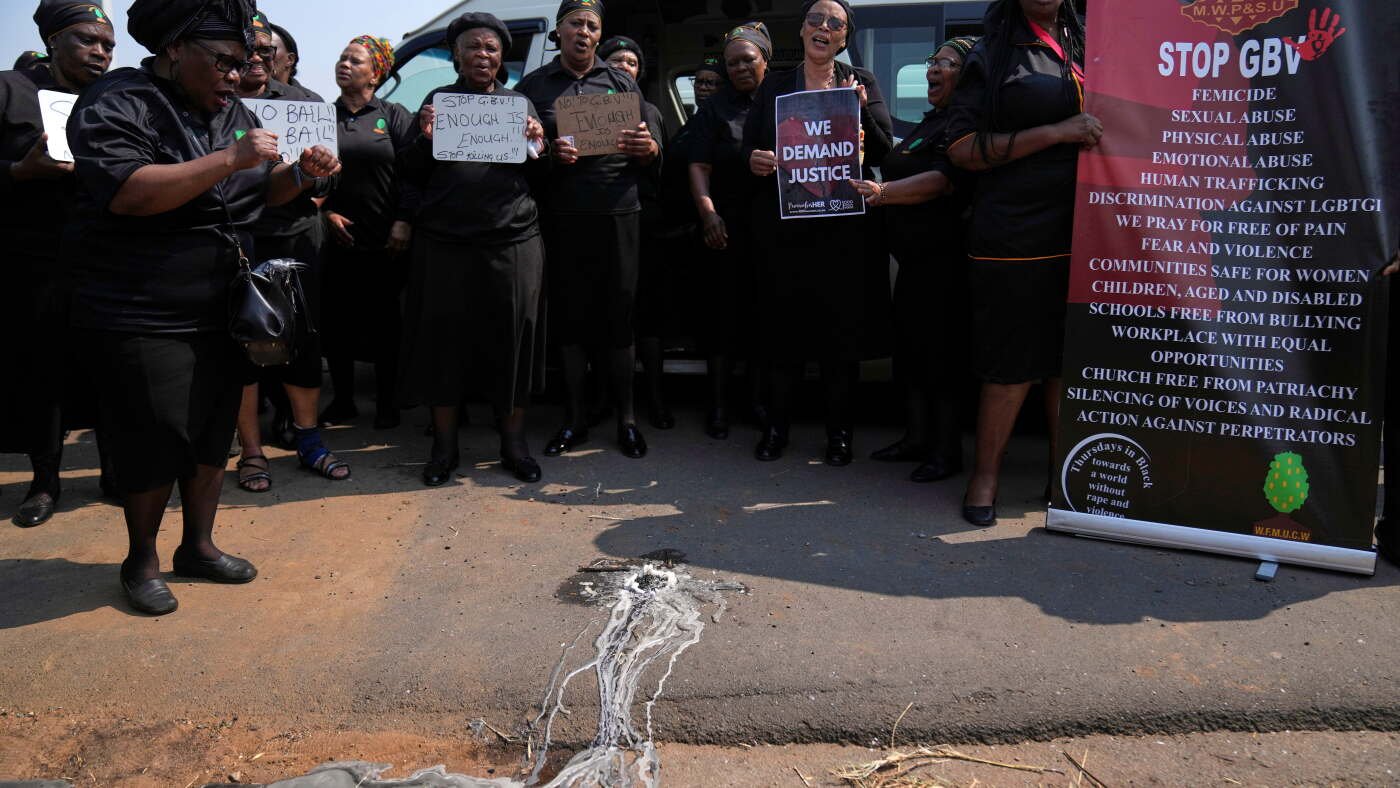
Members of a women’s church group sing next to a melted candle as they pay their respects at the site where the body of a woman was discovered the previous week, in Kempton Park, South Africa, east of Johannesburg, Thursday, Sept. 17, 2026.
Themba Hadebe/AP
hide caption
toggle caption
Themba Hadebe/AP
JOHANNESBURG — Elizabeth Moselakgomo, a 38-year-old manager, mother, and keen runner, went out for her usual afternoon jog in her neighborhood near the Johannesburg airport last week and never returned.
When she failed to come home, her 8-year-old daughter called relatives, who contacted the police. Five days later Moselakgomo’s half-naked body was found in the area, with her face so badly beaten it was unrecognisable.
Moselakgomo is one of nine women who police say have been found slain, most of them in a period of a few weeks, in the same area of South Africa’s biggest city. The majority of them were sexually assaulted.
Even in a country notorious for some of the highest rates of gender-based violence in the world – with over 100 rape cases reported and some 15 women killed daily, according to police statistics — the latest spate of murders has left South Africans shocked, angry and afraid.
Police haven’t ruled out a serial killer and have warned women to be “vigilant” and not to walk or run alone. The approach is drawing backlash from women on social media who said the onus should be on the police to protect them, not for them to have to curtail their movements.
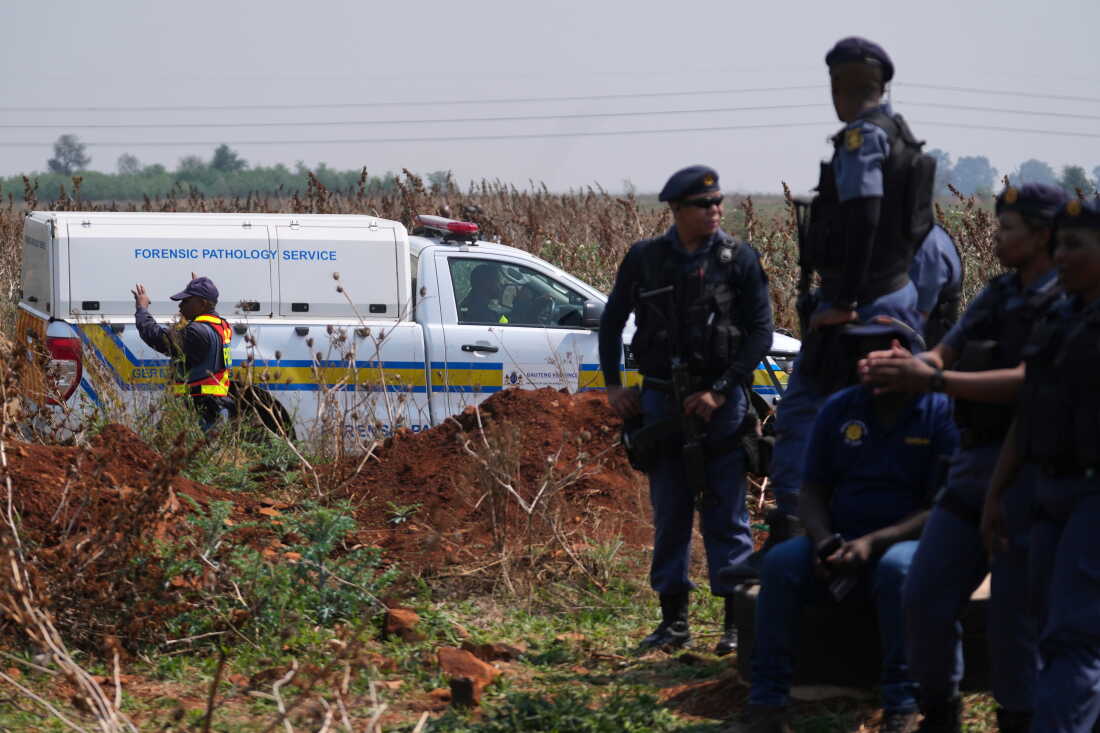
Forensic investigators work at the site where the body of a woman was discovered on the outskirts of Johannesburg, South Africa, Thursday, Sept. 17, 2026.
Themba Hadebe/AP
hide caption
toggle caption
Themba Hadebe/AP
President Cyril Ramaphosa has promised “no stone will be left unturned” in the hunt for the perpetrator or perpetrators. But many South Africans say the government – which declared gender-based violence and femicide a national disaster in 2025 — has not done enough to keep women and girls safe.
“Women in South Africa continue to be hunted and denied the most basic right to life and security,” said Amnesty International’s South Africa Director Shenilla Mohamed. “Women are tired of platitudes. We want to know what is going to be done to make women and children feel safe.”
‘I can’t move freely’
There have been protests in Kempton Park, the suburb where many of the killings have been, as well as in Cape Town, with South African women saying enough is enough.
As Moselakgomo was a keen runner, many local running clubs across the country have been holding runs in her honour and in remembrance of all the victims. At one in Johannesburg, men and women of all ages and races came dressed in black and held a minute’s silence before they set off.
“Gender-based violence, but particularly femicide, is such a big issue in South Africa. As a woman you can’t do anything alone,” one of the runners, 26-year-old Shari Maluluke, told NPR.
“You jog, you can get killed, you go to the post office, you can get killed, in your homes you can get killed…It just makes me angry that I can’t move freely, my whole country feels like a prison.”
All the women NPR spoke to at the event said they did not feel safe in South Africa.
“You send your location, you share your Ubers,” said 31-year-old Didi Tsitsi of the precautions women have to take.
Asked why she thought femicide was such a big problem in South Africa, Tsitsi said she thought there were a number of factors.
“Failure of government and policing, I do think there’s a deep-rooted societal issue of what men are brought up to be and what they believe it is to be a man,” she said.
“And we still haven’t really, I think, dealt with all of the legacies of apartheid – this is I think one of the ways it’s manifesting.”
Some academic research supports this idea, with studies suggesting years of brutal white-minority rule, under which Black men were denied agency and autonomy, has led to a crisis of masculinity and the entrenchment of patriarchal attitudes.



